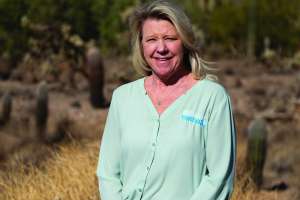
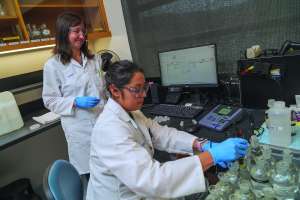
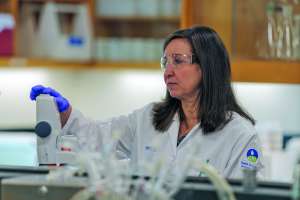
Most days are pretty smooth in the laboratory where Heidi Birdsell works.
But if a test of a wastewater sample plant indicates something is wrong, she enjoys collaborating and troubleshooting to solve the problem.
“Sometimes there’s a lot more troubleshooting than a normal day has,” says Birdsell, senior quality assurance chemist at the Dublin San Ramon Services District in Pleasanton, California. “That’s when it’s nice to have eight people in the lab. It allows us to work together and brainstorm. There’s always a chance that somebody has seen that problem before and maybe they have an idea how to fix the issue. We have really experienced operators, too.
“There’s normally a reason the chemistry isn’t working. Or with the microbiology, there’s something that’s making things too happy or upsetting the process. I love watching people around the plant work. A lot of clever solutions come out of our mechanic and maintenance teams, and the operators, too.”
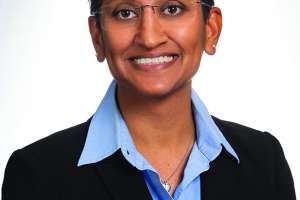
Birdsell was named 2024 Laboratory Person of the Year by California Water Environment Association San Francisco Bay Section, and then by the statewide organization. She was also recognized by CWEA as an Emerging Leader.
Birdsell didn’t plan for a career in water treatment. She studied chemistry intending to become a pharmacist, but after fulfilling a volunteer service requirement by working in a hospital pharmacy, she found that she preferred working in the laboratory.
After graduating from Eastern Washington University in 2005 with a bachelor’s degree in chemistry, she worked for an environmental testing firm in two cities and then spent two years at Denver Metro Water Recovery. She then worked two years with a pharmaceutical lab in Minneapolis testing medical devices.
In 2018 she moved to California with her husband, also a chemist, who had taken a job with the Lawrence Livermore National Laboratory, not far from Pleasanton. She took a temporary position with Dublin San Ramon Services District that led to a regular position in 2019. She took on her present role in 2023.
The district provides drinking water, wastewater treatment and recycled water to the Tri-Valley area east of San Francisco Bay. In summer, almost all wastewater is recycled to irrigate golf courses, parks and other spaces. In winter, the effluent is piped to the East Bay Dischargers Association, which dechlorinates it before discharge through a deep-sea outfall seven miles into San Francisco Bay.
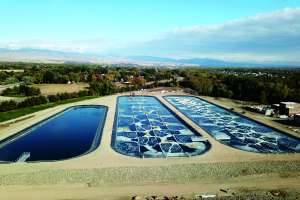
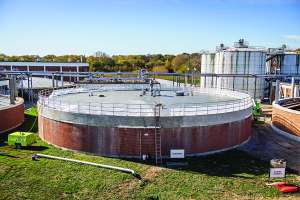
The Dublin San Ramon Services District wastewater treatment plant (17 mgd design, 11 mgd average) meets a significant portion of its electricity demand with a combined heat and power system consisting of three Waukesha Engine generators that use biogas from four digesters. Biosolids are land-applied on district property.
When the plant is producing recycled water, the effluent received tertiary treatment with sand filters (Andritz) before UV disinfection (Wedeco, a Xylem brand). Birdsell works in a lab on the second floor above the treatment plant. She finds a lot of variety in her job.
“The lab is really cool because we analyze wastewater, recycled water and drinking water samples,” Birdsell says. “That’s different than some of the other agencies in the area.” In her senior position, she doesn’t do much actual sampling or testing.
“Before, I was in the lab all the time or out in the field sampling,” she says. “But this is more of a desk job, sitting in front of the computer.” One of her priorities is to make the lab more efficient so it can deliver data to the operators faster.
“Being an in-house lab, the whole point is to get the operators data as soon as possible so they can make decisions,” she says. “Right now, we’re very paper-based, and we’re trying to move in more of a paperless direction, figuring out how to use the software we have available. We’re trying to use the power of the computer to work smarter.”
The staff has been looking to streamline or computerize time-consuming manual processes. One success was connecting balances to a computer to eliminate manually recording weights.
“They were weighing things all day long and handwriting all the numbers,” says Birdsell. “These are five-digit weights; it was a lot of work. Now, the computer is doing the work. It’s easier, smarter and less prone to error.”
The lab is equipped with Skalar San++ automated wet chemistry analyzers, METTLER balances, Thermo Dionex Integrion RFIC for ion chromatography, Thermo iCAP Q for metals analysis, PerkinElmer FIMS 100 mercury analyzers and Olympus microscopes.
Although the wastewater operators have a SCADA system and many in-line instruments, they still find the lab essential for some tests. “Certain things can only be analyzed in the lab,” Birdsell observes.
“A big one is digester health. The volatile acids to alkalinity ratio is important. A meter can tell you total solids, but it’s hard to get an accurate representation of what percentage is volatile. If that’s out of whack, the digestion process is either off or incomplete or not as efficient as it could be. The last thing you want is an upset digester.”
Some of the tests are process checks that look at different points in the treatment process to assess overall plant health: “Every day there is something that can be optimized. That’s why we have SCADA and the plant operators to keep an eye on things. But I’d say at least every other week there’s something you can say isn’t quite right. Of course, it’s never going to be perfect; a plant is a living organism.”
One interesting aspect of the job is seeing changes in the community reflected by influent to the plant. “When we went through COVID, everybody was cleaning more, using more bleach,” she says, “All those disinfectants were doing things to our plant, too. Everything people do at home or in their businesses can have an effect here. It’s fun to figure why something changed. What all of a sudden is going on that’s causing some kind of anomaly?”
Birdsell gives back to the industry and to her professions as a CWEA member and co-chairs the San Francisco Bay Section Lab Committee with Blake Brown, lab program administrator at the Central Contra Costa Sanitary District.
The committee meets quarterly meetings and tries to have webinars or training events every two or three months. “We organize training for our section to help people develop their careers or get better prepared with troubleshooting skills in the lab,” Birdsell says.
“You can go to school and learn the chemistry, but the skill you need to learn is finding out, when something is not working, why not? It’s the same with the plant operators. Why is it all of a sudden foaming? Some of that can be taught, and some of it is just experience. We tackle those things that you can teach, or at least give them some ideas where to start.”
She has also been involved, along with other lab professionals, in raising programs to new state lab standards. “Every lab in California is in this situation right now,” she says. “It was a big lift to bring all of our programs up to the standards. You need teamwork for that, and both internally and as a whole in the Bay area, people really worked together. They would say, ‘Here’s how I solved the problem; maybe that could work for your lab, too.’”
Another CWEA project was helping organize a six-part series of microscope training sessions on monitoring activated sludge. She worked with Ron Trygar, a senior training specialist with the University of Florida Training, Research and Education for Environmental Occupations (TREEO) Center. Trygar presented virtual webinars for plant operators and lab personnel.
In her spare time, Birdsell enjoys baking, which she considers a good hobby for a chemist:
“You mix this and you mix that, and you know what the reaction is going to be. Baking lines up with my chemistry background. I have my own little balance in the kitchen, so I can weigh out my ingredients. It’s not as nice as the ones in the lab, but it does the job.”
As for work in the lab, she enjoys making an important contribution to the community: “I don’t think there’s anything I don’t like about the job. The best thing is, it comes down to protecting the environment. Everybody here is working together and doing their part. The result is that the water we send out is as clean as we can economically make it.
“That’s always in the back of my mind: We’re doing this testing to show that the plant is operating correctly, and we're protecting the wildlife and the people who live in the area. That’s my favorite part. I feel like I’m making a difference here.”