Santa Monica built a facility that can produce 10% of the city’s water demand by treating wastewater and stormwater for indirect potable reuse. And it’s practically invisible.
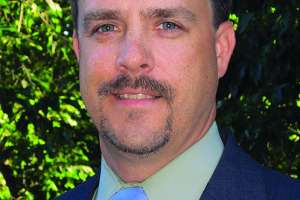
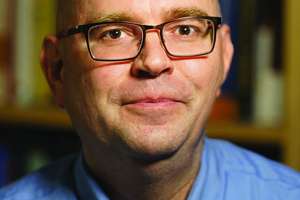
“The bad joke my staff gives me a hard time about is that we spent $96 million on a parking lot,” says Sunny Wang, water resources manager. “Because essentially that’s all we have to show for it on the surface.”
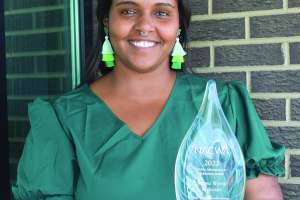
The facility, known as the Sustainable Water Infrastructure Project received a 2023 Helen Putnam Award for Excellence from the California League of Cities. The treatment system came online in November 2022.
The project consists of a 1 mgd advanced water treatment system, a 1.5 million-gallon stormwater collection tank, and upgrades to the city’s urban runoff treatment facility. The advanced treatment plant can process a mix of 30% stormwater and 70% wastewater, 100% wastewater during dry weather.
The treated water is piped to injection wells that recharge an aquifer, from which water then can be drawn out and be treated for drinking water. On the way to the injection well, some of the treated water is used for irrigation or for toilet flushing in dual-plumbed buildings.
The recycled water is suitable for nonpotable and potable reuse. “The water that comes out of that facility actually meets or exceeds all drinking water standards,” Wang says.
The treatment plant and the stormwater storage tank were built under a parking lot next to the Santa Monica Courthouse. Wang observes, “Santa Monica is a highly urbanized community. We’re completely built out. There’s just no space on the surface for this type of facility.
“We put everything underground to be a good neighbor and to be supportive of the facilities around us. We have very efficient odor-control systems. Even within the facility, you don’t have a strong sense of wastewater, and definitely aboveground you don’t smell any hint of it at all.”
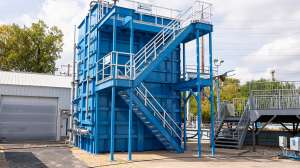
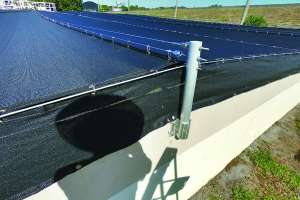
The only visible indications that the water treatment plant is there are two small buildings that provide access to the underground facilities.
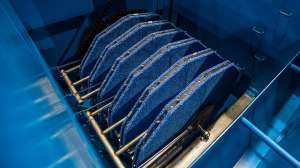
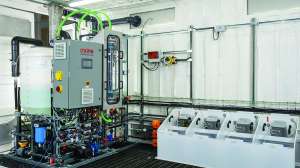
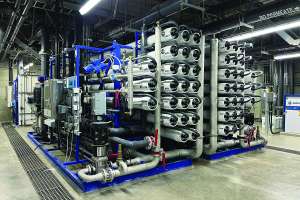
Treatment starts with a rotary drum screen (CleanTek Water Solutions). The stormwater-wastewater mixture then goes to a ZeeWeed membrane bioreactor (Veolia Water Technologies) that consists of an anoxic zone, an aerobic zone and filtration.
“Anything larger than 1 millimeter will get screened out,” Wang says. “After that, it goes to biological treatment. That’s actually the most effective treatment process we have in removing both organic and inorganic industrial contaminants. And then we have ultrafiltration. So the biological process and the ultra-filter membranes work together.”
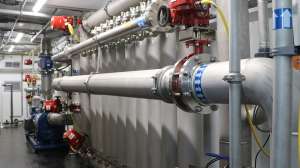
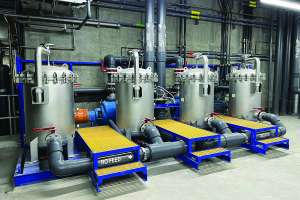
After the membrane bioreactor, the flow goes to cartridge filtration (Harmsco), reverse osmosis with Toray membranes (H2O Innovation), UV advanced oxidation (Trojan Technologies) and finally disinfection with free chlorine. The cartridge filters protect the RO membrane from fouling. The UV advanced oxidation process destroys chemicals such as pharmaceuticals and personal-care products.
“People take painkillers, for example, and that is in our wastewater,” says Wang. “We’ve got to make sure we destroy those before we can use the water to recharge our aquifer. The UV and chlorine zap out industrial contaminants. After that we carry a chlorine residual to provide traditional chlorine disinfection. The quality of the water coming out of the facility is above and beyond typical surface water or groundwater treatment.”
Under California regulations, water injected into an aquifer must remain there for two to six months before being pumped to a water treatment plant. “We have to conduct a tracer test,” Wang says. “We have monitoring wells. We monitor and confirm through tracer testing that we provide the required retention time.”
The raw wastewater being treated at the SWIP is a small portion of the city’s flow. The rest is treated at the Hyperion Water Reclamation Plant, a regional facility operated by the city of Los Angeles. The stormwater now treated at the SWIP previously ran untreated into the Pacific Ocean at the Santa Monica Bay.
“The original motivation for this project was to divert the urban runoff and stormwater water away from the Santa Monica Bay to improve water quality there,” Wang says. “Then it became, OK, if we divert all that water, what do we do with it? So then we decided to recover it for beneficial use.”
During the heavy rains that hit Southern California in the winter of 2022-23, the stormwater collection system diverted 20 million gallons that would have flowed into the ocean. That stormwater was mixed with wastewater, treated and reused.
“We use wastewater to dilute the stormwater,” Wang says. “Stormwater is actually harder to treat than wastewater. Wastewater is organic and easy to biodegrade, versus the heavy metals and oil and grease that stormwater picks up in the streets. That’s why we only treat up to 30% stormwater. Otherwise, it would affect our biological treatment basins.”
In its first year of operation, the SWIP did not run at full capacity, because the injection well couldn’t absorb as much water as expected. The city is developing two more injection wells to enable use of the plant’s full capacity, which is about 10% of the Santa Monica’s water demand.
That’s a big step toward the city’s goal of reducing reliance on water imported from Northern California or the Colorado River. The city hopes to become water self-sufficient, meaning 99% of its water would be locally sourced.
Keeping stormwater out of the bay is also a goal, and the amount collected and treated at the SWIP is a small percentage of what is available. Another underground collection tank is under consideration. “It’s doing great,” Wang says. “But there’s definitely more to be done.”
Wang thinks what Santa Monica has accomplished with the SWIP can be a model for other communities: “We spent quite a bit of time and money to investigate and negotiate with the regulators about how to treat this water to the highest beneficial use, so we hope that this is an example that other communities could follow.
“They don’t have to go through the same exercise we did. We established what those treatment requirements and regulations look like, and others could just follow our lead. We’re really hoping for more utilities to pick up on these ideas and implement this type of project.”