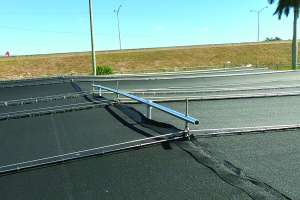
Florida’s hot temperatures and high UV ratings almost year-round cause significant chlorine losses from wastewater treatment plants’ chlorine contact chambers. The impact of chlorine loss is rising as chlorine costs increase.
Shading of chlorine chambers helps keep the UV rays out while also keeping the temperature down. Lower temperature also helps to limit trihalomethanes and control algae.
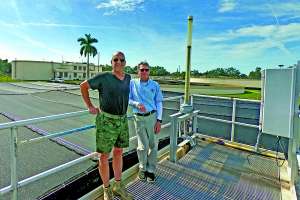
Billy Waitt, superintendent at the Bradenton (Florida) Wastewater Treatment Plant, was concerned about these issues and looked for a cost-effective solution. He sought help from Chuck Baxter, owner of J Mosher Enterprises in Sarasota, to create a UV protection system for his 7,500-square-foot chlorine contact chamber.
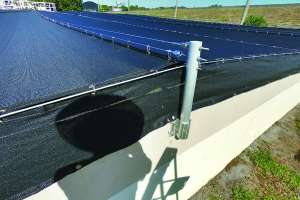
After investigating available shade systems, Baxter found the choices less than ideal. Therefore, he created a system of his own design, using a special UV-protective sunscreen fabric mounted on a low-profile support framework.
Before embarking on his design project, Baxter examined three types of traditional shading systems. Pool cage screen enclosures were not designed for UV protection material, and Baxter believed the material and supporting frame were not durable enough.
Shade balls, considered suitable for very large uncontained areas, also were not designed for chlorine contact chamber applications. Tarp-type covers, Baxter observed, could hold water and become wind sails. In addition, the nonporous material would not allow heat to escape and would require heavy, permanent structural steel frames for support.
Unwilling to compromise, Baxter applied his own ingenuity. “Everything has to be the best of the best in order to survive the harsh environmental conditions at treatment plants,” he says. For shading material, he turned to Dewitt Fabric, a manufacturer of industrial fabrics and screen materials. The company offered a light yet strong 90% UV-protective and chlorine-resistant sunscreen fabric, made from uncoated polyolefin/polypropylene.
Being a knit fabric, it does not fray or unravel if damaged. It has a 132 psi burst strength. The screen allows some air and water to flow through, creating a cooler temperature beneath it. Baxter used an Actron laser temperature gauge to measure the concrete tank temperature, both in the sun and under the screen. Despite only about eight inches separating the two test points, there was a difference of 13 degrees F between them.
To test UV effectiveness, Baxter used a Solarmeter electronic UV measuring instrument. “The UV in the sun was 9.1, and under the screen it was 0.1,” he reports.
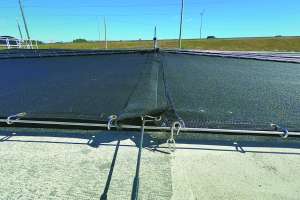
The screen is tailored to fit the chlorine contact tank. To achieve maximum shading, end curtain panels were deployed to help keep sun and wind from coming in under the fabric. This also makes the screen more aerodynamic, forcing most of the wind to blow over the top. That means the screen does not become inflated and blow around in heavy winds.
The system also includes covers to go over adjoining screen sections with 2-inch-wide fabric fastener attachments. This creates a strong rigging system that also allows easy access to the inside. All cables, rigging and hardware are marine-grade 316 stainless steel that will not rust or corrode and will not have a severe reaction to chlorine.
The mounting parts are the same type of anodized aluminum as the hand railings commonly used in industrial facilities.
Waitt calls the end result a strong, maintenance-free, low-profile and removable sunscreen system. “It creates about a 30% reduction in my chlorine use, which saves a lot of money,” he says. “It also helps with algae control. It works great, and I’m very happy with it.”
Baxter estimates a screen life expectancy of eight years or more, depending on weather conditions. In that time he expects the Bradenton plant to recover its investment several times over. “Since the 316 stainless steel hardware is just about indestructible, it can be reused,” Baxter says. “When the screens become old or severely damaged, replacing only the screens will amount to a fraction of the original installation cost.”
Baxter says similar covers can be deployed on decant tanks, plastic chemical storage tanks and other areas that require UV protection, algae control or both.