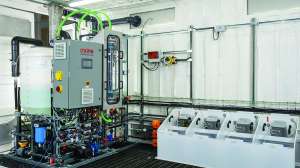
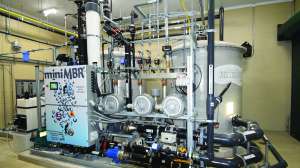
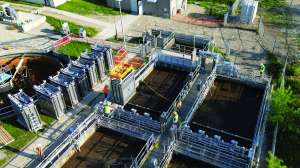
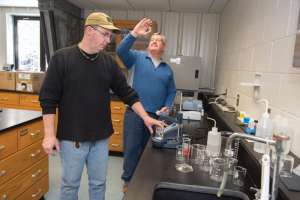
A small community contacted Florida Gateway College about nitrates in the groundwater that supplied its municipal wells.
College personnel explained that nitrates and nitrites occur naturally in food, plants, water and soil. They are formed when microorganisms in the environment break down organic materials such as sewage, animal manure and plants. Nitrates are also found in chemical fertilizers, and nitrites are used as curing agents for meats. Nitrates are more common in water than nitrites.
Through the cycle
Nitrogen is essential for life because it is a component of proteins. It exists in the environment in many forms, and it changes forms as it moves through the nitrogen cycle. However, excessive concentrations of nitrate or nitrite in drinking water can be hazardous to health, especially for pregnant women and infants.
Nitrates combine with various inorganic and organic compounds. Once taken into the body, nitrates are converted to nitrites. Infants less than six months old who drink water containing nitrates in excess of the U.S. EPA maximum contaminant limit (10 mg/L) can become seriously ill and may die if untreated. Symptoms of excessive nitrate ingestion include shortness of breath and “blue baby syndrome” — a consequence of low blood oxygen level.
Nitrates are highly leachable and readily move with water through the soil profile. Excessive rainfall or over-irrigation may leach nitrates below plants’ root zone and eventually into groundwater. Sources of nitrates in drinking water include erosion of natural deposits, sewage leaking from septic tanks, excessive fertilization, poorly managed animal feedlots and landfills. Wells may allow nitrates to seep into groundwater if improperly located or poorly constructed.
High levels of nitrates from particular sources can indicate the presence of other contaminants. For example, faulty septic tanks or animal feedlots causing nitrate contamination may indicate that microbial contaminants are also present; residential or agricultural fertilizers causing nitrate contamination may be accompanied by pesticides.
Knowing the risks
Nitrate in water is undetectable without testing because it is colorless, odorless and tasteless. A water test for nitrate is recommended for systems where infants, pregnant women, nursing mothers or elderly people live, as they are the most vulnerable to nitrate contamination.
All drinking water supplies should be checked every several years to ensure that there have been no significant increases in total nitrogen or nitrogen compounds, including nitrate, nitrite and ammonia. If a fertilizer or manure spill occurs, it should be cleaned up immediately and any nearby wells tested. In addition, annual testing is recommended to monitor the long-term effects of the spill.
The primary health hazard from nitrate in drinking water is its transformation to nitrite in the digestive system. The nitrite oxidizes iron in the hemoglobin of the red blood cells to form methemoglobin, which lacks the oxygen-carrying ability of hemoglobin. This condition, known as methemoglobinemia, causes veins and the skin to appear blue.
Most people over one year old can rapidly convert methemoglobin back to oxyhemoglobin. However, in infants under six months, the enzyme systems for reducing methemoglobin to oxyhemoglobin are incompletely developed. Methemoglobinemia also occurs in older people who have genetically impaired enzyme systems for metabolizing methemoglobin.
There are also potential cancer risks from nitrates and nitrites in water and food. A possibility exists that nitrates can react with amines or amides in the body to form nitrosamine, which is known to cause cancer. Nitrate must be converted to nitrite before nitrosamine can be formed. The magnitude of the cancer risk from nitrate in drinking water is not known.
Becoming a concern
Nitrate contamination of drinking water sources is becoming one of the most important water-quality concerns across the United States. College personnel explained to the community leaders that the EPA lists anion exchange, reverse osmosis and electrodialysis reversal as accepted water treatments for nitrate removal. However, these technologies produce high-strength brine residuals that can pose disposal challenges.
The lack of affordable and feasible nitrate treatment alternatives can force utilities to remove nitrate-contaminated sources from their water supplies. In many instances, this can severely compromise a water utility’s ability to provide an adequate supply of safe and affordable water.
The need for additional nitrate treatment technologies has driven water utilities to explore removal options that are effective and affordable while limiting brine production. Promising options include:
- Weak-base anion exchange and improvements in strong-base anion exchange, such as low-brine residual technologies.
- Biological treatment using fluidized beds, fixed beds and membrane biofilm reactors.
- Chemical reduction using media such as zero-valent iron and sulfur-modified iron.
In practice, nontreatment options are generally considered first because they can be more sustainable and less costly. These include wellhead protection, land use management, well inactivation, source modification, development of alternative sources and blending of water sources. Blending is the most common method. When a low-nitrate source is available, dilution of high-nitrate sources to produce water with acceptable nitrate levels is typically more cost-effective than treatment.
About the author
John Rowe, Ph.D., is a professor of Water Resources at Florida Gateway College in Lake City, Fla. He can be reached at john.rowe@fgc.edu.