
Editor’s Note: John Luther Hodge, 61, died from a heart attack Aug. 23, 2023. Hodge was born on April 18, 1962 in Jenkins, Kentucky. He graduated Owen Valley High School in 1981 and served in the United States Navy. He was an active member of the Spencer (Indiana) American Legion and the Spencer VFW. Hodge is survived by his wife Rhonda, daughter Melissa (Adam) Dean, five siblings and numerous relatives. TPO is publishing this profile as a tribute to his career and his many years of service to the clean-water professions.
He was quiet, humble and self-deprecating, yet he was a confidence builder for his community.
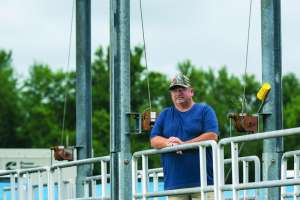
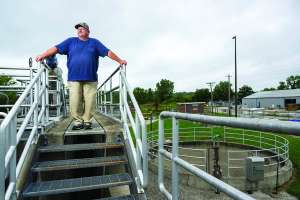
John Hodge, superintendent of the Spencer (Indiana) Sewer Department, rebuilt customer faith in the plant after effluent violations and reporting errors. He mentored young apprentices just coming into the profession, worked with a state park to accept its wastewater, and directed expansion plans at the community’s 0.7 mgd wastewater treatment facility so that a local company could build housing for employees and remain in town.
“We could not have found a better person,” says Jon Stantz, the town council member responsible for wastewater operations. The Alliance of Indiana Rural Water honored Hodge with its 2023 Operator of the Year award.
Hodge complimented his staff for willingness to pitch in wherever needed: “It’s a heck of a lot easier when you have good people working for you and with you.”
And he appreciated the town board. “They’ve been really good,” he said. “They know that when I see something’s broke, we’re going to fix it. You can’t just put something off.” That was his approach when he came to Spencer 12 years ago.
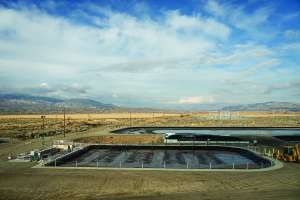
The Spencer treatment plant serves a population of 2,300 using a trio of sequencing batch reactors (Aqua-Aerobic Systems) for biological treatment. A phosphorus removal requirement is met through alum addition. Effluent meets all parameters for quality, including a phosphorus limit of 1.0 mg/L.
In 2008, the plant added TeaCup grit removal (Hydro International) and a mechanical bar screen (Lakeside) in the headworks. Chlorine gas disinfects the effluent, which is then dechlorinated and discharged to the White River.
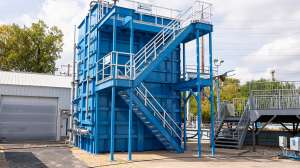
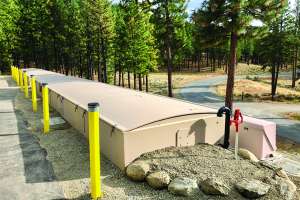
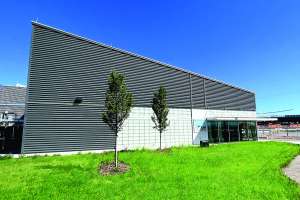
Biosolids are aerobically digested, stored in a pair of holding tanks, and thickened in dewatering bags before being trucked to a county landfill. Late last year the town added a solids handling building, rotary dewatering press (Fournier), and conveyor system to improve dewatering. Hodge says the dewatering bags were difficult to handle in winter weather.
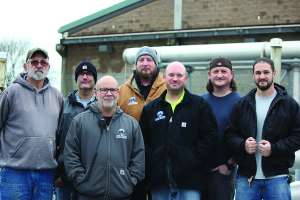
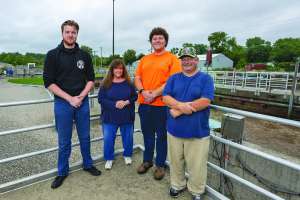
The operations staff includes Ryan Klaassen and John Kelly, wastewater apprentices; Shelley Edwards, maintenance specialist, and Marsha Livingston, lab technician. They monitor plant operations via PLCs. The plant is fully staffed from 8 a.m. to 5 p.m. on weekdays; operators rotate on-call duties on weekends. A 450 kW backup diesel generator (Cummins) is available to run the plant in an emergency.
When Hodge came on board in Spencer, the treatment plant was violating E. coli limits and an employee had been accused of falsifying discharge records. One of his first challenges was to correct the situation and restore community confidence.
The key was giving the town a firsthand look at the changes and improvements he made. “We used plant tours to show people how clean the effluent was that we were discharging to the river,” he recalled.
Like many clean-water professionals, he understood that many people don’t comprehend what happens to wastewater once it’s flushed or drained away from their homes, “Until they get the bill, they don’t think about it.”
Stantz observes, “John was able to get the problems corrected and the plant operating the way it should be. He got us back on even keel.”
The operator award was the highlight of Hodge’s 37 years in the wastewater profession. “I was humbled by it,” he said. “I had no idea who nominated me.” He thought someone had a mistake when he heard his name called.
His career started when he left the Navy in 1986 and took a summer job at the Bloomington (Indiana) Wastewater Treatment Plant. After 26 years as an operator there, he took the position in Spencer as sewer department superintendent.
The apprentices joining the staff at Spencer surely benefit from their leader’s expertise and experience. “They come to us through the Alliance of Indiana Rural Water,” said Hodge. “It’s not like we go out and roll the dice. The alliance identifies young people who have an interest in the field and know what they’re getting into.”
It’s hard to find young people to join the utility, but the current two apprentices have worked out well. “They both have had some college, but that just wasn’t their thing,” he said. “It blows me away how much they’ve learned here.”
The plan is to have them train for two years and then take the required tests and get licensed. One young operator was ready for licensing in just one year. Hodge pointed out how important new blood is to the wastewater profession and his own team: “We’re getting older.”
While getting the treatment plant back on track and bringing the apprentices on board, Hodge was essential in improving the town’s sewer separation project, designed to reduce infiltration and inflow and prevent sewer overflows.
The town received a rural development grant of about $700,000 to complete that project, and the town supplied another $300,000. The project involved smoke testing, TV camera inspection, sewer lining, rehabilitating manholes and building new ones. “Some of our lines were dead-headed, with no access,” Hodge said.
He was also an essential adviser as the town prepared a 20-year plan to add collection and treatment capacity for residential and industrial growth. The town plans to purchase five acres next to the treatment plant and add a fourth SBR and other equipment to handle increased flows. The plan will also evaluate green solutions, including solar panels and energy-efficient pumps. Solar could provide up to 30% of the energy required to operate the plant.
Hodge was a resource for others, as well. The McCormick’s Creek State Park, which offers year-round camping and recreation, completed a $4.7 million project to close its treatment facility, upgrade its sewer system, and install lift stations to direct its wastewater to the Spencer facility, just a few miles away.
Hodge and Dwight Brooks, park director, worked together on the project, which is expected to save the park money in the long run. “John was very cooperative,” says Brooks. “He understood the benefit of the park decommissioning its wastewater treatment facilities. It was good to work with a local person who understood wastewater collection and treatment, as well as the value of the park.”
The transfer is serving as a prototype for other state parks around the state and is expected to save millions in new capital and operating costs.
In another cooperative venture, the Cook Group, a major manufacturer of medical equipment and the town’s largest employer, is building new housing to give team members places to live closer to the workplace. Hodge’s department is supporting that venture by adding sewer lines and lift stations for the development.
When not in the office, Hodge spent most of his time at home with his family, which includes a granddaughter who’s into sports. He made sure to attend all her games. As for his own games, he enjoyed playing Texas Hold ’em poker with friends.
Drew Flanion of Commonwealth Engineering, who serves as the town’s engineer, says the community had confidence in Hodge: “He knew what needed to be done to stay in compliance. He had the town’s best interests in his heart.”