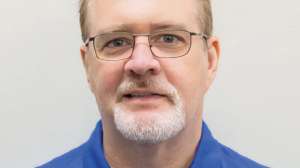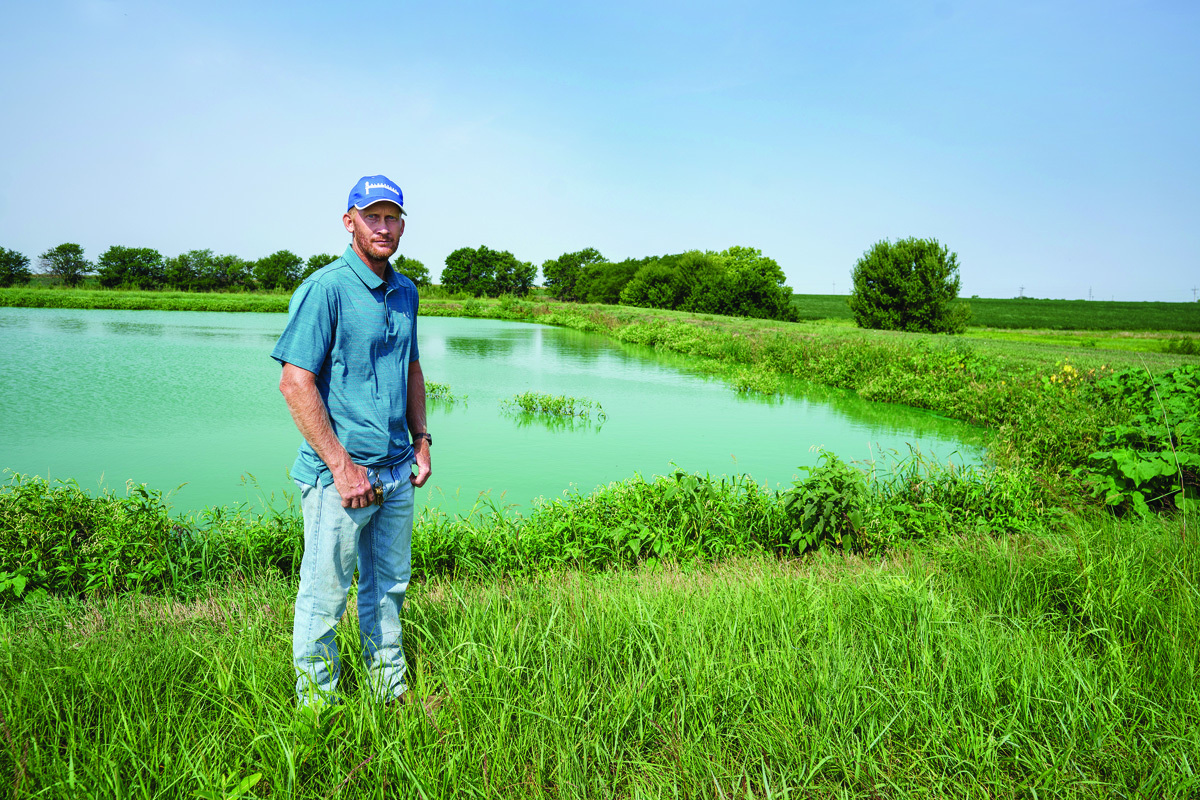

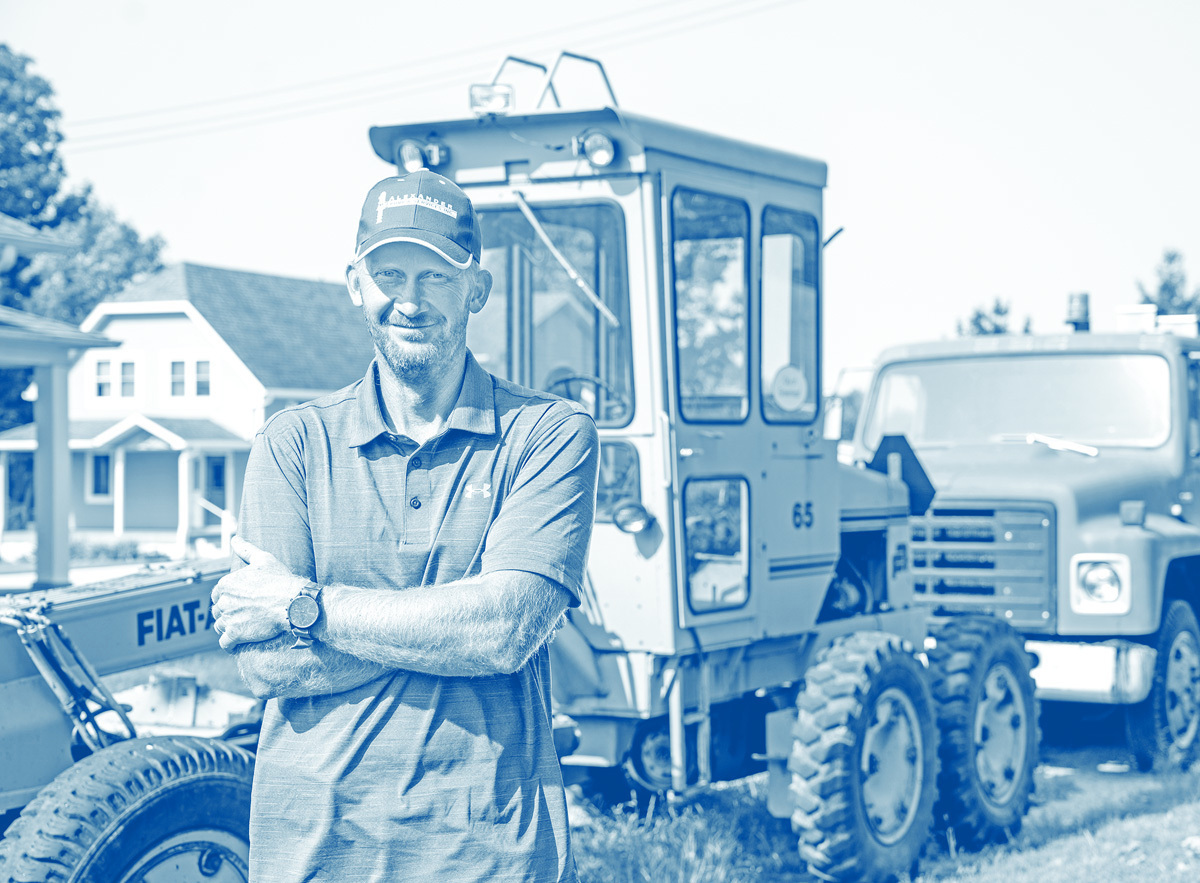
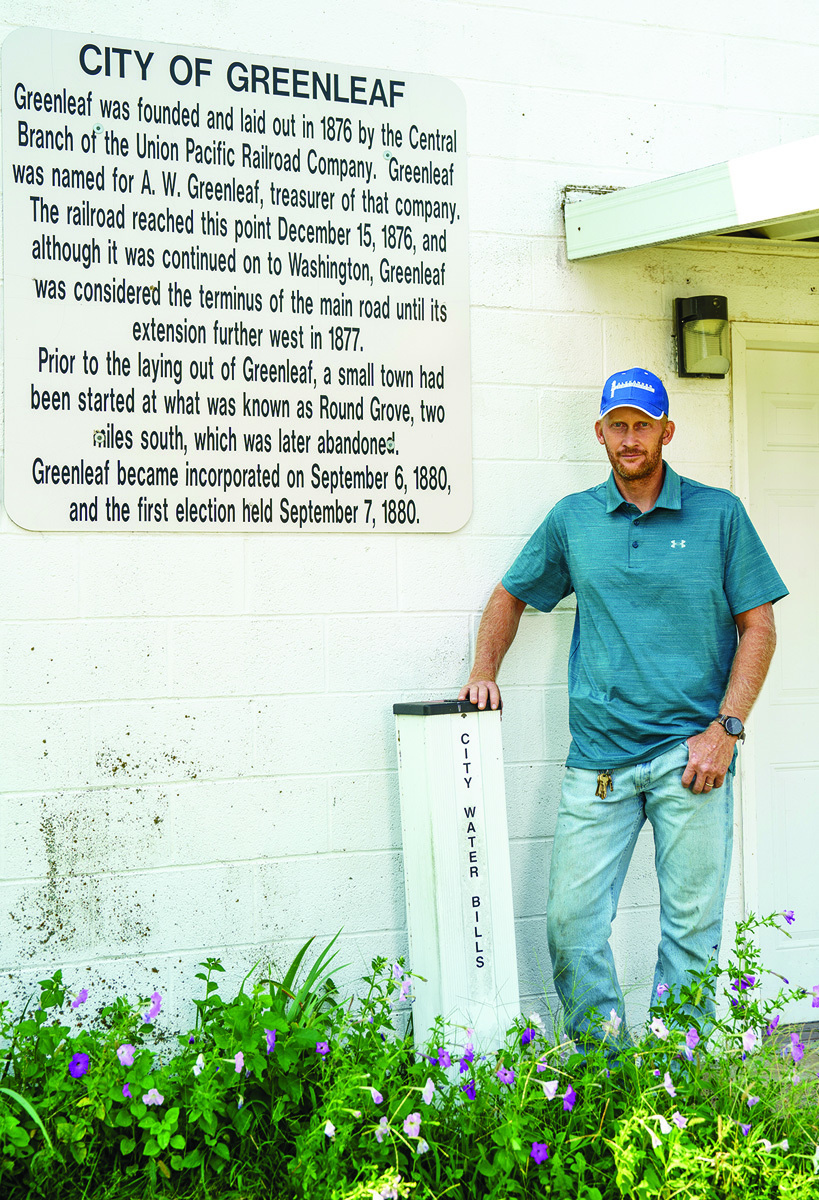
Jerry Baker has a big job in a small town.
As the only full-time city employee in Greenleaf, Kansas, Baker is responsible for water production, wastewater treatment, maintaining the water distribution and wastewater collection systems, mowing grass, repairing streets and much more. In summer he has a helper, but otherwise he’s on his own.
Recently Baker saved the city substantial money by doing all the work to connect the Greenleaf Water system to the Washington County Rural Water District, so the water could be blended to comply with nitrate limits.
A few years earlier, he helped the city obtain a state grant to replace all the water distribution piping, which he installed with the help of numerous volunteers. Thanks to the grant and the volunteer labor, the city replaced its leaky water system without taking out a loan. Efforts like those led to Baker being named the 2022 Municipal Water Operator of the Year by the Kansas Rural Water Association.
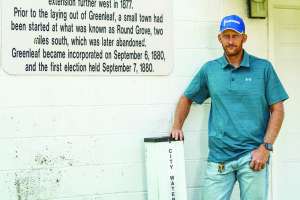
Greenleaf, about 175 miles northwest of Kansas City, has a population of about 350. Years ago the city was bigger, but a tornado in 1973 destroyed 42 homes and 26 businesses, and the population never fully recovered.
Greenleaf is big compared to the nearby town of Morrowville where Baker lives. He grew up there on a farm, and he still raises beef cattle with his father. As if farming and his city job didn’t take enough time, Baker is the boys’ track coach of the local junior high school. His wife, Misty, a grade school teacher, is the girls’ track coach. Baker and his wife have four children.
While at Baker College in Baldwin City, Baker won NAIA All-America honors in track, reaching the national finals in the decathlon. When he graduated in 2004 with a degree in wildlife biology, the job market in his field was weak, and he took a job in Greenleaf.
The job has changed considerably, mainly because of the new water system. Previously, he spent a lot of time fixing leaks. “We went from 20% water loss to 5%,” he says. “There was one time I fixed five leaks in one week.”
Baker was involved in every aspect of the new water system project, from helping provide information for the grant proposal to operating an excavator and connecting the pipes. The city replaced about 4.5 miles of steel waterlines with PVC pipe and installed new meters, fire hydrants and valves.
The project received a $300,000 grant from the Kansas Small Towns Environment Program (KAN STEP), funded by the state Department of Commerce under the federal Community Development Block Grant program.
At the time, it was the largest water improvement grant KAN STEP had made. The grants pay for materials and technical services, but community recipients have to provide sweat equity, and in Greenleaf’s case that meant volunteer labor. “That water system ended up costing the city about $75,000,” Baker says.
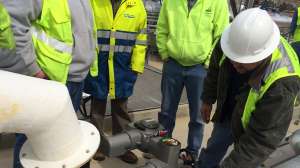
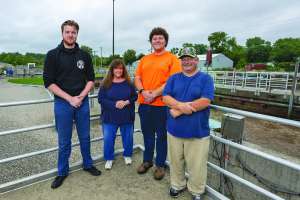
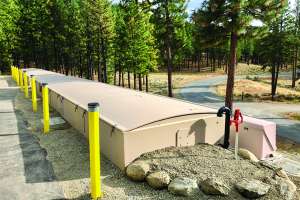
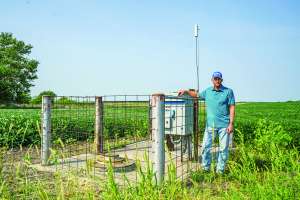
Greenleaf got another bargain when Baker and summer helper Drew Buhrman, along with Greg Metz from Kansas Rural Water, poured a concrete vault and did the plumbing for the connection to the Washington County Rural Water District. “We did it for $40,000 less than the engineer put forward because we poured our own concrete vault and ran about half a mile of waterline,” says Baker. “I hired out the electrical work because I’m not an electrician and I don’t like working with electricity, but other than that, we did everything ourselves.”
Dave Savage, mayor of Greenleaf, appreciates Baker’s skills and his willingness to try new things: “He is very smart, and he can build or fix anything. And he’s not afraid to do things.” Baker believes that not having done something before isn’t a reason to avoid a project. “I’ll try anything once,” he says. “I may not do it twice, but I’ll try anything once.”
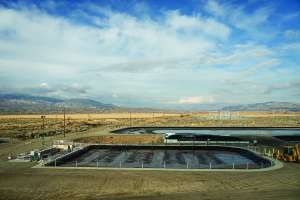
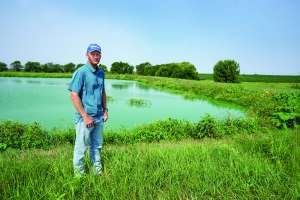
That attitude serves him well, since he sometimes faces tasks that rarely need to be done. In early summer of 2023 he spent time with a backhoe and a dump truck, dredging one of the city’s three wastewater treatment lagoons. Wastewater settles in the lagoons and flows from to another, and the water evaporates. Effluent seldom needs to be discharged, in part because the system was designed when Greenleaf’s population was larger.
Baker believes the lagoon dredging project had never been done before. He isolated the lagoon and let it dry out, and was surprised that it dried out enough so that he could go in with the backhoe and scoop the biosolids off the bottom.
“It’s got a clay base in it,” he says, “So you go out there and you scoop and you watch. I mean you just scoop the black off the top. When you see a color change, you quit.” He piled the biosolids nearby and planned to spread them on a farm field next to the lagoons. You’ve got to sample it before you do anything,” Baker says, “As long as there’s no heavy metals or anything in it that’s going to be harmful, I will spread it on a field in fall. You soil sample the field before and after.”
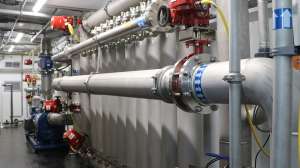
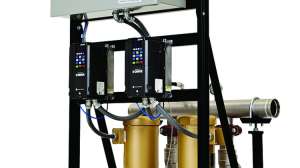
When the blending vault was constructed, Greenleaf upgraded some of the basic infrastructure, adding variable-frequency flow drives (Eaton) and radio controls (EnGenius) instead of phone controls. “That made it easier to blend because I could slow the wells down to get the blend rate that we needed,” Baker says.
Kansas has famously harsh weather, and right after the vault was completed a brutal cold snap froze a 2-inch pipe inside the vault. That prevented blending temporarily, but the city’s wells were still working, so no customers lost water pressure.
“I would imagine it froze because of fresh dirt around it, so the frost could go down quicker, because that vault is five feet in the ground,” says Baker. “There’s no way that thing ever should have frozen. The biggest issue was it fried the electrical outlet in there. I think it broke one fitting, but I had a spare fitting, so I got it fixed the next day and back going. Then I put a heater in there, so it won’t happen again, I guarantee you that.”
One of the few tasks that Baker can’t handle personally is relining sewer pipes. Every year, the city tries to line about 900 to 1,200 feet of sewer line. Greenleaf combines the work with that of other towns to make a project big enough to attract more contractors to bid.
“A bigger town like Marysville, just east of us, would put in for a bid and ask other towns if they want to piggyback to make the bid bigger and maybe a little more competitive,” Baker says. “Then five or six other small towns will put in, and that’s one bid. Otherwise, if I had them just come in here and do 1,000 feet, we couldn’t afford it.”
Baker makes a list of the areas with the most problems and adds them to the project with the other towns. Most of the sewer problems are root intrusions that cause backups. Contractors clean the pipes and repair them with cured-in-place lining. “We do whatever we can afford every year,” says Baker. “We’ve been doing it for seven or eight years now. We started with the problem areas and have been working our way out from there.”
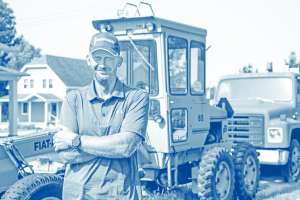
Baker does a lot of the street work himself, including raising manholes up to grade and cold-patching streets, but if hot asphalt is necessary, the city hires contractors. “We buy 100 tons of cold-mix every year,” says Baker. “We use that for patching, sealing. After we did the waterlines, I overlaid most of them myself. The really bad ones, we hired a contractor to overlay. Now I seal so many blocks every year, patch holes and seal.”
The career isn’t what Baker envisioned while studying wildlife biology, but he likes the job: “You know, people call me crazy, but I enjoy work. I like the variety. I do all kinds of stuff on the side, too. I farm, I cut trees for people. I pour concrete. I build things.”
He’s also proud of Greenleaf and the work he does for the city: “I want Greenleaf to have the best streets, to be the cleanest town around. We have the new water system, and we’re working on the sewer system. Whatever I do, I want it to be the best.”