It’s more than product quality that makes for an exemplary biosolids program at the Central Davis Sewer District in Utah.
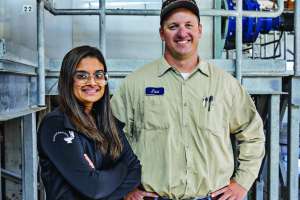
The key ingredient, according to Manjot Masson, the district’s assistant general manager, is concern for people. That includes district team members, people who live near the clean-water facilities and the customers who pay for and use the district’s compost product.
“One thing we do well is that we have great relationships with our citizens,” says Masson. “We make sure that they are being heard and that their concerns are addressed. I think that is why our biosolids program is doing well.”
And clean-water professionals around the state have taken notice. The program received the 2022 Outstanding Biosolids Program Award from the Water Environment Association of Utah.
The Central Davis Sewer District provides wastewater collection and treatment for the cities of Farmington, Fruit Heights and Kaysville and surroundings northeast of Salt Lake City. The district previously won WEA of Utah awards for Outstanding Treatment Plant, Outstanding Collection System, Outstanding Pretreatment Program and Outstanding Safety Program.
On three occasions the district received the Operations and Maintenance Excellence Award from U.S. EPA Region 8. In 2004, the district was recognized with a Clean Water Act Award for outstanding operations and its biosolids program. In addition, staff members have received various honors for excellence in their fields.
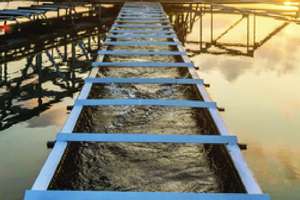
The wastewater treatment plant (9.9 mgd design, 6 mgd average) has two trains that use different processes. A trickling filter train was commissioned in 1961, and an oxidation ditch train was added in the early 1990s. All influent passes through a headworks with two step screens (HUBER Technology and Waste Tech) and a band screen (Hydro-Dyne) and two grit classifiers (Waste Tech).
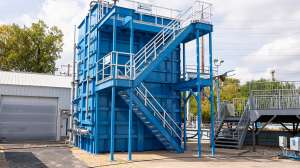
The flow is then divided for biological treatment. On the trickling filter side, the flow is sent to two primary clarifiers and then to the two trickling filters in series. That is followed by settling in two secondary clarifiers. The oxidation ditch side has no primary clarifiers. Three screw pumps (Lakeside Equipment) send the flow to a pair of oxidation ditches (Ovivo), followed by four secondary clarifiers. Final effluent is chlorinated and discharged to Farmington Bay of the Great Salt Lake.
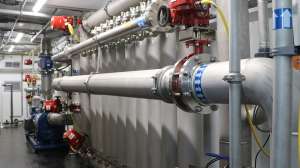
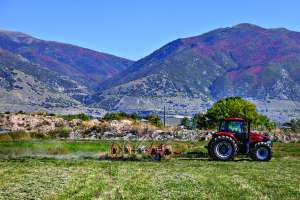
Solids handling differs between the two treatment trains. On the trickling filter side, solids from the primary clarifiers are sent to two primary anaerobic digesters and a secondary digester. The material then goes to a gravity belt thickener (Alfa Laval) that increases solids content to 6.5% for land application or to a belt press (Andritz) that dewaters to 15% solids for compost. This Class B material is land-applied by district staff on 130 acres of district-owned hay fields.
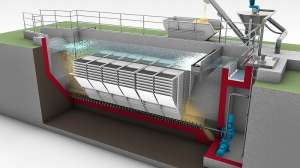
Solids from the oxidation ditch side is thickened in the clarifiers and then sent to two inDENSE units (World Water Works), a gravimetric selection technology that retains denser biomass while the lighter fraction of mixed liquor suspended solids flows out as waste activated sludge. This process promotes higher density and improves settling characteristics.
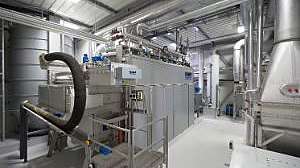
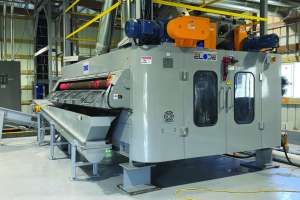
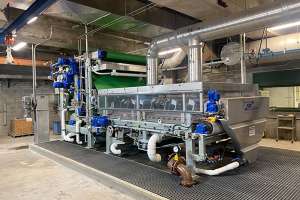
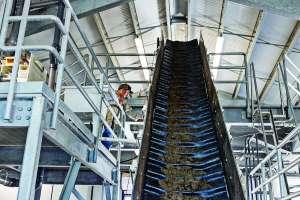
The inDENSE system is followed by a pair of screw presses (FKC) that increase solids content to 15-29% solids. That material is composted from May to October and landfilled for the balance of the year. Biogas from the digesters is flared. “We don’t produce enough to make utilization economically feasible,” Masson says.
Jace Woodrow, wastewater treatment operator and biosolids coordinator, observes, “We used to compost full-time. We started with windrows and used a turner. But as the community grew closer and closer to us, we switched to static pile aeration. Recently we began seeing an increase in odor complaints, and so now we haul to the landfill during the winter.”
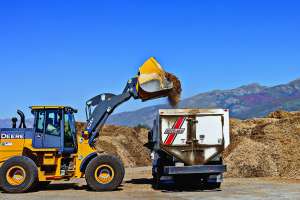
In the compost process, biosolids are placed in a mixer truck in a 1-to-1 (by weight) ratio with wood chips made from old pallets. “We pile that atop 8-inch HDPE pipes 120-140 feet long with 3/8-inch holes drilled every 6 inches,” says Woodrow.
“We have a blower that runs off a timer. Every hour for seven minutes, it blows air through the pile. We don’t have to turn the material or move it until we’re ready to complete the process and dry and screen it. We build our piles in two-week increments. As we’re building each pile, we cap it with old compost to create a biofilter on the top. After the two weeks we start blowing air through the pile and record the temperatures.”
The specification calls for keeping the material temperature above 55 degrees C for more than three days. “We monitor the temperature for 22 days to meet our vector attraction reduction requirement,” says Woodrow. “After that we kill the blowers and just let it sit there and cure.” Compost made in summer often waits until the following year to be distributed to the public.
The finished product is ground and then screened to separate the smaller and larger particles. From there the compost is loaded into dump trucks and hauled to a receiving area where Brigham Justensen loads trucks and trailers for customers as they come in.
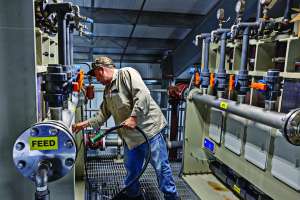
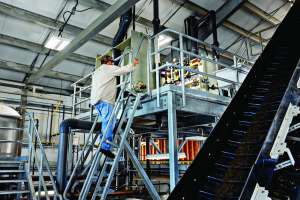
Paco Orona and Wesley Justensen work full-time in the dewatering facility, operating the screw presses, monitoring the polymer doses and the percent solids coming off the presses and running the mixer truck during composting season.
The compost is popular, and not only with district residents. “People call us nonstop starting in March and ask when it’s going to be ready,” says Masson. “We have a webpage to let them know when it’s coming because it runs out so fast sometimes when we have it. People come from all over to get it. Another treatment plant in the area sells compost but it’s a little pricier. When we don’t have compost, we send people there, and they say, ‘It’s not the same.’”
The district offers a fine compost and a coarser material that takes less time to produce. “They either bring a pickup truck or a trailer,” says Masson. “If it’s a pickup truck, we charge $10 to fill the bed.” For anything larger the price is $20 for every three cubic yards.
Masson notes, “A lot of people say, ‘We sent it to you, so shouldn’t we get it for free?’ So, if they shovel it themselves, they get it for free.”
The district’s biosolids program operates under an Environmental Management System under the International Organization of Standardization (ISO 14001), supervised by the National Biosolids Partnership.
That program serves as a model for continuous improvement in environmental performance, regulatory compliance, quality management practices and relations with interested parties and stakeholders. It provides training and support to help organizations ensure that their programs are environmentally sound and protective of public health.
“I believe we are the only program in the state that does it,” says Masson. “We have an audit every year where someone from NBP visits our facilities. As part of it we’re required to have goals, so we’re always progressing toward new gains in our biosolids program.” The district received its first certification in 2007 and since then has received the Platinum Award under the program, most recently for 2022.
Changes are ahead for the program that are not of the district’s making. Masson notes that a freeway being built across the west side of the district’s property will remove 40 acres of the hayfields on which biosolids are land-applied. A connecting road will take another several acres. “So we have to look at alternatives for land application, because a lot of our fields are going to be gone,” says Masson.
“We’ve been looking at composting our Class B product with wood chips. We’ve tried composting it and have done so successfully. We just need to feel out our citizens and see if they have any concerns before we proceed with that. If we have odor complaints or other concerns, we will have to look at alternative solutions.”
Whatever those solutions may be, Masson and her team take pride in the biosolids program. “We are glad to be able to give that product back to our community. And reusing the material is great for the environment.”