In any sport or business, rookie recognition signifies a newcomer achieving great things and destined to do even more down the road.
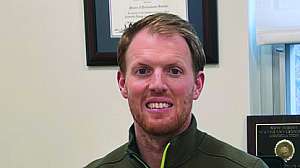
That concept applies in water treatment, and Corry Tschopp of Tower City (Pennsylvania) Borough Authority is a living example. He was recognized as 2023’s Rookie Operator of the Year by the Pennsylvania Rural Water Association.
The annual award recognizes a recently certified operator who shows exceptional effort and dedication on the job. Tschopp has been with the authority, and in the water treatment industry, since February 2019.
“I have watched many rookies,” said Wendy Malehorn, head of training and education development, during the PRWA award ceremony last March. “Some have decided that when the going gets tough, they are D-O-N-E done and they start looking for higher ground. However, as a rookie, Corry Tschopp decided to roll up his sleeves, get a bit dirty and embrace the good, the bad and the ugly.”
For Tschopp, winning the award was only slightly more surprising than having a water treatment career in the first place. “It never was a career choice I had in mind,” he says. “I was actually working a desk job in insurance and I just got sick of the repetitive behavior every day, all day, sitting there nine to five.
“Then I saw an ad that said the Tower City Borough Authority was hiring for their water treatment plant. I took a shot in the dark, applied for it, got an interview and took the job.”
When interviewing Tschopp, authority staff made clear that water treatment in a small town like Tower City (population 1,400) was anything but nine to five.
Tschopp recalls, “All the bad things were brought up during that interview: being available 24/7 for emergencies, dealing with middle-of-the-night winter calls. It was scary to think about jumping in. But I took the job, fell in love with it and have never looked back.”
It’s a 12-minute westward drive down US 209-N from Tower City to Wiconisco (population 1,160), where Tschopp grew up. “I was just a typical boy who played all the sports but never really got into handy work,” Tschopp says.
He graduated from Williams Valley Senior High School in nearby Williamstown in 2013 and then attended East Stroudsburg University from August 2013 to December 2014.
“I’ve had kind of a wild career path, I guess,” says Tschopp. “I went to college to be a physical therapist assistant. But in my second year I withdrew from college when I had my son and needed to be present as a father. I had a couple of jobs and then the insurance job, and that led me here.”
Tschopp was hired as a water operator trainee with the goal to become a certified operator in two years. “I was all for it, even though I basically did all the no-fun stuff,” he says. With a small plant producing only 175,000 to 185,000 gpd, the authority only had Tschopp, full-time manager Kyle Mahoney who was the licensed plant operator, older part-timer George Hand who took care of maintenance, and secretary Chrystal Rhen.
“So I just did odds and ends,” Tschopp says. “I would scrape old paint off buildings, take apart old meters and do new meter installs. The manager also showed me how to test our chlorine and zinc levels and how to keep an eye on the four deep wells that provide our water.”
Four months into the job, Mahoney left. “This meant I was the only person who knew how to do the daily rounds at our four well sites,” Tschopp says. He responded by stepping in to fill the gap, eventually earning his water operator certification: “Looking back, that crisis helped me tremendously because I had to basically pull my pants up, strap my belt, and get to it.”
To meet its legal requirements, the authority hired certified operator Andrew Mione to replace Mahoney. “He’s probably been the biggest mentor for me,” Tschopp says. “He encourages me a lot, makes me feel like I’m always doing a good job and trusts what I do.
“He also pushed me to go for my certification before my first year was up. So I took a 12-week class with PRWA and it just snowballed from there. My career got pushed further along very quickly, which I appreciate.”
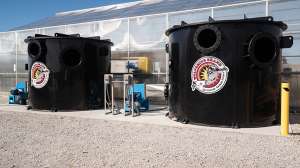
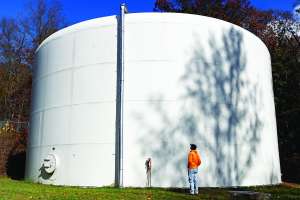
The Authority’s four deep groundwater wells feed two stainless steel storage tanks. “One is a 500,000-gallon tank, and the other is a 350,000-gallon tank that we just put up,” says Tschopp. “We’re rated to output up to 250,000 gpd to serve about 1,200 connections.”
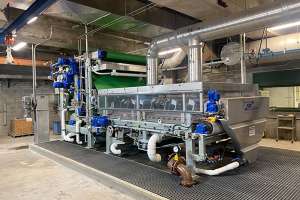
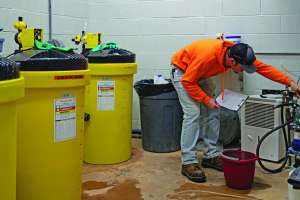
Because the groundwater is reasonably clean, the authority only needs three steps to prepare it for distribution. “We use liquid sodium hypochlorite for disinfection, caustic soda for pH control and then zinc orthophosphate for corrosion control,” Tschopp says.
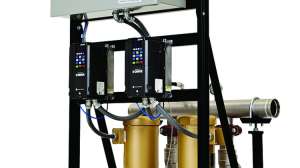
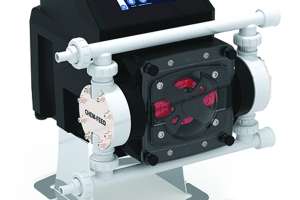
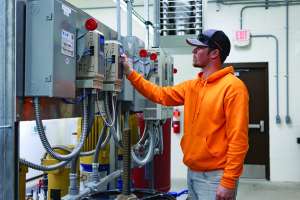
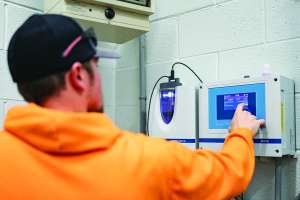
“We use LMI and Walchem chemical pumps (Iwaki), Wallace & Tiernan DEPOLOX 5 chlorine and pH analyzers (Evoqua Water Technologies, part of Xylem), and a Hach Pocket II colorimeter for zinc testing. We also employ the 4-log removal process to remove 99.99% of bacteria in the groundwater.”
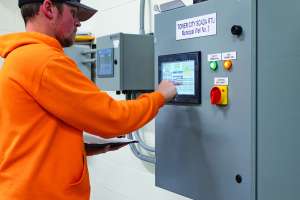
As for the wells and their Grundfos and Burks pumps (Crane Pumps & Systems), “We only have one well being pumped directly into our treatment system,” says Tschopp. “Two other wells feed our tanks for storage, and the fourth well output is pumped into a clearwell. We also have Sentinel dialer alarms (Sensaphone) connected to our four SCADA panels to trigger alarms from the well sites for various settings.”
Getting up to speed fast isn’t the only challenge Tschopp has faced in his short career. “Two years in, we had a major leak that we couldn’t find,” he says. “Everywhere we looked, we couldn’t find it. We were working Sundays, 12-hour days, just trying to find that leak. We were digging holes after holes after holes. Meanwhile the town depleted our water supply in the middle of a drought, and we were hanging on by a thread.”
Two weeks on, authority staff, with the aid of PRWA personnel, finally found the leak and fixed it. Ironically, they found it under the city’s main street after digging two holes. “But that pipe leak seemed so minor that we thought the problem must be somewhere else,” says Tschopp.
After digging around a swamp that the main waterline goes through, the authority repair crew went back to the first leak, only to discover that it had grown to “a three-quarter circle split on the line,” Tschopp says.
“So we fixed that, and that fixed the problem. It was then we learned to fix the little leaks fast because they can grow into big leaks. We weren’t losing that much water initially, and then it drained us over a three-day stretch.”
The next big challenge he has faced is dealing with customers who were vocally angry about the lack of water in their taps. “Obviously social media’s awful, but I live where I work, which also doesn’t help,” says Tschopp.
“There are some not-so-pleasant people out there, and you read stuff that makes it seem like you’re doing an awful job. People don’t care where their water comes from until they don’t have it. So it’s frustrating. You just wish they would walk a couple days in your shoes to see how it is to troubleshoot problems like these.”
Despite the twists and turns of his career, Tschopp loves his work. As for the future, “I get asked that a lot, but truth be told, I don’t really know.
“I always want to be in the industry, but it’s hard to say where I want to go with it. I feel like there are always more places to go and see. I’m treated very well here, but I would be lying if I didn’t say I’d love to go into the massive filter plants and see how some of that stuff works.”