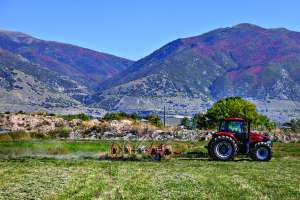
From the time he graduated high school until 1996, Mike Ziegler was a dairy farmer in Beecher City, Illinois.
“Then we had a herd dispersal with all of the cattle being sold off,” he says. “So, I answered an ad for a part-time job at the Effingham Water Treatment Plant, just 15 miles down the road.”
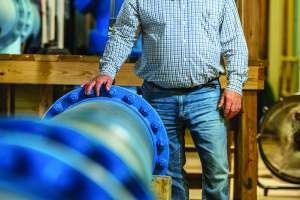
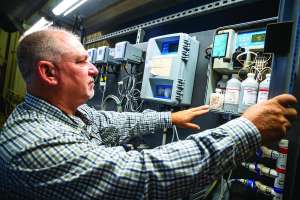
Ziegler has stayed with that plant ever since that time, earning his Class A Water Operator certification (surface water lime softening) and rising to become the facility’s lead operator. In that post, he supervises Effingham’s water system and the distribution of water to five contract customers.
Ziegler is good at his job, which is why the Illinois Potable Water Supply Operators Association named him as 2022 Surface Water Operator of the Year. “It’s great to be recognized by your peers,” says Ziegler. “But this award belongs to everyone I work with on water quality at the city of Effingham.”
Ziegler, born on June 13, 1963, He grew up near Shumway, Illinois, and went to Beecher City Community High School. His parents owned a small dairy farm and raised seven children; Mike was the only boy.
“After I graduated in 1981, I went straight into dairy farming,” he says. If the herd he tended hadn’t been sold, he might still be a dairy farmer. But with the herd and his job gone, he started looking around.
“From everything I read I knew the water field was a very progressive industry and I thought it was an honorable profession,” he says. “I had a wife and two kids who I was responsible for, and I was closing out a previous career of being a dairyman for 15 years that I really loved. So, if I was ever going to do something else, this was the time to do it. So I did.”
Moving from dairy farming to drinking water treatment was a dramatic life change. Compared to tending cattle during daylight hours, working at the Effingham plant was completely different: “I started on nights from 11 p.m. to 7 a.m. at and worked every weekend. That continued after I got hired full-time, for 10 years.”
During that time, Ziegler hit the books, earning his Class A certification when not working the graveyard shift. “A big thank you goes to the people I worked with at the start for encouraging me to study and get my license, and for helping me see that water management could be a rewarding career,” he says. “They pushed me, which helped me become lead operator in 2010.”
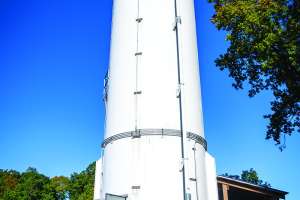
As lead operator, Ziegler manages the Effingham system with its 4,600 customer connections, 120 miles of water mains, and more than 1,000 fire hydrants. The plant has a treatment capacity of 6 mgd, but generally processes about 1.6 mgd to serve the city’s 5,300 users and the five customer communities.
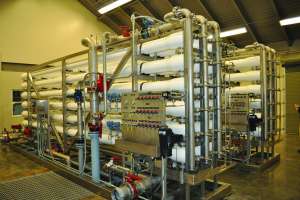
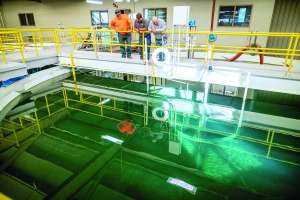
“We are a Class A surface water plant,” Ziegler says. “It is your standard coagulation, disinfection, sedimentation and filtration plant. It was built in 1988, although we’ve had many upgrades since then.”
Lake Sara is the main source of water, supplemented by the Little Wabash and Kaskaskia rivers. Created by the Effingham Water Authority in the 1950s as a dammed reservoir, 800-acre Lake Sara has become a key recreational and wildlife area. The lake is named for Sara Pearson, a local philanthropist, and is carefully tended by the EWA and the Friends of Lake Sara nonprofit conservation group.
“Probably 99.8% of our water comes from Lake Sara,” says Ziegler. “It is gravity fed through a 16-inch pipeline from the dam to a 19-acre treatment reservoir that we call CIPS Lake. The reservoir was built by Central Illinois Public Service when it owned the Effingham water system.
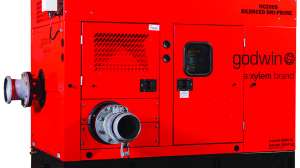
“We also use pumps and pipelines to bring water from the rivers into that same basin. The Little Wabash pumps are older Allis-Chalmers pumps (Flygt - a Xylem Brand) that continue to perform reliably. The Kaskaskia pumps are Pentair turbine pumps. We have a pumping station with Aurora pumps (Pentair) centrifugal split-case pumps that send water from CIPS Lake directly into our treatment plant.”
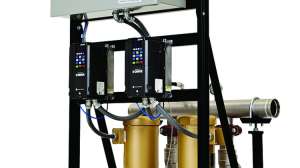
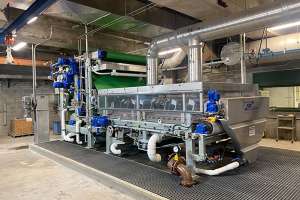
Before the water comes into the plant, it is treated with powdered activated carbon injected into the raw water main using a MERRICK silo system. “Next, the water comes up into our head tank, where the coagulants and a high-density lime slurry (MERRICK system) are added,” Ziegler says. “Then it is diverted off into two 100,000-gallon ClariCone clarifiers (McDermott) where we raise the alkalinity so the sedimentation drops.”
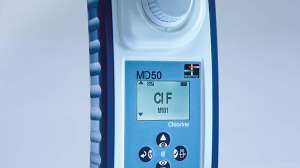
After that, the water comes out of the weirs to a dropbox and into a pipe where it is hit with a low dose of chlorine and polyphosphate. Then it goes through a carbonation vessel where CO2 is added to drop the pH. It is then diverted to four D-cell filters with a foot of anthracite and 3 feet of sand, and then dosed with chlorine, ammonium sulfate and fluoride before being released to a pair of 1 million-gallon clear wells before distribution.”
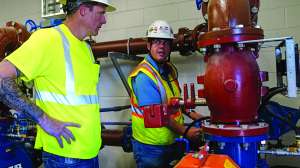
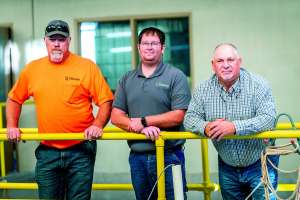
When he talks about the treatment process, Ziegler always credits the team that manages it: Class A operators Bob Rhodes and Derrick Helmbacher, and maintenance personnel Tony Althoff and Pat Brown.
“This team has all been with me since 2017,” says Ziegler. “It’s been a big change when people came and went from the water plant as a means of getting a job and then going elsewhere whenever there was another opening in public works.”
Ziegler notes that a great office staff (Janet Ohnesorge, Emily Bonner and Abby Nosbisch) and the outside water distribution team (Brent Stortzum, Russ Leppin, Jared Westjohn, Clark Bigard and Nate Reisner) also deserve credit for helping the Effingham plant keep up with the challenges of the job.
One such challenge is keeping up with regulations. “There’s always a cost/benefit analysis to everything,” Ziegler notes. “Just like in your home life, it’s a case of wants versus needs and trying to give consumers the best possible product at the lowest price.”
At the same time, the cost of everything the plant needs keeps going up. “We’ve taken 25-30% hits on chemical costs over the last three years,” says Ziegler. “Utility costs are up 40%, and that’s after going out for bids. We’ve also spent a lot of time filling in service line material survey questionnaires. It’s a lot to add to the job.”
Ziegler notes that the first purpose of the Lead Service Line Replacement and Notification Act is to require community water systems to develop, implement and maintain a comprehensive water service line material inventory and replacement plan. An accurate inventory enables communities to set priorities and strategies for lead service line replacement in their systems.
READY FOR THE NEXT STEP
Having a decade and a half in the dairy industry and 27 more in water treatment, Ziegler can’t be blamed for looking ahead to retirement. As that day approaches, he is doing whatever he can “to make the transition for whoever runs with it next as seamless as possible.”
“My goal is to be able to retire when I’m 62, so that’s two more years." As for what comes after that: “I don’t know yet. My life has always been in phases. I always said that at least I was lucky enough to survive my young-and-dumb stage!”