
Producing good water is a balancing act on Alabama’s Dauphin Island.
The barrier island a few miles off the state’s coast in the Gulf of Mexico has several wells, but they are all brackish, and the deepest and most productive well is the saltiest one. The water from that well has to be blended with water from wells in other aquifers to reduce the salt content of the raw water going to the treatment plant.
“If you take our deepest well, which the other day when I checked was 1,944 ppm of chloride, but then you add in one or two of the smaller wells that have 600-700 ppm chloride, we end up with 1,200 and 1,500 ppm chloride raw source water,” says Vaile Feemster, general manager of the Dauphin Island Water and Sewer Authority.
The trick to the blending is to draw enough from the less salty wells to achieve a good blend, but not to draw too much, because then the aquifer would become saltier.
“What we’ve had since day one is saltwater intrusion,” says Feemster. “Dauphin Island sits far enough in the Gulf that the aquifers that come this way are in a transition zone. We draw out of those aquifers, and all of them are brackish. For us, managing those aquifers is the most important thing.”
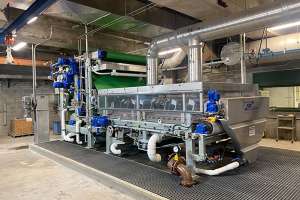
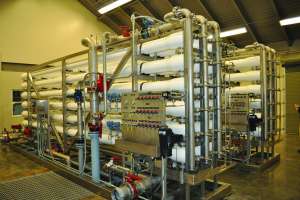
The water is treated with reverse osmosis, which Feemster says does an excellent job of removing both salt and iron, which is also present in high levels in the well water.
Dauphin Island had the first municipal RO plant in Alabama. That plant (Osmonics) still operates on one dedicated well, but it only produces about 120 gpm. The rest of the island’s water used to come from a freshwater aquifer about 35 feet deep that is recharged by rainwater. That water was treated at a 1,400 gpm plant that provided aeration, flocculation, clarification and filtration.
The shallow freshwater aquifer had limited capacity and was also vulnerable to saltwater intrusion from over-pumping and storms. “It just wasn’t a sustainable supply,” Feemster says.
In 2009, the authority invested in a new treatment plant and a new well drawing from a deeper and saltier aquifer. The new plant (Lane Christensen) was built on the site of the old one and was certified LEED Silver, with no-irrigation landscaping, a reflective roof and low heating and cooling costs.
The main room of the plant, which houses all the RO equipment, stays at 76 degrees all year with no heating or air conditioning, thanks to the heavily insulated roof and the water flowing through the plant at 74-77 degrees. The building was designed to provide a healthy interior environment for the staff, to serve as a community resource, to reduce stormwater effects and to be energy efficient.
ROTATING THE WELLS
The RO process, however, is relatively energy-intensive. The pressure applied to the raw water side of the membrane increases as the concentration of dissolved solids increases, and that increase in pressure requires more power.
To conserve power, it would be better to keep the raw water salt concentration lower, but that would mean drawing more water from the shallower wells. Ultimately that could lead to those wells becoming saltier.
That’s the balancing act: Drawing the right amount of water from each well to produce raw water that can be treated efficiently by RO, without drawing too much from any one well.
“We are currently in three aquifers and are able to rotate and manage the wells to keep the chlorides from increasing to where the water can’t be treated with our current technology,” Feemster says.
“Every year RO gets more and more efficient. They’re advancing membranes every year. But we start out with such high brackish water. The higher the chlorides coming in, the higher the net pressure to remove those chlorides. We start out with a terrible water source and we’re able to turn that into a very good drinking water.” The facility uses Toray membranes.
After RO, there are still a few steps to produce finished water. “We add post-treatment chemicals with aeration,” Feemster says. “RO strips everything except gases. We add lime back in to get us some alkalinity and get the pH up. And we disinfect and add a phosphate, like most treatment facilities. After RO it’s really no different from what anybody would do pumping from a well.”
RO produces a waste stream: About 25% of the raw water does not pass through the membrane. That reject water has an elevated concentration of dissolved solids but is not a disposal problem because the waste stream can be discharged to brackish water that is even higher in solids.
Dauphin Island has a resident population of about 1,600 but it has about 2,300 homes, many of them seasonal rentals. Water demand rises significantly in summer, from a winter average of 500,000 gpd to about 750,000 gpd in the peak season.
When the utility built the new water plant, it added a 1 million-gallon ground storage tank. Emergency power generators were also added because the island is vulnerable to hurricanes that can cause lengthy power outages.
It’s not the easiest place to operate a water treatment plant. When the tourists come, demand goes up, and juggling the brackish water sources becomes a little trickier. “Fortunately, for the last 10 years, we’ve been able to keep those levels manageable,” Feemster says. “And that’s always our goal.”