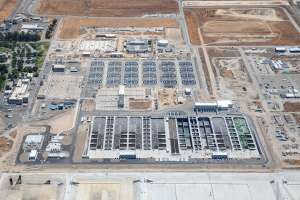
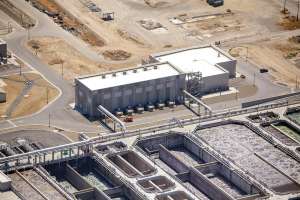
In 2010 the Sacramento Regional County Sanitation District need to make significant upgrades to its wastewater treatment plant to meet strict new permit limits for discharge to the Sacramento River.
Careful planning, smart funding and a savvy pilot project paid off with a mother lode of positive outcomes, for the California district, including unexpected savings and rate dips.
The district, known locally as Regional San, created the EchoWater Project. It is funded by ratepayers and new development impact fees, along with a low-interest State Revolving Fund loan. The collection of projects is designed to take the Regional San wastewater treatment plant from secondary to advanced treatment.
The heart of the project is biological nutrient removal. Being surrounded by a major agricultural region, the district needs to removal excessive organic matter, nitrates and ammonia from influent streams.
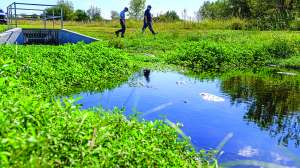
Ammonia removal is most critical, and the BNR process removes more than 99% of it, directly helping the Sacramento River, on which the entire state ultimately depends for drinking water, irrigation and economic stability.
Changing times
As the largest discharger to an inland water body west of the Mississippi, Regional San serves 1.6 million customers in a 386-square-mile area. Permitted for 181 mgd, the Sacramento Regional Wastewater Treatment Plant treats 136 mgd on average dry weather and has a wet-weather capacity of 347 mgd.
Of four contributing wastewater agencies, all have standard separated sewers, except Sacramento, whose older combined system contributes to volume with winter stormwater flows, including leaves, inorganic matter and street debris.
Wastewater enters at the headworks which includes bar screens, followed by aerated grit chambers and primary sedimentation. Previously, secondary treatment used a high-purity oxygen activated sludge process before the secondary clarifiers.
Previous BOD and TSS limits were 30 mg/L. But in 2010, the California Regional Water Quality Control Board issued a new permit ratcheting those limits down to 10 mg/L. “That changed everything for us,” recalls Mike Crooks, deputy director of operations and program manager for the EchoWater Project. “Now that it’s considered Title XXII equivalent, we’re also required to provide tertiary treatment.
“The short residence time of our secondary process really didn’t touch the ammonia as flows went through, so what came into the plant pretty much went out into the river. The process wasn’t designed to address ammonia. It was mostly for the BOD loads we typically saw decades ago when we had customers like Campbell’s Soup. We had to handle those high, spiky BOD loads. That was the important thing then.”
Proof in the pilot
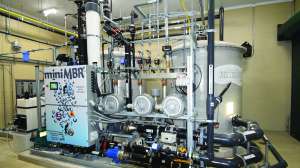
In early 2011, Regional San constructed a pilot plant at the treatment facility to test various filtration and disinfection technologies that could cost-effectively address the new treatment requirements.
“When you embark on a project of this size with the regulatory requirements we had, you can’t get to the end and say, ‘Oh, it doesn’t quite work,’” says Christoph Dobson, general manager. “So, you have to be very conservative in your technology selection. We were able to use our pilot program to confirm that in the case of the filtration, granular media would work, and that was a huge savings. Also, we were able to downsize some of the facilities based on optimization.”
Crooks adds, “On the disinfection side, we looked at chlorination, ozone and peroxide. We also piloted contact times. We were able to prove that we could meet the enhanced disinfection requirements through a shorter contact time using chlorine. That was the lower-cost alternative.
“Plus, the shorter contact time allowed us to shrink the footprint of that component. So, with respect to the tertiary treatments, I estimate we saved probably $100 million from those two elements, the footprint size of the filters and the basin itself.”
Impressive stats
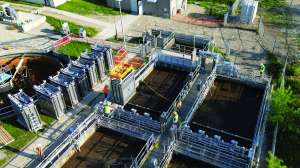
In total, eight basins operate with a 26-foot side water depth, each with a volume of almost 15 million gallons. Each basin has several zones:
-Covered anaerobic or anoxic zone (11% of total area)
-Uncovered anoxic zone (19%)
-Fine-bubble aerobic zone (36%)
-Course-bubble zone (12%)
-De-ox zone (3%)
-Seven swing zones (15%) where operators can run in a mixed or aerated mode, depending on treatment goals
-Re-aeration zone (3.5%)
Team effort
Shortly after completing the pilot, the district hired the Brown and Caldwell and HDR consulting firms to provide program management. “They did a lot of the upfront preliminary engineering,” recalls Crooks. “They developed a basis of design, selected the process and then established a procurement process to get designers on board.”
That was Black & Veatch, who designed the BNR process. Dragados USA built the BNR portion of the facility, while Balfour Beatty Infrastructure constructed the tertiary treatment system. Other consultants including Jacobs Engineering Group, Psomas and West Yost Associates provided supplemental construction management and inspection services.
The tertiary treatment process is new as well. “The effluent from the secondary sedimentation tanks used to just go to chlorination, then to our effluent pumps, then out to the river,” Crooks says. “Now, after the secondary tanks will go to the filter influent pumping station, which will then lift it to the filters.”
The treated water will be chlorinated, then go through a new disinfection contact basin, a 20-million-gallon tank with four basins in parallel, each with a serpentine flow pattern to achieve our contact time requirement. After the BNR, the flow goes to the secondary sedimentation tanks. Those have not changed, although we did have to change out the pumps because our return activated sludge rates changed with the BNR facility.
A portion of secondary effluent is sent to a smaller, side filtration process on site. It was constructed in the early 2000s and provides tertiary-treated water for a number of uses: some plant processes and on-site irrigation. Some of the recycled water is also sent into a neighboring community for irrigating green belts and parks.
That facility produces somewhere around 3.5 mgd. Once the new filtration goes online, the recycled water will come out of the new filtration process being constructed.
Regional San is in the predesign stages of a new program to provide roughly 45 mgd of recycled water to agricultural properties south of the wastewater treatment plant. This program, known as Harvest Water, is to be completed in 2024-25.
Exceeding expectations
The care and planning put into the plant upgrades has paid off beyond expectations. “Whereas before we had almost no ammonia removal, we’re now achieving around 99% removal,” Crooks reports. “We’re removing roughly 30,000 pounds of ammonia per day, which is huge. The turbidity coming out of our secondaries is amazingly clear. I think we’re running roughly 2 NTU coming off our clarifiers.
“At times, we’re seeing 1 NTU, which is really good news for our filters, because it equates to a longer runtime before backwash. The other measure of success, in general, is the delivery of this thing in a cost-effective way. We were expecting that much higher rates ($60-$65 monthly) would be required.” The actual rate is around $37.
The operations staff will increase to about 25, which is close to a 50% increase. The plant also has higher power costs. The BNR system receives flow from a new primary effluent pump station with four 400 hp pumps, and its aeration system consists of six blowers at 3,000 hp each. These new costs should be offset by a clustered solar energy array.
The solar array provides power to the wastewater treatment plant fairly cheaply through a power purchase agreement. Regional San is also preparing to construct a cogeneration facility that will burn digester gas.
Bright horizons
Dobson is excited about the upgraded plant’s energy efficiency: “Environmental stewardship is a really big part of our business and one of our core values. We anticipated a pretty large increase in power consumption, but we’ve found that some of the systems we removed were very energy inefficient, and those systems were replaced by very efficient new ones.
“Added to savings from recent drops in consumption through consumer conservation, we’re not seeing the increase in power demand we thought we would. Though we still have tertiary treatment facilities to come online, it looks like there will be no net increase in power consumption.”
He ends with a look to the near future, with more good news: “We brought a sustainability program to our board. A team made up of various focus areas will work on different elements of our sustainability program.”
It all demonstrates the strides forward that can happen when operators look for opportunity in situations others might view as problems.