Applying innovative thinking to its commitment to environmental stewardship, the City of Hamilton (Ontario) Water and Wastewater Division has developed a waste-to-biogas cogeneration facility that not only reduces greenhouse gas emissions but also generates $1 million (Canadian) in annual revenue.
The Woodward Avenue Water and Wastewater Treatment Facility houses the cogeneration unit, which won the Peter J. Marshall 2008 Municipal Innovations Award from the Association of Municipalities of Ontario for leadership in creating innovative sustainable energy. The award culminates an ambitious project launched in 2005 to create green energy.
The cogeneration facility operates continuously and fulfills nearly all of the wastewater treatment plant’s heat load and 20 percent of its electrical load. Total cogeneration plant efficiency exceeds 80 percent, and the projected payback on the cogeneration equipment is five years.
“While not a novel technology in itself, the heat-recovery system associated with our biogas engine has seldom been applied to a wastewater treatment plant,” says Jim Harnum, senior director of the Water and Wastewater Division. “The combination of electricity generation and heat recovery is innovative for use in this setting.”
Challenges met
Overseeing the operation of the cogeneration facility is an 11-member board of directors. In developing the project, the city looked at a number of goals consistent with its strategic plan and a commitment to a triple bottom line of environmental, social and economic well-being.
The ultimate aim was to produce clean, renewable energy from a waste product, reducing greenhouse gas emissions, increasing energy efficiency, generating revenue and reducing operating costs for the wastewater treatment plant.
To bring the project to fruition, the division overcame a number of technical, political and economic challenges. For example, developers had to apply the existing technology of the heat-recovery system associated with a biogas engine-generator to the new setting of the wastewater treatment plant.
The plant’s anaerobic digestion process produces biogas that contains roughly 65 percent methane and 35 percent carbon dioxide. Previously, most of the biogas was flared. Now, the gas is burned in a Cat 1.6 MW (Caterpillar Inc.) engine-generator set, powered by a Cat G3520C low-energy fuel engine.
The engine includes a specially designed cooling system that elevates jacket water to the optimum temperature to prevent condensation of fuel-borne sulfur compounds and the formation of sulfuric acid, which can damage engine components. A crankcase ventilation pump ejects potentially acidic blowby gases and draws in fresh, filtered air.
Limited fuel treatment
Because of the engine’s low-energy fuel modifications, the digester gas conditioning system requires only a moisture trap followed by a coalescing filter to remove remaining moisture droplets and particulates.
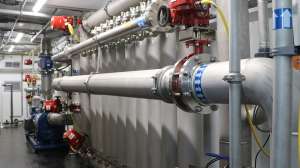
Engine heat is captured by jacket water and first-stage after-cooler heat exchangers and an exhaust gas boiler. Heated water passes through a plate-and-frame heat exchanger connected to the treatment plant process heat loop.
The package also includes 4,160V switchgear, utility interconnections, paralleling and synchronization controls, and protective relaying. A PLC-based control panel designed and built by Toromont Power Systems regulates the heat recovery and gas delivery systems as well as the engine and generator. Toromont delivered the complete cogeneration system in a stand-alone module with a sound-attenuated enclosure.
Developers had to address the issue of legislation that kept the city from directly participating in a cogeneration venture. That led to the creation of a new city-owned corporation, Hamilton Renewable Power Inc., which took responsibility for construction, operation and maintenance of the renewable energy facility.
A further challenge involved the best way to maximize the economic benefits of the project. To that end, the city signed a 20-year contract with the Ontario Power Authority (OPA) to produce renewable energy.
The project was the first wastewater treatment cogeneration plant in the province to receive such a contract, and Hamilton became the first municipality in the province to be accepted by the Ontario Electricity Financial Corp. to build a generator for sustainable green energy.
Bottom-line benefits
In fact, says Harnum, the plant is one of the most innovative large-scale examples of biogas cogeneration in Canada. Since the facility was commissioned in July 2006, it has provided environmental and economic benefits that include:
• A reduction of 8,000 tons of green-house gas emissions directly from the facility and an estimated reduction of 6,500 tons of carbon dioxide emissions through the production of renewable energy and replacing natural gas usage. That represents a total reduction of some 130,000 tons of greenhouse gases over the 20-year contract.
• A 15 percent reduction in the plant’s total energy requirements, through reduction of natural gas consumption by 1.5 million cubic meters.
• $1.1 million (Canadian) received to date from electricity sales to the Ontario Power Authority.
• $540,000 (Canadian) in natural gas costs saved to date from thermal energy recovered from the engine. Annual savings from thermal energy recovery are expected to run about $450,000 annually.
“The Woodward Avenue facility is an example of a project that is positive from an environmental, economic and social perspective, with a high level of applicability to other settings in North America,” says Harnum, who is also president of Hamilton Renewable Power.
“The market for this type of project essentially includes every wastewater treatment plant, including those at small-sized towns. For larger cities with considerable availability of biogas, the potential for significant returns and benefits is clear.”
Harnum believes widespread adoption is inevitable, particularly as he and City of Hamilton officials share their story and provide information about applying innovative technology to help make the world greener.