Big savings can come in small packages. That’s the case at the Hampton Roads (Va.) Sanitation District (HRSD), where continuous hydrogen sulfide monitoring technology is significantly cutting the use and cost of odor-control chemicals.
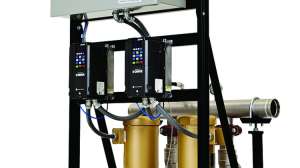
Sentinel continuous gas-analyzer/monitor units from Vapex Inc. measure the amount of H2S in the inlet, mid-point and outlet air streams of HRSD’s wet chemistry odor-control scrubbers. Based on these data points, the units can either directly control the feed pumps metering chemicals into the scrubbers, or interface with the pump control system to provide the appropriate amount of chemicals.
Compared to the previous practice of applying chemicals based on the pH of the scrubber water, the units have saved close to $1 million in chemical costs since installation in 2000. “I can’t think of any reason not to use continuous H2S monitoring units on any wet chemical scrubbing system that currently operates by pH control,” says Mark Feltner, HRSD environmental scientist. “Otherwise, you’re flying blind.”
“Find a solution”
A Michigan State University graduate, Feltner joined HRSD in 1994 to take on the district’s air-quality permitting. It didn’t take long before his job included odor control. “The treatment director challenged me one day to find a continuous hydrogen sulfide monitoring technology that worked,” Feltner recalls.
Soon after, Feltner took part in a pilot test of a Sentinel unit alongside another monitoring system HRSD was also considering. The test, conducted in 1998-99, was a success. “The Sentinel was much more reliable and accurate and proved to be more precise than relying on pH readings to determine chemical dosage,” Feltner says.
When using scrubber water pH to determine chemical dosage, he explains, operators usually set rates based on diurnal or seasonal peaks when H2S is high, independent of the real-time odor load to the scrubber. As a result, more chemicals than necessary may be applied during nonpeak periods.
After the pilot testing, HRSD ordered nine Sentinel units — one for each of the packed tower scrubbing systems at its nine major treatment facilities. Today, it owns 17 units, applied to scrubbing systems at treatment plants throughout the district.
Real-time picture
Each unit consists of a stand-alone controller with data storage and local or remote reporting. Three sensors accurately measure H2S at the inlet, mid-point and outlet of the scrubber system, enabling the user to track the H2S content of the gas in real time. An air purge occurs every 15 minutes, cleaning the sensors and preserving their life.
Typically, the units can reduce scrubber chemical usage by up to 60 percent, and can lower scrubber maintenance costs by reducing the scaling effect of the chemicals on the scrubber media. The units also alert the operator in case of scrubber failure.
Over the years, HRSD and Vapex have worked to improve the technology, now in its fourth generation. Advances include new PLC-based software that is more user-friendly. It combines various options previously available individually into one package.
If operators want to add a sensor, for example, they can simply touch the screen to set that up. That makes it easy to operate and troubleshoot the system. Vapex’s Patrick Resch says remote monitoring is now also possible, enabling Vapex technicians to identify issues without traveling to the site. The newer units are built to industrial-rated standards to hold up in difficult field environments.
In addition to gas monitoring, HRSD uses Vapex’s O-Mega odor-control system to eliminate odors at pump stations. The system produces a hydroxyl ion fog and injects it into confined spaces like wet wells to oxidize hydrogen sulfide compounds. “It’s been another good application for us,” says Feltner.
Making it work
As with any technology, Feltner emphasizes that operations and maintenance staff have a lot to do with making it successful. “Usually you’ll have some staff who love the new system, some who are neutral, and some who might just as soon stay with the status quo,” he says. “It’s really important to get your staff to buy in when the new system is rolled out.” In any case, Feltner says, the system has to be maintained.
By HRSD’s rough calculations, the capital cost of the gas-monitoring units has been more than offset by savings on chemicals, with payback in as little as one to two years. “The financial analysis indicates that we can save as much as $25,000 per year of sodium hydroxide in each of our wet scrubbing systems,” says Feltner. “Sodium hydroxide and sodium hypochlorite used in our scrubbers cost a lot of money.
“The price of caustic alone has increased by more than 110 percent just in the past year. Based on that, the expenditures for the H2S monitoring units are more than justified, including continued investment in software upgrades and new analyzers.”