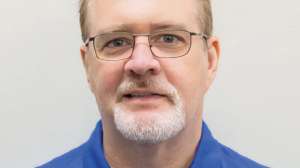
When Kevin McKinnon hooks into a fighting steelhead in a pure Alaskan stream, it makes him feel good about what he does at the office.
He’s the superintendent of the Anchorage Water and Wastewater Utility’s Eagle River Wastewater Treatment Facility, which turns out crystal clear effluent and works every day to preserve and protect Alaska’s natural environment.
People are drawn to Alaska by its unparalleled camping, hunting and fishing opportunities. “The fishing here will spoil you,” says McKinnon. That’s what drew him to the state 30 years ago, and it has kept him there.
“I was born in Nebraska and went to college in Colorado, and my mom gave me a one-way airline ticket to Alaska for graduation,” he recalls. “I fell in love with the place.”
After an introduction to the public works profession in the small town of Wellington, Colo., where he did everything from digging graves to mowing parkways to maintaining the water and wastewater treatment plants, he moved to Alaska, hiring on with the Anchorage utility in 1985. In 1988, he joined the staff at the Eagle River plant, working his way up to superintendent in 2007.
Along the way, McKinnon has directed a number of innovations that help keep the plant in compliance with its discharge permit and help drive down operating costs. He credits an experienced team of operators for the plant’s success, in turn recognized by numerous state and national honors.
Good move
The Eagle River facility has received awards from the Alaska Water and Wastewater Management Association (AWWMA) for plant of the year, unit of the year, accident-free performance, and consecutive years without a permit violation. The U.S. EPA has recognized the plant for best performance in Region 10, and as runner-up in its class for the Operations and Maintenance Award.
Last May, McKinnon received the AWWMA’s large system Operator of the Year award at the association’s annual statewide conference.
“I can’t say enough about Kevin’s work at Eagle River,” says Craig Woolard, director of the Anchorage utility’s treatment division and president-elect of the American Water Works Associa-tion. “He knows the process cold, and he fosters a strong feeling of teamwork among his staff. That’s the reason the plant has performed so well. He does a great job.”
Quality effluent
The Eagle River plant serves a community of about 25,000 with 6,330 active sewer connections. It was built in the early 1970s, and in 1991, activated sludge replaced the original rotating bio-contactor (RBC) operation.
Today, an average flow of 1.5 mgd passes through the headworks, which contain a bar rack, grit removal channel and rotary screen. After primary clarification, the flow enters aeration basins for biological treatment, including ammonia removal. Secondary clarifier overflow is chlorinated, then sand-filtered and dosed with sodium bisulfate for de-chlorination. Later this year, a new ultraviolet light disinfection system will replace the chlor-dechlor operation.
Treated effluent, meeting a strict toxicity standard, flows to Eagle River, which empties into the Cook Inlet of the Gulf of Alaska through one of the state’s largest estuaries.
A pair of gravity belt thickeners thicken primary and secondary sludge, and pumps move the material to an on-site storage tank. A private contractor hauls the solids to the Asplund wastewater treatment facility in Anchorage for final treatment and incineration. The plant’s annual operating budget is $1.3 million.
Better and better
The Operator of the Year award cited several innovations and improvements that McKinnon and his team have made to maintain high performance in the face of plant upgrades, and to save money and energy.
In one instance, the staff had to shut down the primary clarifiers to make repairs to the primary sludge gravity thickeners. “We explored our options and decided the simplest solution was to bypass primary treatment altogether,” says McKinnon. By increasing the mixed liquor suspended solids in the aeration basin, thereby adjusting the food-to-mass ratio, and by keeping a close eye on nitrification, the operators were able to keep the plant in compliance with its discharge permit during the repairs.
Another improvement involves the cost of sludge hauling. Nearly 3 million gallons at 4 to 5 percent solids have been transported to Anchorage in past years, at a cost that has risen to 7 cents per gallon.
McKinnon’s team plans to use a new 3-inch Periflo hose pump to feed primary sludge to the gravity belt thickeners, where it will be combined with waste activated sludge. The overall solids content should approach a target of 8 percent, significantly reducing sludge hauling costs. “This project is happening right now,” says McKinnon. “We will bypass primary treatment again to allow the contractor to install the pump, piping and controls.”
Deep experience
For years, the plant has adjusted pH with soda ash, which came in 50-pound bags or had to be fed to the Schenck AccuRate feeder system in 5-gallon bucket loads. In 2008, however, the plant installed a “super bagger” (NBE), which handles 2,000-pound bags and automatically feeds soda ash in proportion to the plant flow.
An LDO dissolved oxygen meter (Hach) positioned in the activated sludge basin has reduced power costs. Tied into the plant’s SCADA system, the meter optimizes the air flow and saves significant electricity.
“Our staff is always looking for ways to save chemicals and utilities in the operation of our plant,” reports McKinnon. “Between 2007 and 2008, we saved 28 percent on bisulfate usage, 18 percent on chlorine usage, and 29 percent in our use of polymers.” Electrical and natural gas consumption fell by 4 percent.
For achievements like these, McKinnon credits his team of operations foreman Mike Hill, level IV operator Mike Silvernail, and level III operators Larry Caswell and Billy Gould. With McKinnon they represent a total of 125 years of operator experience.
“Our operators really pay attention to the chemicals and utilities we consume and make an effort every day to avoid waste,” says McKinnon. “They’re a great group who really know what they’re doing. Anything I get credit for is really just a reflection of their dedication and hard work.”
Alaskan challenges
Treating wastewater is challenging in any region, but in Alaska, McKinnon and his team must deal with special situations — cold weather for one.
“We have conditions that vary from one extreme to another,” he explains. “In winter, we can have temperatures that plunge to 20 or 30 below zero. Then, with winds as high as 100 miles an hour, we can get a warm spell off the Pacific that produces a ton of melt water. We call it the Pineapple Express, and it can raise temperatures into the mid-50s.”
Just such an event occurred in January 2009. “It melted 2 feet of snow in 24 hours and gave us an additional 500,000 gallons a day (a quarter of total plant flow) coming essentially through manhole lids,” he says. “The ground is frozen 6 feet deep this time of year.”
The cold weather can cause problems for Eagle River’s nitrification process, as well. “We have to watch the food-to-mass and dissolved oxygen levels,” McKinnon says. “Our nitrifying bacteria don’t like the cold, but we have a strain of filamentous bacteria that does. Routinely in the winter, we have to chlorinate.”
Mother Nature
Then there are volcanoes and earthquakes. “Mount Redoubt is only 110 miles away,” says McKinnon. “When it blows, as it did recently, we make sure to bag and shut down our computers and instruments when we leave at night to guard against dust and ash.”
Eagle River is developing a standard operating procedure (SOP) for volcanic events, specifying procedures like:
• Shutting down the HVAC system, again to keep ash and dust from getting into the building.
• Providing dust masks in all the vehicles.
• Having emergency power generation equipment available and ready in case of major ash fallout.
• Restricting vehicle use during an ash fallout and having only essential personnel report to work.
• Stocking special filter media to protect blowers and generators in stock.
Earthquakes are also a threat in Alaska, so structures at Eagle River must be built to seismic standards. Despite these demanding conditions, McKinnon wouldn’t be any place else.
Here to stay
“We still have a lot of improvements to make at the plant,” he says. “The UV upgrade will be a big deal, and we’ll have a big party when those 1-ton chlorine cylinders are hauled away.” And then there’s the outdoors.
“I love hunting for moose and caribou, and fishing for trout, steelhead and king salmon that can run 50 to 60 pounds,” he says. “It’s beautiful up here.” He’s happy protecting this spectacular environment and passing it on to the next generation, and has no plans to leave. With two sons coming along who also like to hunt and fish, why would he?