Located in northwest Georgia, the City of Dalton, in the foothills of the Blue Ridge Mountains, is home to many of the nation’s largest floor-covering manufacturers.
With more than 150 carpet plants and 100 carpet outlet stores, Dalton is known as the Carpet Capital of the World. Its carpet plants employ more than 30,000 people in the Whitfield County area. They also pose special challenges for Dalton Utilities, which provides wastewater treatment and other services to the city and its immediate surroundings.
The Riverbend Road Wastewater Treatment Plant, one of Dalton Utilities’ five treatment facilities, meets those challenges daily. This 20 mgd activated sludge plant was named 2008 Wastewater Plant of the Year by the Georgia Association of Water Professionals (GAWP). That is just one of several awards the plant has earned since it was completely rebuilt in 2002.
The plant includes treatment technologies designed to accommodate the characteristics of carpet plant wastewaters. It also has strong management and an experienced and highly trained staff intent on delivering high-quality treatment and protecting local water resources.
Native industry
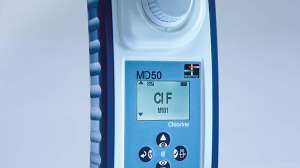
The Riverbend Road plant is a key part of the utility’s wastewater treatment system, which besides the treatment plants includes four pump stations with screw pumps from US Filter/Zimpro (now Siemens Water Technologies), one equalization basin, 2.9 miles of effluent canal, and 320 miles of piping. The plant’s secondary effluent is sprayed on a 9,200-acre land application system (LAS) site. The effluent is disinfected with chlorine before spraying.
The Riverbend Road plant, originally constructed in 1970, was rebuilt in 2002 at a cost of $21 million to mirror the 20 mgd Loopers Bend Wastewater Treatment plant, also located on the LAS site. The Abutment Road Treatment Plant also processes wastewater, as do two unmanned package plants, Whitfield Acres and Mill Creek, which opened in 2008.
These plants and a state-of-the-art solids-processing facility protect the Conasauga River and enable Dalton Utilities to serve residential and industrial customers effectively.
“We have a strong commitment to environmental stewardship and world-class customer service,” says Leslie Rush, vice president of water and wastewater services. “Our capital investment of $110 million since 1997 has contributed to a quantum improvement in operational performance and enhanced our ability to keep pace with the region’s growing wastewater treatment needs.”
The wastewater system serves a variety of customers in a community of 120,000 and processes about 32 mgd. Some 87 percent of that is industrial wastewater, primarily from the carpet mills. Not surprisingly, Dalton Utilities has had to adapt its treatment processes to that waste load.
Dalton’s carpet-making roots go back to 1895 when teenager Catherine Evans Whitener gave her brother and his bride a tufted bedspread. She copied a quilt pattern and sewed thick cotton yarns with a running stitch into unbleached muslin, then clipped both ends of the yarn so they would fluff out. Finally, she washed the bedspread in hot water to hold the yarns by shrinking the fabric.
Catherine began selling bedspreads in 1900, and by the 1930s they had become so popular that Dalton was called the Bedspread Capital of the World. After World War II, bedspread tufting technology was adapted to mechanize carpet making, and Dalton’s pool of workers with tufting skills helped it become the center of the new industry.
Technological edge
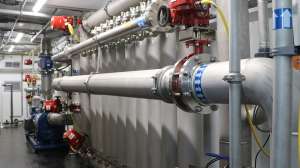
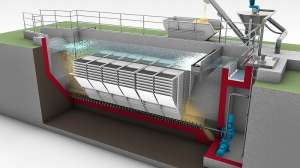
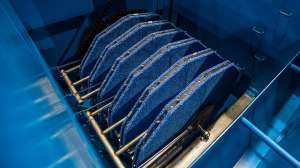
The Riverbend Road plant’s most obvious concession to the carpet industry is the fine-screen building, which consists of static, self-cleaning screens (Andritz) with 80 mgd capacity. The screens filter raw wastewater pumped into the plant by the screw pumps, removing lint from carpet plant wastewaters and other nonorganic particles down to 0.020 inches.
Like other Dalton Utilities plants, Riverbend Road uses diffused air technology in its secondary process. Some 42,000 fine-bubble diffusers (ITT Water & Wastewater – Sanitaire ) line the bottoms of four 2.9 mgd aeration basins and introduce oxygen. The process reduces influent BOD from 368 mg/l to 12 mg/l and reduces TSS from 125 mg/l to 9 mg/l. Rush, an 11-year Dalton Utilities veteran, says the diffused air system is twice as efficient as surface aeration technology.
Industrial flow is also the key reason Riverbend Road uses an equalization basin. Wastewater generated by industrial customers falls dramatically on weekends. At those times, the plant processes water captured in the basin, keeping plant flows uniform and keeping the biological process running smoothly. Completed in 2004, the basin has 3,960 diffusers (ITT Water & Wastewater – Sanitaire) and a capacity of 10.25 million gallons.
To enhance productivity and support process quality, the Riverbend Road plant maintains a high degree of automation, which includes a SCADA system (Invensys/Foxboro). Dalton Utilities as a whole exchanges information by way of its own 100 percent fiber optic network, OptiLink, the first of its kind in Georgia. All the utilities’ gas, electric, telecommunications, water and wastewater operations are connected through more than 300 miles of fiber.
“We ourselves are a major customer that uses the utility’s OptiLink services every day to monitor our operations,” Rush explains. “The SCADA system allows our operators to spot problems once they have occurred and, more important, to pinpoint potential issues that we can address before trouble develops.”
People make the difference
As important as technologies are, people play an equally critical role. Dalton Utilities puts a premium on operator training and development. At present, the wastewater plants have 20 Class I operators, four Class II operators and eight Class III operators.
The Riverbend Road plant staff includes Class I operators Jim Shafer, Jeff McNeeley, Kenny Stokes, Eric Walker, Paul Dodson, Daniel Duke and Kevin Young, and Class II operators Matt Warner and John Burgess.
“Without question, we have the finest operators and staff of any wastewater plant in the state,” says Don Johnson, manager of water/wastewater treatment. “They learn their jobs quickly and progress from one grade to another, which not only rewards them financially but also makes their work more fulfilling and keeps our turnover rate very low. We believe strongly in cross-training so our employees can develop their skills. In some cases, employees have moved to entirely new positions in our lab or elsewhere in the utility.”
Johnson, who has been with the utility for nearly 21 years, points to John Burgess, one of the newest operators. He calls Burgess “very aggressive in his learning style. He sees every new situation as a challenge.” In four and a half years, Burgess has earned Class II certification and has learned to operate the Riverbend Road plant, the other wastewater treatment plants, the LAS pump stations, and the solids dewatering and composting facility.
Biosolids innovation
The solids facility was completed in 2000. Before that, biosolids were land-applied on the LAS. Today, 100 percent of biosolids are composted. That reduces nutrient loading to the soil in the LAS, which is close to the Conasauga River, and eliminates the risk of nutrient runoff to the river during heavy rainfalls or floods.
Today, aerobically digested solids are thickened with polymer, then dewatered by two centrifuges (GEA Westfalia Separator Inc.) The facility processes an average of 100,000 wet pounds of dewatered biosolids daily, or approximately 3 million wet pounds per month.
Dalton Utilities partners with Harvest Farms, a firm near Chattanooga, Tenn., to take the solids produced and create compost. This composting partnership saves Dalton Utilities more than $350,000 each year in biosolids management costs.
The dewatered biosolids are mixed with organic material, such as tree bark and wood chips. Then the mixture is held in static piles kept above 131 degrees F for three days and at an average of 114 degrees F for a total of 14 days to meet EPA Class A regulations.
After treatment, the material is placed in windrows on the LAS facility for four to six months for further treatment, then screened to produce a product that is ready for sale to landscape contractors. Harvest Farms handles the marketing and sale of all the compost generated.
Earning recognition
Consistent performance has brought recognition to the wastewater treatment facilities. Rush pointed out that the facilities have received Gold and Platinum awards from the Georgia Association of Water Professionals for nine consecutive years.
In 2004, the utility was named the Wastewater Collection System of the Year by the Georgia Water & Pollution Control Association. In 2005, the Riverbend Road plant won the GAWP Wastewater Treatment Plant of the Year award. The wastewater department also received two Top Operator awards.
“We apply for every award we are eligible for,” Rush says. “Undergoing this scrutiny on a regular basis really keeps us on top of our game and helps us to continuously improve our operations.” With its strong management team, effective technologies and engaged workforce, more recognition for Riverbend Road and the other treatment plants looks like a sure thing.