In wastewater operations, washer compactors perform a deceptively simple function: to reduce debris volume for handling and disposal. But a lot of factors can complicate this process, including atypical wastewater debris, inconsistent debris volumes, and solids that cling to and/or jam the auger.
It was with these challenges in mind that Duperon expanded the capacity of its washer compactor. Using two 10-inch augers running in counter-rotation, the new higher-capacity washer compactor can handle a wide range of debris with minimal jamming and less risk of overflow. It can continuously process up to 450 cubic feet of debris per hour with a peak capacity of 600 cubic feet per hour, which it can maintain for up to two minutes. Although designed for high capacity, the self-adjusting compaction housing allows it to efficiently process debris even at low debris volumes.
The Duperon high-capacity washer compactor offers a wide range of benefits to any wastewater operation, including:
High debris volume reduction. The robust dual-auger system allows the Duperon washer compactor to reduce debris volume up to 80%. This can significantly cut landfill costs. In addition, it can provide up to 60% dry solids content and up to 70% mass/weight reduction.
Acceptance of variable debris. Most washer compactors can handle material like wood, rags and other debris that are comparatively normal for wastewater systems. But more challenging debris, including bricks, hardhats, metal and more, wind up in channels far more often than they should. Powered by a 10 hp motor, the dual-auger design enables the washer compactor to handle even the most challenging materials.
Continuous compaction. In a single-auger compactor, tacky or stringy debris tends to rotate with the auger. In order for the debris to be compacted, it has to stop rotating and be pushed forward toward the compaction unit. The Duperon washer compactor’s dual augers move in counter-rotation in close proximity, creating continuous positive displacement. For clingy debris, such as vegetation mats and grease, this minimizes the tendency to stick to one auger and ensures debris is always pressing forward and being compacted.

Less operator intervention. There are two main reasons why a washer compactor would need operator intervention. The first is, as mentioned above, that debris gets stuck on the auger and must be cleared by hand. Duperon’s washer compactor design avoids this with its counter-rotating dual augers. The second is when brushes used to clean the strainer wear out and must be replaced. The Duperon washer compactor eliminates the use of brushes. Instead, the lower auger has intimate contact with the floating strainer. The gentle pressure removes any excess debris that might get stuck to the strainer. At the same time, springs allow the strainer to flex away from larger and harder pieces of debris, reducing the risk of damage to the strainer and minimizing the need for replacement.
Reliable compaction. Many washer compactors struggle when flow volumes have wide swings. Those that are designed for low flow rates run the risk of over-compacting during high flows, which in turn can damage the unit. However, no wastewater system, particularly municipal wastewater treatment plants, can ensure consistent flow rates. Duperon’s washer compactor uses a self-adjusting compaction housing. These compaction housings mechanically adjust to maintain consistent pressure regardless of debris volume.
Reduced footprint/increased capacity. The Duperon washer compactor’s dual-auger design, combined with larger, 10-inch augers and a 29 rpm top speed, allow it to process a continuous loading of 450 cubic feet of debris per hour. That roughly correlates to over 1 million gallons per day of wastewater in a municipal system with 1/4-inch bar openings. As such, the washer compactor has approximately three times as much compacting capacity as most standard-size washer compactors. Existing wastewater operations have the option to replace up to three outdated or worn washer compactors with a single Duperon washer compactor, saving space for other operations. Alternatively, the unit can be installed to provide additional capacity in anticipation of population-growth-induced volume increases.
Reduced odors. Flood-washing ports clean the debris in a flood zone before the compactor. This reduces the amount of fecal matter and other odor-causing material in the plug.
Range of applications. The Duperon washer compactor can be used in a variety of wastewater applications, including municipal wastewater, combined sewer overflow, pump and lift stations, industrial wastewater, and any other scenario where difficult or variable debris is common.
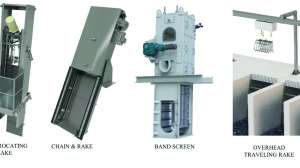
Beyond these benefits, Duperon’s newest washer compactor can be equipped with a discharge extension option. Most washer compactors rely on the debris chute for compaction and motorized conveyors to move the plug. Duperon instead leverages the combination of dual augers and chute geometry to create backpressure. The DEO allows the washer compactor to transport compacted debris up to 40 feet without the use of mechanical conveyance. This can save money on manual labor, as well as on installing, running and maintaining motorized conveyors. The DEO also potentially eliminates the need for bar screens that extend multiple levels. Instead, bar screens can discharge underground to the washer compactor, which can then push the compacted debris to the ground level using the DEO.
While washer compactors have a simple job to do, the nature of wastewater debris is anything but simple. Duperon’s new high-capacity washer compactor is designed to tackle the most difficult challenges while reducing overall operating costs.