Some might consider the relentless maintenance regime at a treatment plant in Kansas to be almost too proactive.
But the longevity and reliability of the site’s equipment speaks volumes for the way the Gardner wastewater facility is run, not to mention the multiple awards it has earned.
Scott Millholland, site superintendent in Gardner, just southwest of Kansas City, is a firm believer in keeping the Kill Creek Water Resource Plant clean, fully serviced and at optimum efficiency, at all times.
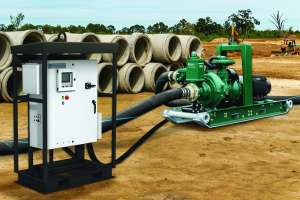
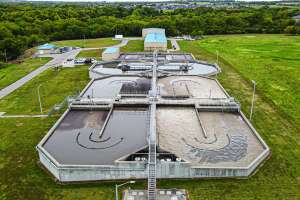
Plant equipment includes two mixers (Landia), that help keep everything in suspension in the racetrack-format nitrification/denitrification setup and have been operating since the plant was built by Kruger in 2002 with a Bio-Denitro phased oxidation ditch process (Veolia Water Technologies).
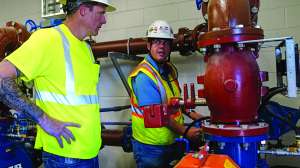
“The Landia mixers continue to keep everything moving and do a very good job for us,” says Millholland. “We pull them up every spring and fall to pull off any rags and make sure there’s nothing on the magnetic plug rings. After checking them over we put them right back into service. They’re an integral part of what we do here.”
In the corrosive world of wastewater treatment, proactive maintenance is partly summed up with the statement: Oil is cheap. “We didn’t have to carry out any type of rebuild on the first Landia mixer until it had completed 14 years of service,” Millholland says.
“We look after them properly, but they’re a strong, solid design and very easy to maintain. Equipment should always be maintained properly, but clearly, these mixers are truly built to last. After our rotors have been on for an hour and a half, we run the mixers for 45 minutes.
“At just 13 amps, they are low on energy usage, especially when compared to blowers. We’ve just replaced 130-amp (125 hp) blowers with new units that draw just 50 amps, so it has been a very quick payback.”
Keeping 21-year-old mixers in top condition is just one of many reasons Gardner has rightly been recognized as an outstanding treatment facility. All 23 lift stations in the collection system are checked every day to ensure that wastewater is getting through properly.
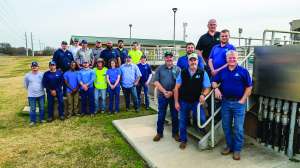
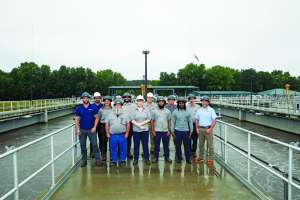
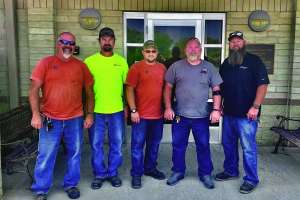
Serving a population that has grown from 6,900 in 1998 to nearly 25,000 today, Kill Creek has won the Kansas Water Environment Association Wastewater Treatment Plant of the Year award seven times. Millholland oversees the entire facility, leading and mentoring his team while still working as an operator, mechanic and engineer.
The team is inspired by the goal of building better community for future generations and takes great pride in protecting the environment and waterways. The plant has not seen a permit violation for more than two decades.
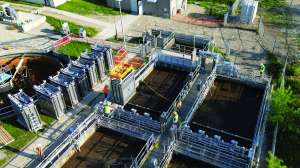
The plant was originally designed to serve a population of 25,000 with a mgd capacity and now treats an average of 2.3 mgd. The modular design provides room to expand to 7.5 mgd without process changes.
“Gardner is one of the fastest growing cities in the United States, very much on the up with new jobs and an expanding economy,” Millholland observes. “So it is very important that we keep at least one step ahead with our operations. We try to save money wherever we can, but never compromise on treatment quality.”
In addition to population growth, the Kill Creek plant faces the challenge of meeting new effluent phosphorus and nitrogen limits. That means making process adjustments. Treatment in Gardner has evolved from lagoons, to fixed-film treatment with trickling filters, to rotating biological contactors, and now the oxidation ditch.
“We used to do pretty much everything on an on-call basis, from checking the water and wastewater plants, water breaks, turning meters on and off, and anything and everything else that needed to be done,” Millholland says. “For new challenges that include removing nutrients, all of our equipment, no matter how new or old, will play a part.”