When 26 percent of Fox River Water reclamation District employees took early retirement in 2006, including several key managers, there could have been serious consequences. Instead, the retirements opened the door for other employees to move up, and ultimately strengthened the organization.
The district reacted to the sudden loss of long-time, highly valued employees by promoting mainly from within and giving the new managers the training they needed to keep up the treatment plants’ excellent performance.
The new team managed successfully through an extensive series of plant upgrades and performed so well that the plants received several awards from the National Association of Clean Water Agencies.
Ed Brown, chief operator of the South Plant, credits the successful transition to front-line employees willing to accept challenging new roles, and to a work culture that encourages teamwork and sharing of information.
Major exodus
The FRWRD is headquartered in Elgin, Ill., about 35 miles northwest of downtown Chicago. Its three wastewater treatment plants and water plant serve 180,000 residents. The district’s 50-member team includes 21 operators, 13 people in maintenance, five in the lab, five in engineering, and six in administration.
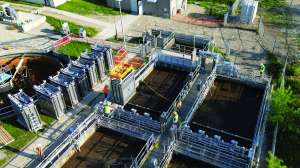
The largest of the district’s activated sludge treatment facilities is the 25 mgd (design) South Plant. It treats sludge from all three plants by anaerobic digestion and dewaters the biosolids for land application. That plant is also home to the district administration offices and laboratory.
The North Plant has an 8 mgd design flow, and the West Plant 5 mgd. All three plants have consistently met their discharge permits. “We have to meet pH, dissolved oxygen, ammonia, seasonal chlorine residual and coliform, but other than that, our permit specs are probably pretty typical for the size of our facilities in our area,” says Brown.
In November 2005, the district Board of Trustees approved an Early Retirement Initiative (ERI), expecting perhaps three or four employees to take advantage. Within 18 months, 13 of the 50 staff members decided to retire, forcing the district to prepare for the loss of 40 percent of its core management and a large share of its institutional memory.
Those who left included the general manager, lead operator, chief chemist/lab manager, superintendent, and industrial surveillance officer, as well as several operators and maintenance staff. “When they offered the ERI, it seemed that everyone who was eligible took it,” Brown recalls. “Most of them had 30 years on the job.”
The district created an action plan to deal with the open positions, and the board conducted a nationwide search for an experienced general manager. The retiring general manager agreed to screen resumes and sit in on interviews.
The ERI allowed a 12-month “retirement window” in which employees could announce their intent to retire months before they actually did so. That made time for aggressive training for their replacements and smoothed the transfer of institutional knowledge.
Promoting from within
Fortunately, the remaining employees, some of whom had been there for 20 years or more, answered the call. Except for new general manager Bob Trueblood, an external hire with 30 years of experience, all other management positions were filled from within.
These included Brown (18 years of experience), superintendent Doug Haacker (25) and assistant superintendent of operations Randy Chapman (30). Other key managers are:
• Scott Hansen, chief operator, South Plant, second shift.
• Steve Moore, assistant superintendent of maintenance.
• Rick Manner, assistant general manager.
• Jack Russell, lab manager.
• Herb Rudiger, chief operator, North Plant.
• Mike Dacka, industrial surveillance officer and pretreatment coordinator.
The district hired eight entry-level employees to fill the positions of those who moved up. “Not all the people who moved into management positions had management experience, and so there was quite a learning curve, a seat-of-the-pants, learn-as-you-go type of situation,” says Brown. “But, what’s amazing is that we were successful in meeting our specs during that time. There was no loss of quality, and if anything, we have seen an increase in quality.”
Chapman agrees: “If we had hired people from outside the district to fill those positions, I think it would have been more difficult with more mishaps. By promoting from within, everyone stepped up to the task and improved the culture within the district. It’s more of a group effort now.”
The managers dealt with their employees’ learning curves by offering a great deal of technical training, but they were on their own when it came to managing people. Chapman believes the district’s managers have succeeded because most of them started out as operators, knew wastewater treatment, and knew their plants and personnel.
Also important: Their personnel knew them. “We came into these positions already having the respect of the people working under us,” says Brown. “It takes time to build that kind of working relationship, and not having to spend the time and energy doing that gave us more opportunity to concentrate on learning the technical aspects of the positions we were promoted to. I believe that contributed to our success, along with the ability to work together when it comes to decision-making.”
A better environment
Since the reorganization in 2006, the district has made significant changes that strengthened the team. Those include:
• More personnel development and training.
• More operators and maintenance personnel involved in project design and development and in daily process control decisions.
• More participation from non-management staff in wastewater and water supply professional organizations.
“These things together contribute to a better working environment and greater job satisfaction, and hopefully that results in a smoother, more efficient operation,” Brown says. The district has seen an increase in certified employees, as many operators and maintenance personnel went back to school.
“Before the ERI, there were six Class 1 wastewater employees,” says Brown. “Four of those retired, and yet we now have nine. We had five Class 4 wastewater employees before ERI. One retired, and now there are eight. If you look at all the Class 1 to 4 operators, we had 16, lost six, and now have a total of 20. That’s a pretty good increase.”
Meeting challenges
Since 2006, the district has gone through 13 plant upgrades. “We’ve had quite a few changes in the last few years, including a switch to sodium hypochlorite disinfection, upgrades to the main pumping station, and new force mains,” says Brown.
Although the larger projects were outsourced, in-house teams handled some of the smaller jobs, such as replacing the pumps at three lift stations and complete skirt replacement on two 110-foot-diameter Lakeside Equipment peripheral feed clarifiers.
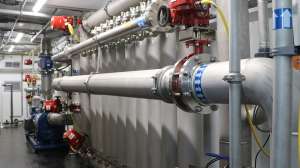
The switch to sodium hypochlorite in 2009 was mainly for safety reasons and to improve control. “We now have a much safer, less labor-intensive disinfection system,” says Brown. “The chemicals are now computer controlled using oxidation-reduction potential (ORP). That gives us better overall control of disinfection and dechlorination.” Other upgrades included:
• A sludge force main between North and South plants.
• Replacement of conveyors for belt presses and a truck loading bay at the South Plant.
• Replacement of three return sludge screw pumps with Lakeside screw pumps at the South Plant.
According to Haacker, the plants’ biggest challenge came in September 2008 during heavy rains related to Hurricane Ike. “We had nine inches of rain in two days, and it was during the middle of our pump upgrade project,” he says. “We had five 10 mgd portable pumps all running to bypass the station. All we had were these pumps, but luckily they came through OK.”
Good workplace
Despite all the changes from the ERI, there has been no turnover in the district except for one new hire who didn’t work out. “It’s a good place to work,” says Brown, “but I think it’s more that people like their jobs and look forward to coming to work every day.”
It’s also the management style. “We make a point of talking to all the operators between shifts and making everyone feel like part of the team,” says Chapman. “Everyone shares information, and I don’t need to ask them how it’s going, because they tell me.”
Haacker stresses that it’s not just the operators who keep the plant running well. The lab, maintenance and engineering employees also deserve a great deal of credit. “Our lab people, including the manager, test everything from suspended solids to phosphorus, and inorganic materials with atomic absorption spectroscopy,” he says. “Keeping this work in-house provides us with better quality control, as well as immediate feedback for process control.”
Brown adds, “The maintenance crew is an integral part of the whole thing. They do everything from rebuilding pumps, repairing force main breaks, repairing sewers, maintaining the vehicles, doing grounds work, and checking and maintaining lift stations. The engineering crew orchestrates all the process improvements.”
Always improving
Despite a track record of compliance and awards, a healthy culture and happy employees, the managers at FRWRD are not complacent. They plan to continue their education and their participation in professional organizations.
“My goals include continuing to educate and train myself and others,” says Brown. “I also plan to stay actively involved with the organizations I am a member of, and continue to do the best job that I can to prepare myself for the next advancement opportunity.”
Brown, Haacker and Chapman are members of the Water Environment Federation, the Central States Water Environment Association, the Illinois Association of Water Pollution Control Operators, the Illinois Section of American Water Works Association, and the Fox Valley Operators Association, of which Brown is vice president.
“It’s extremely helpful to be involved in these organizations because of the training they offer, and because it helps to share ideas with other wastewater operators as well as hear about problems others have had and how they solved them,” Brown says.
Brown hopes others can benefit from knowing about the district’s ERI experience. “The takeaway from this is that a few key people who were once in the background were able to step up and keep the district running without missing a beat,” he says. “With this type of loss happening or about to happen nationwide, maybe some of our experiences and the obstacles we overcame will help other plants out there.”
Chapman says that if other plants were to go through what his district experienced, “new managers should include everyone in the decision-making process. That can improve everyone’s attitude.”
Haacker recommends that experienced as well as less experienced managers keep up with their training: “If you run a small facility and half the employees retire, and you don’t know anything about operations, where does that leave you?”