Keeping loose vegetation out of a waterway is a common purpose for nearly every trashrack. As vegetation accumulates on a screen, it can cause blinding and lead to headloss. In applications with heavy vegetation, large floating mats can be particularly problematic. There are a lot of trashrack designs that have capabilities to address vegetation, but until recently there has never been a solution designed exclusively for such challenges.
Duperon developed the Harvest FlexRake specifically for applications where a constant flow of large vegetation presents a problem. Its unique design allows the scrapers to easily grip all manner of plant life while providing fine levels of screening with minimal blinding and head loss.
Evolution of an idea
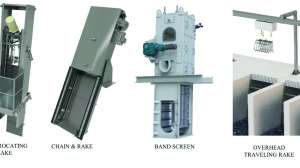
One of the biggest challenges in applications with heavy vegetation has been the bar opening width. Due to how quickly vegetation can cause blinding, most trashracks use larger bar openings, often between 1 and 3 inches. If finer screening is needed, a common solution has been to use multiple screens. The first is typically a coarse screen with mechanical cleaning for removing large debris, such as tree stumps and large branches. This is often followed by a finer bar screen, which might have an opening as small as 1 inch, and which most likely is also mechanically cleaned. In order to get to openings as small as 1/4 inch, a traveling water screen is often employed. These fine bar screens are highly effective at removing small debris but cannot handle large debris.
Some years ago, Duperon was asked by a client to design a custom solution that would provide fine screening with just one trashrack. The customer harvests algae for water treatment. The biological algae system removed nitrogen and phosphate from the water before it flows to the next stage of the water treatment process.
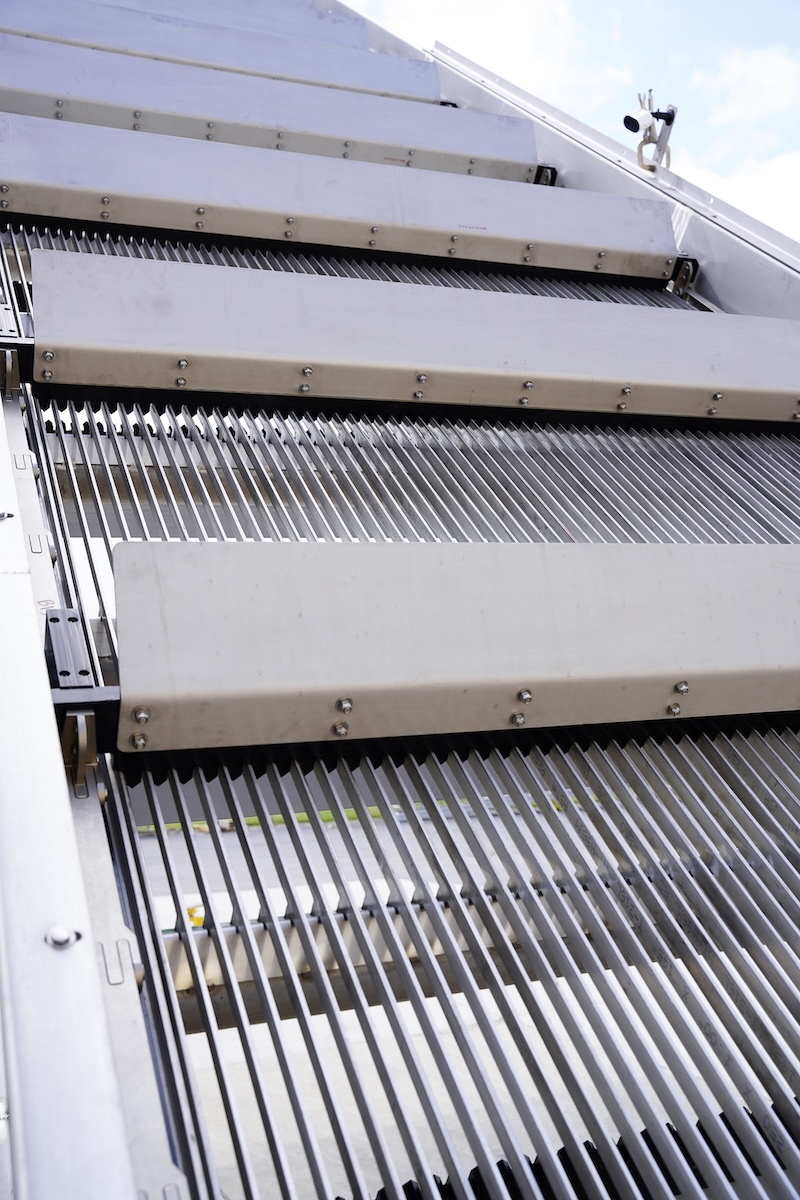
However, the algae were very long — up to several feet in length. The long strands would often blind the screen and get entangled in the discharge mechanism. This caused problems downstream. Duperon’s solution was to develop a screening system with unique scraper and tooth geometry. The Harvest FlexRake is a front-clean, rear-return system that uses specially designed fully penetrating scraper teeth into the bar screen field. This maximizes the flow and ensures that nearly any kind of algae and other heavy vegetation can be removed. In addition, the scraper has a concave scoop shape that can catch smaller debris. The design allows long, stringy debris to simply roll off and “self-discharge” without any additional mechanical intervention.
Wide-ranging applications and benefits
After the success of this custom design, Duperon quickly realized that a wealth of applications existed that could benefit from the specialized features. The Harvest FlexRake can be applied in open channels, at hydroelectric stations, and in stormwater solutions, fish hatcheries, and more.
The system boasts a variety of benefits that customers can take advantage of.
Wildlife safe. At under 2 rpm, the Harvest FlexRake has a low operating speed. This intentional decision makes the system wildlife friendly. Should animals come in contact with the scrapers or mechanical components, the low momentum, combined with a specially designed scraper-to-bar engagement point, reduces the risk of becoming trapped or injured. This makes it safer to use in waterways that manatees, turtles or other endangered species may frequent.
Low carbon footprint. In addition to being wildlife friendly, the system has other environmental benefits. Primary among them is low energy consumption, thanks to its low-horsepower motor (between 1 and 3 hp). Not only does this reduce both carbon footprint and energy costs, it also enables the system to be fully powered by a solar panel system under the right circumstances.
Adaptable cleaning volume. Given the low speed of the system, the Harvest FlexRake was designed to allow extra scrapers to be added, should the cleaning volume need to be increased. Scrapers can be set as close as 21 inches apart. So long as the scrapers are spaced evenly throughout the chain, the additional weight does not require more power to run; the scrapers moving down the backside of the machine provide a natural counterbalance to those being pulled up the front.
Stable in side currents. The Harvest FlexRake was designed without tracks. Unlike a chain, the link systems can only flex in one direction, which allows them to stay easily contained within the sidewalls of the framework. As such, side currents won’t cause the scrapers to shift out of place and disrupt or damage the cleaning mechanism.
Backflow- and turbulence-resistant. The design holds the scrapers to the screen with minimal tolerance for shifting or movement, which prevents any possible backflow or turbulence from moving them out of position. This makes it ideal in waterways that experience natural waves or other flow agitation.
No solid bypass. Harvest FlexRake’s return chamber acts like a revolving door, preventing most solids from passing underneath the screen.
Low maintenance. Water-lubricated links reduce the need for maintenance and associated downtime and costs.
Keeping a waterway clear of debris is critical to many operations. When large volumes of vegetation are present and fine screening is required, it is important to utilize a solution that is designed for this kind of unique challenge.