Creativity played a big part in the plan to upgrade the landscape and beautify the surroundings of the wastewater treatment plant in Perry, Ga.
While many facilities depend on local landscape architects orother professionals to lead the way, personnel at this 3 mgd activated sludge plant looked to one of their own to provide the vision. That creativity revealed itself in the creation of an entire nature walk area that serves to educate and entertain visitors to the plant.
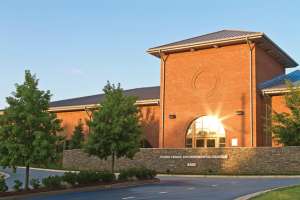
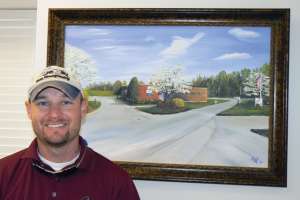
“The whole idea started slowly with a brainstorming session,” says plant operator Brandon Lewis. “Our assistant plant manager, Chad McMurrian, is very artistic and paints as a hobby. He got things rolling by first painting a canvas that depicts our main operations building.”
Plant manager Sharon Kelly was so impressed that she has the canvas hanging in her office for all to see. “Chad’s love for the environment came early in life, with his passion in bass fishing as a young boy, and now his profession in water and wastewater treatment,” says Kelly. “It’s evident from his creative artwork and his devotion to the industry that he is enthusiastic about educating the public and protecting the environment for our future generations.”
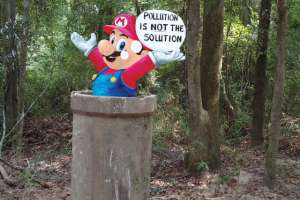
McMurrian has since painted characters Mario and Luigi of Nintendo fame on 2- by 3-foot wooden cutouts. Each one has a narrative bubble, one of which says, “Pollution is not the solution,” while the other says, “Save our rivers and streams.” Mario and Luigi are post-mounted along the trail in front of strategically located concrete culverts to appear as though they are exiting a tunnel, much as they appear in the video game.
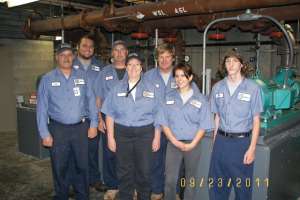
From that time on, construction of the nature walk steadily progressed, but without any tight schedule. “Whenever anyone in the plant had time, and particularly our line maintenance supervisor, Ryan Bode, or lead supervisor Randy Engram, plant staff pitched in to work on the trail,” says Lewis.
The walking surface has been kept as natural as possible with grass, compacted leaves and soil. Gravel was used in low-lying areas and at the approach to the two bridges that cross some wetlands. Lewis says that the bridges are sturdy and wide enough to handle an ATV.
The trail itself varies from 15 feet to 25 feet wide. It meanders through some 200 yards of magnolias, oaks, birches, maples and other natural growth to the plant’s receiving stream, Big Indian Creek. Along the way, and hanging from one of several canopies formed by the trees, is an owl McMurrian painted and whose narrative bubble says, “Give a hoot – Don’t pollute!”
Near the trail’s end is a deer feeder with a nearby motion-activated wildlife camera. Lewis says lots of other animals appear along the path and are sometimes caught on camera. A tire swing hangs from another tree farther down the trail near some duck houses the staff built and installed. And a crawfish trap is submerged in Big Indian Creek at the end of the trail.
Creativity and innovation also helped fund the project, because no direct dollars were spent to acquire products or labor. The materials were all unused resources, like scrapped pieces of wood from various projects and rocks and gravel from an abandoned trickling filter. The concrete culverts were recovered from a nearby lowland area where they had been dumped years ago. Otherwise, materials like the liner for the fish pond were donated.
And, of course, the artwork was donated by McMurrian. “We are extremely proud of what the entire team has put together at the Perry Wastewater Treatment Plant and how Chad has been able to capture that in numerous pieces of artwork for all to enjoy,” says Kelly.
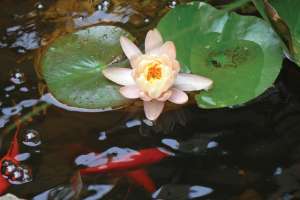
The fish pond near the end of the trail is a particular source of pride to the staff, because its population of goldfish and colorful koi are nurtured by the flow of effluent on its way to Big Indian Creek.
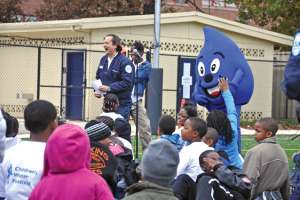
Lewis says the purpose of the nature trail is to entertain visitors to the plant, educate the public about the wastewater process, and build awareness of the environment. The plant staff conducts tours often for the general public and for students at local schools.
Says Lewis, “We’re proud of our job and we want the citizens to know what we are doing for them and the environment.”