A troubleshooter receives a phone call from a frantic operator who has described a very unusual condition at his wastewater treatment plant.
Operator: Can you come out to our treatment plant and give me some advice about an unusual-looking effluent?
Lab Detective: Sure. What seems to be the problem? Can you describe the unusual effluent?
Operator: Well, the effluent is all white. Very cloudy-looking, mostly white. Must be some kind of solids. My effluent filters are clogging up with this stuff. It looks like cotton going over the weirs.
Lab Detective: How long has this been happening?
Operator: It started a few days ago. It’s got our plant out of compliance with the reuse regulations and we can’t discharge to the reclaimed water system that the local golf course uses for irrigation. I’ve never seen anything like it. How soon can you be here?
That conversation kept playing through the lab detective’s mind. A white, cloudy effluent that looks like cotton. Very strange indeed. The detective arrives at the plant about two hours later that same day. The plant is a 0.35 mgd conventional activated sludge facility. It is made up of two plants, one built just recently as part of an expansion.
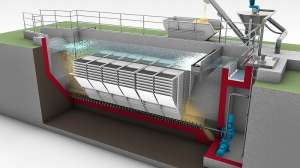
The facility upgrade added effluent filtration, filter dosing and backwash water tanks, and an influent flow equalization tank, along with a 100,000-gallon aeration tank and secondary clarifier. The original treatment plant is a precast concrete structure with rectangular settling tanks.
The facility uses the flow equalization tank to split flow between the two plants. The effluent from both facilities enters the effluent filter dosing tank for polishing and undergoes high-level disinfection with chlorine before going to reclaimed water storage and ultimately application on the golf course.
When the effluent does not meet effluent reuse regulations, it is directed into a reject storage pond and recycled back through the plant. That is the current mode of operation, since the effluent is very high in solids.
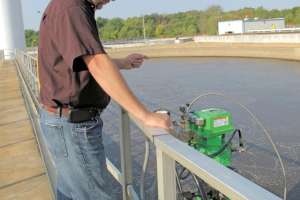
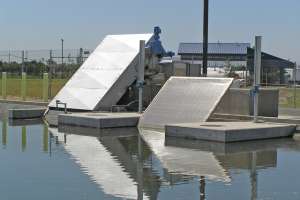
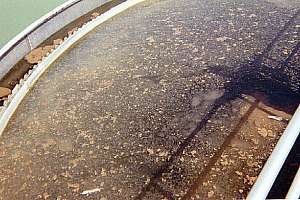
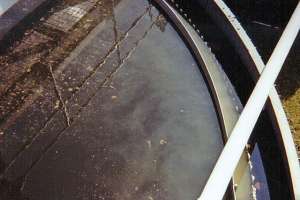
The operator meets the lab detective and gives a short tour of the plant. The detective observes that the secondary clarifier of the new plant looks very bad. Solids are popping up throughout the clarifier, rising and dispersing across the tank surface (Figure 1). The liquid around the rising solids is very turbid and seems to have a white color. The water flowing over the weir is off-white and milk-like in density (Figure 2).
The plant operator describes the flow pattern through the plant and notes that the old treatment plant does not seem to have the problem the new plant is having with the white, cloudy secondary effluent.
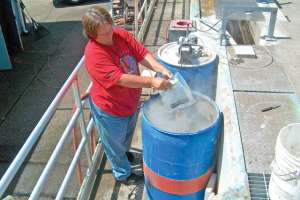
The detective collects a sample of the milky effluent for closer study and notices that the solids are large enough to be seen with the naked eye. When the sample beaker is viewed from the side, the solids appear to be moving — actually swimming in the liquid.
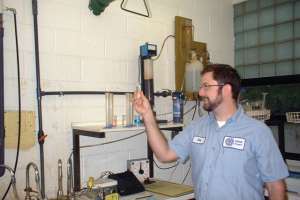
The treatment plant has a very old microscope in the makeshift lab/office, so the detective sets up several wet-mount slides. The microscope offers a limited view of the solids, but the evidence is clear enough. The organisms appear to be long and wormlike and fill the field of view under low-power magnification. They look and act like nematodes — long and round, actively swimming in the liquid on the slide.
The old microscope does not allow a closer look, so the detective takes another walk to collect more samples for study and see how these critters are affecting treatment. Once the influent is split between the two treatment trains, the influent mixes with return sludge from each plant’s secondary clarifier as the flow enters the aeration tanks.
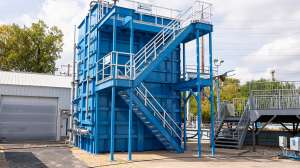
The new treatment plant aeration tank is a round, metal structure built on site from square panels with metal reinforcing bands circling the perimeter. A small blower provides diffused air for the aeration tank, but the airflow is so low that little mixing is apparent, and DO readings are consistently below 0.5 mg/l. The new secondary clarifier is made from the same material and has a motor-driven scraper mechanism mounted at the end of the clarifier bridge structure.
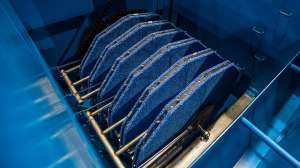
The effluent from the two treatment trains blends in a filter dosing tank before filtration. The water directed to the filter is very cloudy, and the effluent from the filter looks as turbid as the water applied. The filtered water flows to a chlorine contact tank where a minimum of 1.0 mg/l total chlorine residual is normally met. The solids flowing into the contact tank exhibit such high chlorine demand that no residual is realized, even with the chlorine equipment feeding at maximum output.
The filters are trying their best to capture the effluent solids, but the headloss is so great that the filters are continually backwashing. The backwash water flows into a plant drain lift station, then back into the influent flow equalization tank. The influent flow is split between the two plants, and the whole process repeats itself. The old treatment train does not seem to have the problematic cloudy clarifier and has no white-colored effluent.
The lab detective recommends increasing the DO in the new plant’s aeration system and leaves with several samples of the cloudy effluent. After giving one of the samples to a local university’s biology professor, he returns to his lab where he can observe the organisms under higher magnification.
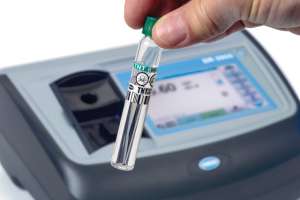
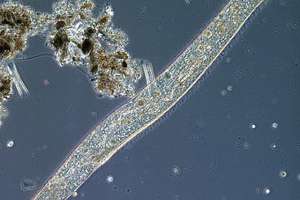
The offending organisms are not nematodes at all, but a large species of free-swimming ciliate called Heterotrich spirostomum. This omnivorous creature can grow to lengths greater than 1 mm, can contain high amounts of intracellular calcium and seems to prefer low-DO environments (Figure 3). The sample given to the university professor was not opened or observed for more than one week. When they finally looked at it, the biology professors and students were astounded to see such a large amount of H. spirostomum in one sample and thriving in zero-DO conditions.
The detective relayed the information to the plant operator about a week later during a return visit to the plant. The operator thanked the detective for the advice given during the first visit, since it seems to have worked. The effluent leaving the new treatment train secondary clarifier is now clear.
An additional blower with higher airflow was placed online, and DO levels climbed to over 1.5 mg/l. Nitrification seems to be occurring. The plant operator had also applied 65 percent granular chlorine (HTH) to the filter dosing tank and the filters themselves to kill the free-swimming ciliates living in the filter media.
No reason for the H. spirostomum infestation was ever found, and they have not been seen at that treatment plant since. The lab detective has observed H. spirostomum in small numbers in other treatment plant MLSS samples, but never to the extent that caused a cloudy, milky clarifier effluent.
Ron Trygar is senior training specialist in water and wastewater at the University of Florida TREEO Center and a certified environmental trainer (CET). He can be reached at rtrygar@treeo.ufl.edu.