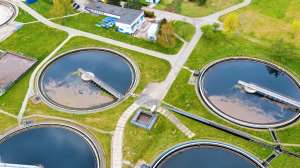
The 400,000 gpd wastewater lagoon in Parsons, W.Va., had dissolved oxygen, BOD5, TSS, ammonia, and significant algae problems, resulting in more than 40 state Department of Environmental Protection permit violations in six months.
The surface aeration system — four vertical splasher-type and four horizontal aspirator-type surface aerators installed across six of the seven treatment cells — was the wrong equipment for a lagoon 10 feet deep. Air never reached the bottom, and mixing air and water at the surface created heavy stress on the motors. They failed frequently.
The city solved its problem quickly and cost-effectively by installing a new portable aeration system from Triplepoint Water Technologies.
Tough to maintain
The old aeration system was a challenge to maintain and service. “Disassembling the compressor from the mixer was difficult and time consuming, and I needed a boat to reach them,” says chief wastewater operator Frank White. “I would send the equipment out for repair, but it was very expensive.”
The lagoon’s annual maintenance budget was $5,000, and the work was risky: once the boat capsized near the edge, and White and an employee fell into the lagoon (they were not injured). Unable to take the facility offline to drain the lagoon and install a diffused aeration system, city officials believed they had no option except to continue using surface aeration.
But White was not convinced. He found Stu Harper of S.R. Harper Inc., a manufacturer’s representative in Canonsburg, Pa., who put him in touch with Braden O’Leary from Triplepoint. “Parsons needed an inexpensive rehabilitation, and our MARS 3000 aeration technology was a good fit,” says O’Leary. “We simply hook up the units, lower them into the water, and turn on the blowers.”
After a product presentation, the city council voted to purchase an 18-unit aeration system, but funding for it would take a year. The DEP responded to the delay by issuing an ultimatum. “They told us to get some air into the lagoon or face serious penalties,” says White.
O’Leary offered to install an emergency system to tide the city over until the full system was installed. “We mustered a blower and four aerators incorporating fine- and coarse-bubble diffusion — less than one-fourth the recommended aeration for the lagoon,” he says. Despite this, the equipment brought BOD5 and TSS levels into compliance within one month.
High efficiency
When working properly, the Parsons Wastewater Treatment Plant used $24,000 of electricity annually. The high-speed surface aerators (total 50 hp) averaged 2 pounds of oxygen per horsepower hour (lb/hp-hr). The MARS 3000 unit, with Double Bubble technology, can produce 7 to 8 lb/hp-hr of oxygen, and the full system delivers 20 brake horsepower (the power actually used).
Each aerator diffuses up to 30 cfm and has a central coarse-bubble tube surrounded by eight 9-inch membrane fine-bubble diffusers positioned 16 inches above the sediment. The 29-inch-high units have four weighted legs and a bottom clearance of 11 inches. An onshore blower pumps air through flexible weighted tubing through the unit’s central static tube, creating a venturi that circulates the water and liquefied sludge. Anti-clogging technology on all the diffusers prevents backflow.
While suspended in the water column, the sludge mixes with fine bubbles from the self-cleaning membrane diffusers. The high surface-area-to-volume ratio of degraded debris and fine bubbles maximizes contact time and efficiently reduces BOD5 levels.
“We didn’t have to do any work on the lagoon to prepare it for the installation,” says White. “As soon as we turned on the blower, the mixing process brought foul-smelling black sludge to the surface.” Within 24 hours, oxygen had broken down the sulfur and methane and dissipated the odor.
Complete rehabilitation
In April 2010, the four remaining surface aerators were removed and the full 18-unit MARS aeration system was installed. One aerator went into each of the four concrete pretreatment basins, 10 into the lagoon’s primary treatment cell, and four into the secondary treatment cell.
“We didn’t aerate the tertiary treatment cell because it’s used as a settling basin before disinfecting and discharging the water to the Shavers Fork River,” says White.
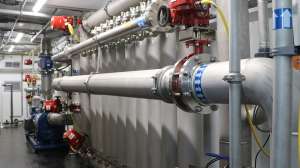
Flexible weighted tubing attaches each aerator to an onshore Type 304 stainless steel header with custom-welded manifolds. The airflow, regulated by ball valves on the manifolds, comes from two onshore Kaeser 15 hp CB 130C tri-lobe blowers, each delivering up to 270 cfm.
“The blowers run quietly at 60 to 70 decibels,” says White. “Depending on how we set the variable-frequency drive on the one unit, the city will spend $6,000 to $9,000 on electricity annually, instead of $24,000.”
The aerators have no moving parts — the blower requires only oil changes and new belts on a regular schedule. Consequently, the city reduced the lagoon’s maintenance budget from $5,000 annually to $500. “The system will pay for itself within four years and save the city many thousands of dollars over its lifetime,” says White.