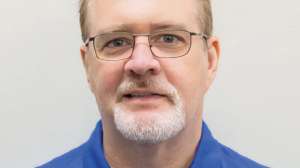
Gus Strehlo might not have come to Wausau, Wis., or entered the wastewater profession at all, if not for his need to get a job and support a family after graduating from college.
“I had a degree in biology from the University of Wisconsin-Eau Claire, but this (wastewater) was not at all what I planned,” he remembers. “Still, jobs were tough to find in 1979, so I took a position at the treatment plant in Hudson, Wis. Before that, I thought it was a fish hatchery.”
He knows the difference now. At the Wausau Wastewater Treatment Plant, in north central Wisconsin, about 4 mgd flows from 39,000 residents and an industrial-commercial base that includes technology firms and medical facilities that support the community’s traditional lumber, dairy, and pulp and paper businesses.
Many achievements
Like so many in the wastewater treatment profession, Strehlo is a study in modesty. After 30 years of service at the Wausau Wastewater Treatment Plant, he strokes his beard and seems to have a hard time coming up with any big accomplishments during his tenure.
“We’ve been in compliance 99-plus percent of the time,” say Strehlo, the Wisconsin Wastewater Operators Association 2008 Operator of the Year for the North Central section of the state. “And we’ve seen a lot of improvements in technology and efficiency.” Probe deeper, however, and the achievements start lining up like a grocery list:
• Staffing. When Strehlo arrived at the Wausau facility in 1980, he was one of 17 operators who manned the operation 24 hours a day, seven days a week. Today, the plant runs even better with five operator-maintenance specialists on site five days a week from 7 a.m. to 3:30 p.m.
• Automation. Increased process automation made personnel reductions possible. Strehlo has overseen upgrades from an old Autocon controller to a modern Altronex Control System (a division of L.W. Allen Inc.), and SCADA program supported by IntelliSys Information Systems data management software. Automated dialing alerts operators if an alarm occurs during nights or weekends.
• Pretreatment. Time was when the plant battled pH swings from acid dumps by local industries or the discharge of whey by cheesemakers. Strehlo and assistant superintendent Jim Riege have developed a well-structured, well-enforced pre-treatment program that prevents what he remembers as “helter-skelter” periods.
• Process improvements. Little by little, without much fanfare, Strehlo’s team has improved the treatment train, stabilizing the system, keeping it performing well, and making it easier to operate. Upgrades include new mechanically cleaned bar screens, improved grit removal, and better dissolved oxygen control and energy efficiency in aeration, plus UV disinfection and sand filtration to meet summer BOD requirements.
• Biosolids. The plant used to be one of the largest contributors to the local landfill, but now all biosolids are dewatered, stored on site in a large shed, and spread on as many as 30 farms in spring, summer, and fall. Under Strehlo’s leadership, the utility owns and operates its own spreading equipment, assuring quality control and good community relations. “We can’t keep up with the demand,” he says.
• Energy recovery. Although long in the tooth, the digester and gas-handling systems work, and Strehlo makes sure the maximum energy is recovered from digester gas, which powers the aeration blowers and heats the plant.
• Collections. Strehlo is responsible for 250 miles of sanitary sewers and 25 lift stations. He dealt with infiltration and inflow by methodically improving the lines. A larger interceptor solved high-flow issues in a section of town prone to overflows. The utility has invested in new digital TV equipment. In addition, whenever a street is resurfaced, the wastewater utility replaces or lines sewers as needed.
• Safety. Strehlo has driven a comprehensive safety program that includes procedures for every conceivable event and empowers employees to take steps to ensure they act safely in all procedures.
And there’s more to come. Working with the city finance department, Strehlo has applied for economic stimulus money for a project that will reconfigure the aeration system for more efficiency, and improve the digester gas collection system so the gas stream is less corrosive on the engines. A new UV system, with fewer bulbs and less maintenance, also is in the works.
“Gus simply gets things done,” says Riege, a Strehlo colleague for more than three decades. Strehlo responds, “If it needs doing, go ahead and do it. Why wait? Why be last to make a necessary change?”
Consistent compliance
The Wausau plant is a conventional activated sludge facility. Headworks are followed by alum addition for phosphorus removal, then a fine-bubble aeration system. Clarified effluent flows directly to the Wisconsin River in winter, and through the UV disinfection and pulsed-bed fine sand filters as required by waste load allocations in the summer. The plant easily meets its permit for BOD, TSS and phosphorus.
Biosolids are thickened and anaerobically digested before dewatering, storage, and land application. Cake averages 12 to 15 percent solids.
At 45 degrees north latitude, Wausau has cold weather and storms, but neither bothers the Strehlo team. The sewer system is tight, and as long as the water keeps moving, the subzero temperatures are not an issue. Instead, his biggest management challenges have related to personnel. “Sometimes I think we almost need to act as parents or big brothers — dealing with interdepartmental issues and keeping everyone moving in the same direction,” he says.
His boss, public works director Joe Gehin, credits Strehlo’s unique ability to delegate, which not only builds consensus but also makes employees realize their responsibilities as team members. “He doesn’t dictate, but empowers his people to be part of the solution,” says Gehin. “He won’t let them get the monkey off their back. He’s a quiet leader.”
Riege agrees: “We’ve had a great working relationship. He has given me enough rope to do my job, and it’s given me confidence.”
Life after Gus
Strehlo plans to retire soon, and already Wausau is implementing measures to replace him, hard as that may be. “He has a tremendous amount of knowledge,” says Gehin. “And he’s made a significant contribution to the city. We all have a better understanding of what goes on at the treatment plant. He’s saved taxpayers a lot of money and made the operation much easier.”
Strehlo is already working with his replacement. Once the transition is made, Strehlo, who has three children and a pair of grandchildren, looksforward to more time outdoors in the Wisconsin Northwoods. It’s his favorite pastime. “I like to hunt, fish, and camp out,” he says.
His familiar pickup truck with camper-top will be gone from the plant parking lot — now it will be seen more often in the woods and river valleys of northwest Wisconsin, near his home town of Hersey.