At the 75th Street Wastewater Treatment Plant in Boulder, Colo., five resource recovery specialists (RRS) manage biosolids. Their collective experience runs into decades.
That experience came into play during a three-year plant expansion that included major upgrades to the biosolids process. The team used its experience to work with consultants and contractors on project components ranging from equipment selection to building layout. The new process includes a more efficient dewatering system using centrifuges and an automated loading system for the trucks hauling cake to land application sites.
Paul Heppler, operations supervisor, acknowledges that working on the new design, in addition to routine responsibilities, challenged the team. But he believed the plant staff understood the importance of their participation.
Today, five RRS team members work in four 10-hour shifts, each with a different day off, meaning four of them are on site on any given day. Don Colgate, chief operator, has 11 years under his belt, and Tyeson Miracle and Greg Reichrath, both operators, have between six and seven years each. The RRS industrial mechanic, Tim Renkin, was hired last year. Their dedication and expertise lend themselves not just to smooth operations, but also to awards and recognition.
Heppler, the fifth team member, has been in the field for more than 25 years and has no plans to leave. “I enjoy what I’m doing,” he says. “It’s an exciting field to be in and I don’t intend to retire.”
Experience pays
Improvements to the biosolids system began in 2004 and came about in part because an expansion was necessary to handle flows projected to 2025. More treatment units were required to reduce nitrogen in plant effluent. As the volume of influent increased, and with it solids removal efficiency, the current biosolids process needed an overhaul.
In considering alternatives, the staff could not ignore the age of the equipment. Maintenance frequency for the two original centrifuges, installed in 1987, was increasing and parts were becoming harder to find. A third centrifuge, installed during a
2005 expansion, was operating effectively, but could not handle the anticipated increased loads.
The design of the biosolids system expansion for the 75th Street plant was not led by consultants and contractors. It was led by experts at the facility.
“Through every piece of equipment, I sat down with the consultant,” Heppler says. “We looked at what the equipment did, what I wanted it to do, and what changes were possible. This was unique. We’d receive the 30-percent drawings, then kick them back with changes. Every design meeting included all the staff.”
That level of involvement was no surprise to the consultants. During the selection process, Heppler let them know the extent of input plant personnel would have in the design. Their hands-on approach wasn’t just with equipment — it also extended to the building.
“I sat there with an Excel spreadsheet and laid out the break room, the lab, what equipment we’d have in there, even the laundry room,” Heppler says. “All the way to the SCADA system — even what the screen looked like.”
Equipment of choice
The changes to the biosolids management system were aimed at handling the increase in production and reducing the final water content, thus reducing transportation costs.
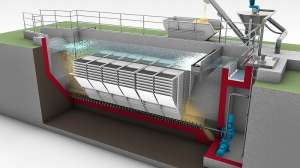
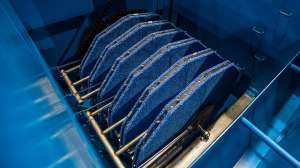
Solids from the primary clarifiers, and wasted mixed liquor from the aeration basins and the secondary clarifier, are combined and concentrated using dissolved air flotation (DAF). Both streams are pumped to the primary and secondary anaerobic digesters, then thickened using a Parkson StrainPress sludge screen.
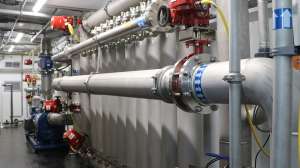
After the screen, two 0.5-million-gallon tanks provide about two weeks of pre-dewatered storage. Dewatering is done by three Alfa Laval centrifuges, one sized to handle 150 gpm and the others at 250 gpm. The centrifuges handle 4.5 dry tons per day and produce 20-percent solids cake. Pumps send the material to a three-story tower that holds 100,000 pounds — the equivalent of 6.5 days of storage.
“The trucks back under a driver station at the cake tower,” says Heppler. “Drivers log in their names, the truck number, and the pounds they want, then the automated loading system fills the truck and kicks out a ticket. The drivers sign it and leave, and the information is sent to the control room. The process takes about 15 minutes, and drivers can watch as their trucks are loaded.”
Initially, most drivers were unfamiliar and uncomfortable with automated loading. Heppler worked with the hauling contractor and drivers through training sessions to overcome any apprehension. Typically, only one driver transports the biosolids, but all are trained to step in if needed.
The loading system includes safety features, monitored from the comfort of a new control room three stories up. “If something happens during loading, we can stop it,” Heppler says. “Our control room is clean and quiet. It looks like an office.”
Class B biosolids are transported to various agricultural sites on Tuesdays and Fridays. Three to four loads are hauled per day.
Parallel tracks
Improvements to the treatment plant and biosolids management facility ran concurrently, but they were completed as separate projects with different schedules. Work on the liquid stream began 12 months before the solids stream.
“We had different consultants involved with the different streams,” says Heppler. “There were two construction trailers and different construction meetings. I was involved with the liquid stream, but not as much as the solid stream.”
The contractor for both projects was Garney Construction who, in Heppler’s view, saw the solids handling project as more of a $10 million change order to the original wastewater treatment plant renovations than as a completely separate project. “Garney did an excellent job,” Heppler says. “The projects had different project managers. There was a lot of coordination.”
With no downtime scheduled for bringing new equipment online, the switch from old to new had to be seamless. It was accomplished in a series of steps that spanned three to four months without interrupting service. Heppler owes the smooth transition to everyone involved.
“We put in a lot of hours,” says Heppler. “There was a lot of careful planning and no problems.” In total, renovations to the plant and biosolids management system cost $40 million over three years. The renovation, completed in October 2008, was celebrated with presentations and public tours.
Earned recognition
Those involved with the renovation and operation of the 75th Street facility know how impressive it is, but the plant and people also have earned awards for it. In 2008, the plant was honored by the Rocky Mountain Water Environment Association (RMWEA) for outstanding results in biosolids management.
The plant received the Water Environment Federation’s William Hatfield Award in 2006 for outstanding performance and professionalism in operating a treatment plant. Heppler was acknowledged for his work with biosolids. Awards included a 1995 citation by the governor of Colorado for outstanding efforts in smart growth and development, and recognition in 1997 by Boulder County for outstanding volunteer service for his work with the county extension office.
Heppler has been involved with the RMWEA Biosolids Committee since 1989. He was elected chair of the committee in 2003 and, in 2005, the association honored him for his work.
Heppler has taken his expertise to the classroom as chair of the Colorado wastewater operator test review committee. He also sits on the committee responsible for developing the national biosolids land applier certification program.
However, Heppler is quick to point out that he’s not the star of the show. “This isn’t about Paul Heppler,” he says. “There’s a lot of pride and ownership here.” That pride and ownership started decades ago and continues today