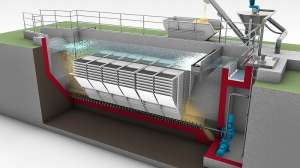
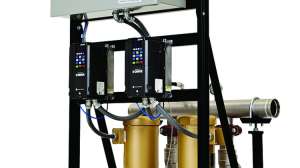
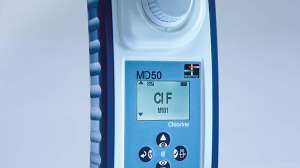
In municipal and industrial wastewater treatment plants, sludge clarifiers are often used to separate solids from the effluent system by introducing air and flocculants.
The process causes the sludge to rise to the top of the pond or tank, then spill over a weir into a separate collection area. The amounts of air and flocculants are controlled by measuring the liquid level interface between the sludge and water (Figure 1).
Many types of flocculant chemicals treat municipal and industrial wastewaters. They cause suspended solids in wastewater to float to the top or sink to the bottom for removal. Flocculants also are used in stormwater treatment and in drinking water filtration. In industrial applications, they remove oil, heavy metals, ink, and other contaminants from water.
Need for precision
Precise measurement and control of the mixture of wastewater effluent, flocculants and sludge is essential to efficient wastewater treatment. The level/interface instruments that support the process liquid measurements must distinguish between liquids with varying properties to detect the levels where the liquids interface in the pond or tank. With this knowledge, operators control the amount of air, effluent and flocculants to produce the optimum mix for treatment.
Such wastewater treatment systems operate under conditions that vary with system and plant demand. In addition, seasonal temperatures and humidity rise and fall affect bacterial growth and the quantity of air and effluent required for proper operation. Furthermore, the instruments need a rugged design to survive in dirty, harsh conditions where methane and hydrogen sulfide are often present.
Numerous liquid-sensing technologies have been tried as level/interface sensors in wastewater treatment applications. When selecting a sensing technology for liquid level/interface, it is important to consider the process media, desired performance criteria, and the plant environment.
Measuring with temperature
Multiple technologies detect level/interface in liquids and foams. Each has advantages and disadvantages. Optical detectors, for example, have limitations because they tend to foul.
Thermal dispersion sensing works well in liquid level/interface switching applications. This technology places two thermowell-protected platinum RTD temperature sensors in the process stream. One RTD is heated; the other senses the actual temperature.
The temperature difference between the two sensors is measured, and is directly proportional to the flow rate of the liquid (Figure 2). When a liquid-to-liquid interface change occurs, for example in oil to water, large changes in natural convection and thermal properties will cause substantial changes in the temperature. The liquid level/interface switch point is preset at the factory or field-adjusted by the plant operator.
Similarly, when clear liquid is present, the natural convection heat transfer is higher than when settled slurry, such as a flocculant, is present. Again, a substantial and easily detectable temperature change occurs because natural convection indicates the presence of clear liquid or a slurry.
An effective option
For flocculant/sludge basin control in wastewater treatment, flow/level/temperature switches are effective solutions. Such devices (Figure 3) monitor, control, and alarm for flow rates or levels of critical fluids such as flocculants/sludge, wastewater, foams, emulsion layers, and other liquids and slurries.
One highly effective switch is a dual-function, insertion-style instrument that measures and monitors flow/temperature or level/temperature simultaneously, with high accuracy and reliability. Dual 6A relay outputs are assignable to flow, level or temperature.
The switch relies on the specific heat transfer properties of the media to identify the interface of different liquids. With thermal dispersion sensing capability, it monitors the interface of liquids with similar densities, such as wastewater and flocculant/sludge, for reliable control in basins, separation tanks, and other vessels.
These devices identify the interface between media including flocculant/sludge, wastewater, foam, emulsion layers, other liquids and slurries. A dual switch-point option allows one instrument to control two different interfaces. Two or more switches control product discharge and intake at specified points.
Wide working range
The switch operates over a wide set point range in water — from 0.01 to 0.5 feet per second. Level/interface accuracy is ±0.25 inch, and measurement repeatability is ±0.125 inch.
With its advanced thermal dispersion mass flow sensor, the device has built-in temperature compensation, ensuring repeatable and reliable operation even in dirty environments. The automatic compensation adjusts the instrument for changes in operating environment temperatures to ensure that the trip points remain accurate and do not cause false alarms or alarm failures. This improves end-product quality, maximizes safety, and allows alarms to have a narrower set point range.
Many standard and custom process connections are available for the switches. The electronic control circuit can be integrally mounted with the sensing element or placed in remote locations. Switches can be housed in coated aluminum alloy enclosures suitable for ATEX locations and rated for NEMA Type 4X (IP66) environments. Stainless steel or fiberglass enclosures are other options.
Choosing carefully
In selecting a liquid level/interface switch for interface detection and control in wastewater treatment, it is important to look for a sensing technology that provides accurate sensing and control in harsh, dirty, wet environments.
The environment also is subject to variations in plant demand, throughput, and seasonal temperature swings. In addition, methane and H2S will likely be present, requiring hardened instruments.
Ideally, the technology should require only minimal maintenance. Wastewater treatment instruments are often in hard-to-reach locations, where a failure means significant downtime and costly repairs.
About the author
Steven Craig is a senior member of the technical staff at Fluid Components International LLC (FCI), a manufacturer of flow, level and temperature-sensing instruments based in San Marcos, Calif. He can be reached at 760/736-6152 or by e-mail to steve_craig@ fluidcomponents.com.