When the Town of Crewe, Va., upgraded its wastewater treatment facility in 1997, it was designed for traditional treatment, removing BOD and TSS. Then along came nutrient loading requirements designed to protect the Chesapeake Bay, to which the plant’s receiving stream ultimately flows.
Plant manager John Hricko (pronounced RICK-o) and his team would have to operate under a General Permit for Total Nitrogen and Total Phosphorus Discharges and Nutrient Trading in the Chesapeake Bay Watershed. That meant making changes in the secondary treatment process.
Local engineers devised a plant upgrade that would have cost at least $250,000 — a big burden for a community of just 2,400 people. Then Hricko and chief operator Jason “Peanut” Lewis came up with adjustments to the oxidation ditch process that would enable the plant to meet the nutrient requirements for less than $10,000.
Hricko and Lewis installed the improvements themselves, reducing nitrogen discharges by more than 50 percent on average and bringing the plant into compliance with the new permit, which took effect in January 2007. Even better, the plant is in position to sell nutrient reduction credits in a market that will become active in 2011.
These achievements helped the facility earn a 2008 Wastewater Treatment Plant of the Year award from the Virginia Rural Water Association. In addition, Hricko and Lewis were honored as Wastewater Operators of the Year.
Clamping down
The Town of Crewe lies about 60 miles southwest of Richmond, the capital of Virginia. The wastewater collection system includes 11 miles of sewer mains and eight pumping stations. The treatment plant process includes screening and grit removal, an oxidation ditch (Siemens’ Orbal process), two secondary clarifiers, phosphorus removal by addition of liquid alum, disinfection (chlorine gas), and post-aeration (cascade steps).
A Roediger belt filter press served by two 100-gpm Moyno progressive-cavity pumps dewaters digested biosolids to 16 to 18 percent solids, and the material (7 dry tons per week) is sent to a landfill.
Nitrogen and phosphorus limits on Virginia wastewater treatment plants are part of an effort under the Chesapeake Bay Program to reduce nutrient enrichment, a major cause of water-quality impairment in the bay and its tributaries.
Under its new permit, the Crewe treatment facility has an annual waste load allocation of 9,137 pounds of total nitrogen and 761 pounds for total phosphorus. At design flow (0.5 mgd), this means a total nitrogen concentration of 6.0 mg/l and a total phosphorus concentration of 0.5 mg/l in the effluent.
When Hricko arrived as plant manager four years ago, the town was just exploring how to meet the nutrient requirements. The plant had been upgraded as an entirely aerobic facility, with aerobic sludge digestion and even an aerated grit channel at the head end. “At the time, the designers weren’t looking at nutrients,” says Hricko. “The purpose of grit channel aeration was to freshen the influent. We had the air in all three oxidation ditches as high as possible, because total nitrogen had never been a concern.”
Taking a look around
The Town of Crewe’s key challenge was nitrogen removal. “When Jason and I started looking at it, the town leaders were thinking we would have to go through an engineer and have a major overhaul,” says Hricko.
The plant uses a three-channel oxidation ditch with two sets of discs, one on each side, each one crossing all three channels and using a single shaft and one motor. They had proposed using discs on separate shafts for the three ditches and installing variable-frequency drives to provide finer control of aeration.
“The town was looking at whether it might be more cost-effective to buy nutrient reduction credits than to pay for the upgrade,” says Hricko. “We visited some other facilities in the area to see what they were doing. Our aim was not to install the same equipment they were using but to mimic the basic treatment technology within our plant.
“We came up with the idea that if we could get a reduction in dissolved oxygen in the first ditch, yet maintain a high enough DO in the last ditch where we needed aerobic conditions, we might have some success.”
A typical oxidation ditch process keeps DO levels at less than 0.5 mg/l in the outer channel and from 1 to 3 mg/l in the inner channels. However, Hricko and staff found that when they lowered DO levels to improve denitrification, the level of total Kjeldahl nitrogen increased. So they looked for an economical way to control DO in each channel to improve denitrification while also reducing TKN.
One common way to accomplish that is to remove some aeration discs in the first ditch to reduce aeration and lower the DO level. But Hricko and Lewis found that that reduced the mixing velocity and led to settling of solids on the basin bottom. Operating the aeration motors in on/off cycles brought only marginal results in reducing DO.
The next approach was to toggle the disk motors between their low and high speeds at specified intervals. “We started out in a manual switching mode, going from high to low for a period of hours, and then back to high,” Hricko says.
Automating the solution
When that solution showed promise, Hricko sought and won approval from town manager Wade Walker for a proposal to automate it at a cost of about $10,000.
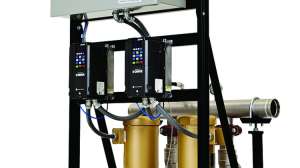
The system uses a simple Precision Digital PD690 level/process controller in a feedback loop with a GLI International Pro-D3 DO transmitter fitted with a GLI Series 5500 DO sensor. The transmitter’s 4-20 mA signal, directly proportionate to the DO level measured in the ditch, is looped through the controller.
By trial and error, Hricko and Lewis determined that the most effective place for the DO probe was in the third channel. Experience had shown that when DO there fell below 3.0 mg/l, TKN increased significantly. Experimentation revealed the set point range that best balanced control of both total nitrogen and TKN.
“The PD 690 has four control relays,” says Hricko. “Because we have two aeration motors, 180 degrees apart, we use different DO set points for each. On the low side, we have the set points of 3.3 to 3.6 mg/l, and on the high side, 3.8 to 4.1 mg/l. With these set points as the control, each side’s motor runs on high speed until the upper DO limit is reached, at which time the speed switches to low.
“The motors then run on low until the lower DO limit is reached and they switch back to high speed,” Hricko explains. “Control is with a narrow range for each side, yet it is very effective in achieving our goals.
“Normally, in the colder months, the low side runs on low almost continuously, as the DO content of the colder water stays in the high-side range. So while the low side stays on low speed, the high side toggles speeds and maintains that 3.6 to 4.1 mg/l range throughout the ditch.
“We got immediate results with this approach, and each year we’re getting better and better,” Hricko says. “So far, for this year, we have about a 60 percent reduction in total nitrogen over the numbers we had before installing the system. We’ve also benefited from reduced power costs, as previously both motors always ran on high speed alone.”
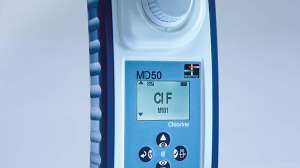
The staff monitors the DO level in all three channels using a portable DO meter from YSI Corp. They also use that meter daily to calibrate the inline DO probe.
Additional measures
Regular laboratory testing helped the Town of Crewe staff fine-tune the process. They performed daily total nitrogen tests in-house and sent daily samples to an outside lab for expedited TKN testing. The daily testing regimen continued for about a year, until the staff felt the process was sufficiently controlled to yield consistent nitrogen reduction in compliance with the permit.
Beyond DO control in the ditches, the staff took other steps to reduce total effluent nitrogen. These included:
Carbon addition. Testing showed that influent BOD was not sufficient to feed the denitrifying bacteria in the ditch. By performing CBOD analysis, the staff found that adding a carbon source to the second channel would aid denitri-fication. They chose dry molasses as an inexpensive food source and gradually adjusted the quantity until they found the optimum level of 100 pounds per day.
Alkalinity increase. Hydrated lime added to the first channel at 100 pounds per day maintains sufficient alkalinity for nitrification. (The alkalinity has the added benefit of increasing hardness to precipitate zinc, which is present in influent at 300 to 500 parts per billion and must be reduced to 70 ppb or less for compliance.)
Sidestream flows. The staff found that influent nitrate levels increased when they operated the belt filter press or decanted the aerobic digester. To combat that, the staff installed timers to enable regular on/off cycles on the digester aeration system (two hours on, one hour off). This reduces nitrate before it enters the influent.
Grit channel modification. Aeration of the grit channel was increasing DO levels in the first oxidation ditch channel. “We cut that off, and now the influent DO numbers have dropped to where that first ditch is almost in an anoxic condition,” Hricko observes. “It’s never above 0.2 mg/l, and it usually stays below 0.1 mg/l. That’s about as good as you can get for nitrate reduction.”
Piping changes. The staff extended influent and return activated sludge piping so that both discharged below the surface, reducing surface agitation that had been introducing oxygen.
Set up for the future
Hricko notes that the Town of Crewe plant achieved compliance with its nitrogen limits in 2008 and will be able to sell nitrogen reduction credits when the market opens in January 2011. He estimates those credits will bring $20,000 to $25,000 in annual revenue to the town. “Instead of having to purchase credits or pay for a major plant upgrade, we have positioned ourselves to create a little bit of money,” he says.
Hricko is quick to credit his team, which in addition to Lewis includes class III operator Phil Pegram, a team member for two years. “Both these men are tremendous assets to our facility,” he says.
Lewis, an 11-year staff member, provided valuable insights during the nitrate reduction project. “Jason and I did research at other facilities together,” Hricko says. “He provided the kind of fresh perspective that is always helpful. Having been here much longer, he had a better grip on what had been tried in the past and whether ideas I had would be likely to work.”
Hricko also offers gratitude to town leadership: “Town manager Wade Walker was a huge help in having the confidence to let us do this. Public works director Toney Shelton was always there to help whenever we needed anything. Everybody really pulled together to help us come up with good results.”