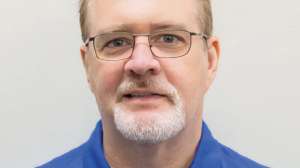
The Town of Frisco (population 2,800) lies amid three major ski resorts in Colorado. That means district manager Butch Green and his team at the Frisco Sanitation District have a dual challenge.
First, they need to keep sending clean effluent out to the Lake Dillon reservoir even on special holidays that can attract more than 20,000 tourists. Second, they need to be essentially invisible. They succeed admirably on both counts.
The 2-mgd (design) activated sludge treatment plant consistently meets its BOD and TSS limits as well as a stringent phosphorus limit that requires advanced water treatment (AWT) units. And tourists rarely notice the plant, even though it lies at the end of Main Street, a short walk from a marina, shopping and condominiums.
Green says the credit goes to the members of his staff: Mike Signorelli, Emily Moore, Brent Riisager and Loren Mendenhall. “Any manager worth his or her salt will tell you that without properly trained and knowledgeable people to operate it, the best equipment in the world won’t make much of a difference,” says Green.
“Our board of directors realizes that and provides an aggressive ongoing education program. The district is able to keep costs down and keep the plant performing at a high level because everyone on our team is accomplished in what they do, and each can cover for the other. That’s the secret to our success.”
Rural roots
Green, a Kansas native, started professional life working on a small community’s electric utility. In 1974, when the community’s wastewater operator resigned, local leaders asked Green to take over the plant.
Green, then 24, said yes. He worked there for five years while farming on the side. “Since then, everybody has known me as the Sewer Guy,” he says. “I would set up the sewer plant in the morning. We would farm all day. Then I would go back and work at the sewer plant at night.”
Green then moved to Colorado and worked through most of the 1980s at the Upper Thompson Sanitation District in Estes Park, Colo., and at Summit County’s Snake River Wastewater Treatment Plant, across Lake Dillon from Frisco.
When he came to the Frisco district in 1989, “It was in sad physical and financial shape,” Green recalls. To make repairs and bring the facilities up to date, the district had to raise user fees by more than 80 percent and increase taxes 360 percent. That process was far from painless: Some residents strongly opposed the project.
“In those early years, I was out in front of anybody who would listen to me to explain our plans,” Green says. “When you undertake a project like that, there’s always a certain segment of the community that wonders if you really know what you’re doing.
“So I took the 10 most vocal of those folks, put them on an advisory committee, brought them down here to the plant and said, ‘Look, here it is. What do you think?’
“Our old system was a package plant, and it had a wooden structure over the top of it because otherwise it would freeze. While we were standing inside there, looking at what we should do about that structure, a piece of it fell off the roof and hit one of the committee members in the head. In the end, they actually voted to spend a little more money than I was asking for.”
Making strides
The original treatment plant, built in 1968, the same year the sanitation district was formed, consisted of lagoons. A small built-in-place activated sludge plant built in 1973 was replaced with a larger Cantex package plant in 1975.
A major upgrade in 1985 added AWTs for phosphorus removal, as well as sidestream equalization, a headworks, and maintenance buildings. In 1992 the Cantex package plant was converted to aeration basins, the sidestream equalization basin was converted to a digester, two new clarifiers were built, the AWTs were upgraded, and other improvements were made.
Additional blowers and new diffusers were installed in the digester and aeration basins in 2002, and AWT equalization basins were installed in 2008. Another upgrade in 2010 is to include UV disinfection.
Along the way, Green and the board of directors have set about finding employees with multiple skills and automating treatment systems using a SCADA system. Those successful endeavors enabled user fee reductions in 1996, a 38 percent cut in district taxes in 2003, and elimination of taxes in 2004. User fees today are lower than in 1994.
Green and four staff members now run the entire treatment facility, along with a 21-mile collection system with seven lift stations. “Our engineers, Black & Veatch, suggested in 1994 that we should have eight or nine employees for an operation this size,” Green says. As it stands, each staff member wears multiple hats.
Special talents
Signorelli, a seven-year team member, is assistant district manager and also laboratory director, chief operator, operator in responsible charge, collection system inspector, and IT specialist. He holds class A wastewater, level 4 collection system, and level 1 laboratory certifications. “Mike is a do-everything employee,” Green says. “He has a degree in chemistry, so he understands how it all works.”
Moore (eight years) serves as office manager, operator 2, and laboratory technician, and holds class C wastewater certification. “Emily was our weekend operator before 2003 when the office position opened up,” says Green. “She continues to take a share of the daily process control every week, takes standby nighttime and holiday call-outs, and helps in the collection system when asked. In her office function, she is just a delight. When customers call here, they’re just enamored with talking to her.”
Riisager (five years) functions as maintenance manager, operator 1, and collection system operator and inspector. He holds class D wastewater certification and has passed the level 1 collection system exam. “Brent is a key reason we can operate a system this size with so few people,” says Green. “He can fix anything. He single-handedly keeps all the equipment running in the treatment plant and the pumping stations. He shares in the daily process testing and plant adjustments, and he manages our collection system maintenance program, cleaning one-third to one-half of the system each summer.”
Mendenhall, who serves as operator 1, joined the team in summer 2008 and has passed his class D wastewater certification. He helps with collection system cleaning and operates the utility on weekends. “Loren shows an aptitude for maintenance construction and is a quick study on process control,” Green notes.
Thomas Loewenstein joined the team as an intern during the past summer.
Putting it together
That team delivers the consistent performance required by the district’s setting in a tourist area (elevation 9,000 feet). The Breckenridge, Keystone and Copper Mountain ski areas are all just a short drive away.
On top of that, the town is adept at promoting itself for special events. “They’ll hold a barbecue challenge on a weekend and my population jumps to 18,000,” Green says. “Then they’ll have every Corvette in the world show up for a Corvette Weekend. On the Fourth of July, there might be 25,000 people in town for a huge display of fireworks that they shoot off just behind our treatment plant.
“The challenge is not to let those people know we’re here. They don’t want to stand outside and smell sewage while the fireworks go on.” All of that makes work life, in Green’s words, “intensely interesting.”
Influent runs through a Parkson bar screen, an aerated grit chamber, and a Schloss grit-removal cyclone. From there it is pumped to the aeration basins for the activated sludge process. There are three aeration basins, all built in the old package treatment plant structure.
“We have three staged aeration basins, and that enables us to run whatever size basin we need,” Green says. “Our shoulder season flows are really low (0.4 mgd), and peak flows are really high (1.0 mgd). We can add or subtract basins according to how we expect the flows to show up.”
Waste activated sludge, along with solids from the clarifiers, runs through a gravity thickener and then is transferred to a 356,000-gallon aerobic digester. Westfalia centrifuges dewater the material to 15 to 20 percent solids. A contractor trucks that finished product to a nearby molybdenum mine for composting as part of a revegetation project on a tailings site.
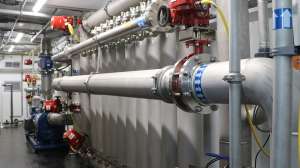
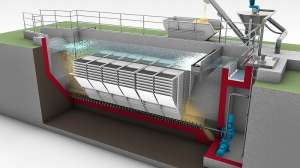
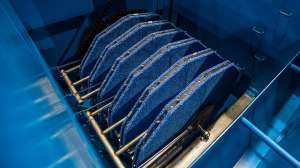
Clarifier effluent goes into the equalization tanks and then into the AWTs, which remove phosphorus down to 0.039 mg/l. The charcoal and sand filters provide final polishing before discharge to Dillon Lake, which is a drinking water reservoir for the City of Denver and a popular spot for boating, trout fishing and other recreation.
A living system
Green enjoys the challenge of keeping that complex system humming. “I love doing this,” he says. “You have to create an environment where the microorganisms can live, and they have to be right all the time. It’s really easy to kill them off, and it’s not so easy to bring them back. When you work in a resort town, things change rapidly all the time. You have to stay ahead of it, not behind the curve. You need to know when the flow is coming and how much you’re going to get.”
He enjoys the people side of the business, too. “You get to meet a lot of folks,” he says. “I’m around town all the time. I’m over at the post office and usually run into people there. The coffee shop across the street is a good place to meet folks. I tell them what we do and make myself available.
“I get customers who call and say, ‘How come this costs so much?’ The fact is, I’m running the wastewater treatment plant, and then I’m running the phosphorus control facility, which is as large as a water utility. I tell them, ‘The best thing to do is just come and see us, and I’ll show you what we’re doing.’ Usually, by the time they’ve wandered through the place, they have a better idea why it costs what it costs.”
What Green likes most about the people side of the business is dealing with his staff and the board of directors. “I try to hire good people and get out of their way — just point in the direction we need to go and let them do their jobs.
“I always think you should hire to your weakness. If you’re really good at something, hire somebody who’s good at what you’re not good at. That’s how all of us are. We seem to complement each other. The board treats us well. It really means a lot to have a board of directors that is good about providing everything we need to do our jobs in the best way we know how.”
Green never loses sight of the real reason he and his staff and the district itself exist. “Sewer lines and water lines are the veins and arteries of civilization,” he says. “People get to be here because we’re here. If we don’t run a really good treatment plant, people can’t move to town, people can’t build houses, you can’t have businesses. It’s the things we do that make civilization work.”