Hydraulic overloading and the need to meet dissolved oxygen (DO) requirements were constant concerns at the Lockport (Ill.) Wastewater Treatment Plant. Its ammonia nitrogen limit was 15 mg/l discharging into Deep Run Creek, and superintendent Joe Findlay had trouble keeping it below double digits. The DO hovered just above the permitted 6.0 mg/l.
Enlarged three times since it opened in 1959, the facility consists of the original north plant and the south plant built in 2005. The latter had room for one final expansion, and the design work went to Robinson Engineering Ltd., South Holland, Ill. They selected a three-pass, plug flow, conventional aeration system that included a sludge-handling building with centrifuge and gravity belt thickener, sludge storage tank, and an aerobic digester. Four aeration basins were added to the existing two.
More equipment, however, meant higher electric bills. The Robinson team knew that blower motors were responsible for 50 to 80 percent of the energy required in the diffused aeration activated sludge processes. They turned to engineers at Metropolitan Industries Inc., a designer of custom pumping controls and equipment in Romeoville, Ill., to look for solutions.
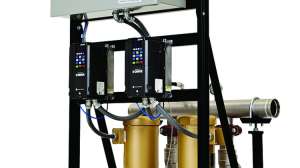
Their answer incorporated DO sensors, modulating valves, multiple proportional-integral-derivative (PID) control loops, and variable-frequency drives (VFD) to control pressure in the air header and modulate airflow to each aeration zone. They also retrofitted the two aeration basins in the north plant. The combination reduced Lockport’s overall energy usage 60 percent and eased concerns about permit levels.
South meets north
Four upgrades between 1971 and 2007 increased the design capacity of the Lockport plant from 250,000 gpd to 5 mgd. Anaerobic digestion was added in 1986. Lockport has six lift stations, 100 miles of sewer mains, and an average daily flow in excess of 3.5 million gallons. It serves 9,410 residential and 328 commercial/industrial accounts.
The north plant wasted the retained mixed liquor once a week from its two aeration chambers, both 40- by 80- by 18-feet-deep. The new basins, 43- by 100- by 21-feet-deep, retain mixed liquor for about 14 hours. Fine-bubble aeration provides the necessary oxygen transfer efficiencies, enabling the south plant to waste daily or every other day. “Best of all,” says Findlay, “the DO levels are consistently at 7 or 8 mg/l in the receiving stream. And our ammonia hasn’t risen above 1 mg/l.”
The north and south plants each have a sludge centrifuge stored in a 70-foot-diameter, 41-foot-tall tank. The old centrifuge processes 50 gpm, and the new one 200 gpm. Continental Farms in Peotone, Ill., land applies the dewatered biosolids, but Lockport can haul liquid material if needed.
“Holding the sludge longer and increasing digestion with the aerobic digester have produced fewer biosolids and cut our hauling expenses,” says Findlay. “Before the upgrade, Continental was moving 42 cubic yards a week. It’s down to 28 cubic yards a week now.”
The system also reduced maintenance work. “My guys used to run around manually throttling the inlet valve on each blower and taking DO readings by hand,” says Findlay. “It’s done automatically now, freeing them to do more sludge handling or other maintenance projects, and the SCADA control system has made it easier for me to operate the plant.”
Process control
Automation began with programming of the remote terminal unit (RTU) to hold adjustable DO set points in treatment zones by using PID loop controllers. DO sensors in strategic locations transmit signals to the SCADA-RTU, which compensates for BOD, ambient air density, temperature and process demand to minimize power input to the blower motors. The PIDs also prevent blower surging and adjust the speed to changing organic loads.
“The VFD blowers are far more energy-efficient because we don’t run the motors as fast or as hard,” says Findlay. “That increases their lifespan, reduces maintenance, and minimizes parts replacements.”
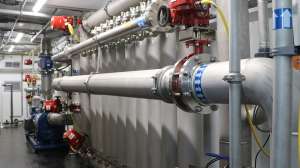
To balance the air flow between each basin and treatment zone, the zone header pipe in the blower room has a motor-operated valve that modulates automatically. The programmable logic controller (PLC) uses information from an airflow meter, air pressure transducer in the header pipe, and DO readings in strategic zones to monitor and adjust blower speed and valve positions continuously.
“I can set the DO levels on each zone air-supply pipe and select which DO sensor controls a zone on the SCADA-RTU screen,” says Findlay. “Zones not furnished with DO sensors follow the air supply of a similar zone. The system allows me to see what is happening in real time from my desktop.”
Concerns put to rest
By controlling the number of operating blowers and their speeds, Findlay can regulate how much air pressure is delivered to the zone air valves. The zone having the greatest air demand determines the pressure set point. Findlay maintains DO at 2 mg/l. “Concentrations above 4 mg/l don’t improve the system’s operation, but they do increase aeration costs,” he says.
The south plant now has three 100-hp inverter duty-rated motors. The north plant has three 300-hp units. All blowers are by Hoffman — a division of Gardner Denver. They are shut down monthly to grease the bearings. “We’re halfway through switching all of them to sealed bearings,” says Findlay. “Once we do that, we’ll change them out every five years.”
A new precast influent building at the headworks houses the level controls and the new ABB Series 550 VFD for the six 40-hp influent pumps. Lockport’s final expansion laid Findlay’s anxieties over permit levels to rest, while improving the plant’s energy use and operating costs significantly.