The Housatonic River runs from the Berkshire Hills near Pittsfield, Mass., and flows south for 148 miles into Connecticut and Long Island Sound. The City of Pittsfield Wastewater Treatment Facility consistently meets stringent permit limits for discharge into the Housatonic.
“In some respects, our permit is more stringent because we contribute a large part of the river flow at its headwaters during low flow periods,” says plant superintendent Tom Landry. “The headwaters of the Housatonic are in the Pittsfield area, but as the river progresses through Massachusetts and Connecticut, our contribution as a percentage of the river flow decreases.”
Landry, operations foreman Joe Mack, and their staff make sure the plant protects the river, and does so efficiently. They take pride in running a safe, clean operation and a preventive maintenance program that keeps even the oldest equipment working reliably. On the horizon are a series of energy-efficiency enhancements that will reduce greenhouse gas emissions and help control costs for customers.
In January 2009, the U.S. EPA’s New England office awarded the Pittsfield staff a Regional Wastewater Treatment Plant Excellence Award for operations and maintenance. It was among four plants in New England honored for exemplary performance during 2008.
In 2006, the Massachusetts Water Pollution Control Association recognized Pittsfield with a plant performance award for best large plant, after considering criteria such as performance on TSS, BOD and fecal coliform.
Recognizing success
“We’re proud of this recognition, and our entire staff deserves these awards,” says Landry. “This is a 24/7 operation, with some employees working at night and on holidays to keep things up and running.”
The plant began operating in 1902 and has been upgraded six times. These improvements, combined with a conscientious staff, have resulted in the plant’s high performance. Major equipment additions have turned the plant into an advanced secondary treatment facility.
The plant is considered to have a major impact on the Housatonic River because of its 17-mgd design flow, largest on the river. The EPA calculates the effluent limits using the design flow and the 7Q10 (seven-day, 10-year low river flow). The agency is also concerned about protecting Long Island Sound.
Besides Pittsfield, the plant treats water from Dalton, Hinsdale, Lanesboro, North Lenox, Richmond and part of Peru. Once an industrial hub with a large General Electric plant, Pittsfield is now home to just a few smaller industries, including plating, metal finishing and printing. An industrial pretreatment program ensures that these industries don’t create issues.
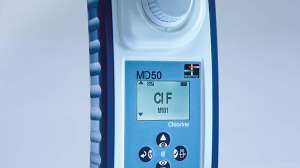
Influent passes through Rex bar screens and grit collection before primary sedimentation. Trickling filters provide secondary treatment, followed by intermediate settling tanks and nitrification aeration. Effluent from the secondary clarifiers is chlorinated before discharge to the Housatonic.
On the solids side, primary sludge and thickened waste activated sludge are sent to a primary digester, then to two-stage anaerobic digesters, and finally to the secondary digester. The biosolids are dewatered with Ashbrook Simon-Hartley belt presses and landfilled.
Experience counts
The plant has performed consistently — there has been only one permit violation in the past 12 years. “Part of the reason for that is our operators have a lot of experience,” says Mack. “We also have a very good preventive maintenance program, which is important because much of our equipment is older.”
The plant employs 24, including 14 operators, five maintenance people, a chemist, and two laboratory technicians. Landry has been with the plant for 35 years and Mack for 40 years. The shift supervisors have 27, 25 and 20 years of experience.
With 120 acres and 11 buildings, operators do everything from equipment repair to painting and grounds work, which includes mowing 30 acres of grass.
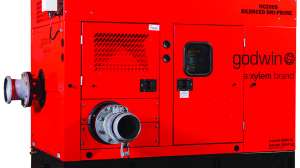
Besides permit compliance, Mack says his biggest challenge is making sure the equipment works reliably, especially during peak flow, which may reach 25 to 30 mgd after heavy rains. When that happens, operators must monitor the main pumps.
“One pump operates automatically, but the second pump is operated manually, and we have to watch it closely to make sure the solids don’t wash out,” Mack says. “I also have to make sure I have enough operators to cover the shifts.”
A maintenance person is always on call in case there is a storm and the plant loses power, or a clarifier goes down. Mack is also serious about safety and plant cleanliness. “We have a good safety record, which is another reason we have won awards,” he says. “State and federal inspectors look at things like the chemical systems to make sure they are safe. They also consider cleanliness. Is the lab clean? Is the equipment painted? If the plant is dirty, they look more closely at everything. They don’t like sloppy plants.”
A big part of Mack’s job is employee training to make sure the staff is kept up to speed. He feels that the hardest part is making employees “understand why they are doing a certain thing, not just that they’re doing it.”
Finding operators
Lately, an even bigger challenge is finding licensed operators or operators with enough experience. “Getting a license doesn’t make you a good operator,” says Mack. “It takes at least a year to get you where you should be, and a head operator should have two to three years’ experience. Ideally, I’d like to hire grade 6 or 7 operators, but I can’t even find grade 4’s these days.”
He solves this problem by hiring people who are not yet licensed but have an interest in the job, and sending them to school. With his own retirement looming in January, Mack is concerned about who will replace him. “Licensed operators don’t necessarily have an interest in being a supervisor, so I’m not sure who will do the job once I leave,” he says. “I guess not a lot of people want to get into wastewater treatment.”
In March 2008, lab director Joel “Flush” Gordon retired after 30 years. Gordon, winner of a 2008 New England Water Environment Association Award, was known for his writing and for his Flush Gordon’s Dirty Water Web site, which offered a primer on water pollution issues.
“It’s not easy to replace employees of Gordon’s caliber,” says Landry, who described Gordon as a “really hard-working guy, a great employee and a great friend.”
Improvements in store
Upgrades over the years have made life easier for the operating staff but have not resolved all the plant’s issues. The bar racks were not upgraded as part of a headworks upgrade in 1963, and it is now difficult to find parts for some of the older equipment. The plant’s oldest machinery, from the 1960s, includes an emergency generator designed to run only a portion of the plant.
Landry says the plant is due for some upgrades, including energy-efficiency improvements. He credits Bruce Collingwood, commissioner of Public Works and Utilities, with his efforts to make that happen.
“We’ve always been interested in saving energy, and we’re working with Bruce on a waste-to-energy project that will allow us to use digester gas,” Landry says. The gas will be used in a combined heat and power system that will reduce peak energy demand and curtail greenhouse gas emissions by eliminating a flare stack. SEA Consultants Inc. of Cambridge, Mass., began designing the system after a feasibility study that showed an attractive payback.
Massachusetts cities and towns spend about $150 million per year on electricity to treat 662 billion gallons of wastewater and drinking water. Energy comprises 35 to 40 percent of a treatment plant’s operating budget.
The state Department of Environmental Protection launched the Energy Management Pilot for Wastewater and Drinking Water Plants, which brings together state and federal agencies and utilities to conduct facility energy audits, assess plants for renewable and clean-energy projects, and support their implementation.
Stimulus funding
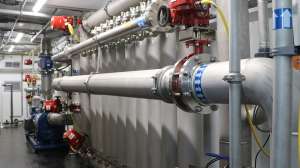
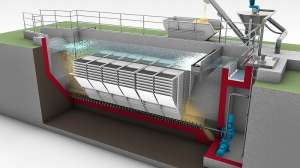
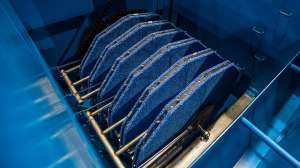
The Pittsfield plant was chosen for the pilot program, which provided an initial screening and ongoing tracking to compare the plant’s energy performance against similar plants nationwide. As a result, the plant will receive federal stimulus money, distributed through the Clean Water State Revolving Fund (SRF), for converting the mechanical aeration system to a fine-bubble diffused-air system. Money will also be awarded for bar screen replacement and the combined heat and power system.
Even with these improvements, the plant will be challenged to meet its permit limits. A new permit issued in August 2008 reduces the phosphorus limit to 0.1 mg/l, and meeting all the requirements would cost the city an estimated $30 million. The city is appealing parts of the new permit.
In the meantime, plant personnel are continuing to do what they do best — operating a first-class plant with dedication and pride.