When it comes to saving energy and protecting the environment at its tertiary wastewater treatment plants, the philosophy at the City of Roseville (Calif.) can be described in a single word: diligence.
“We recognize that we work for our ratepayers who rely on us to protect their health and the environment, and do it in a cost-effective way,” says Art O’Brien, wastewater utility manager. “It requires diligence and asking ourselves: Can we do that? Can we do it efficiently? Can we do it better?”
At the Dry Creek Wastewater Treatment Plant (18-mgd average dry-weather flow) and the Pleasant Grove Wastewater Treatment Plant (12 mgd), continuous improvement has led to a host of initiatives that put processed water to the best possible use, cut energy consumption, minimize chemical use, and help the salmon population.
“Doing what we do for the environment is not just a mission statement, it’s something we live on a day-to-day basis,” says O’Brien.
Using recycled water
The plants’ effluent meets stringent California Water Recycling Criteria (Title 22). Recycled water from both is used to irrigate golf courses, landscapes and commercial properties.
Water from Pleasant Grove, which went on line in 2004, supplies the cooling water for the Roseville Energy Park (REP), which includes a 160-MW natural gas-fired combined-cycle power generation facility. The park, next to the Pleasant Grove plant, is operated by municipal-owned Roseville Electric. Recycled water is used as cooling tower makeup, firewater, service water and process makeup.
The REP, which can fulfill up to 40 percent of the community’s electrical needs, reduces the city’s dependence on the open electrical market. “The only way the REP came into play was with recycled water, because the state energy commission would not permit a power plant cooled with potable or groundwater,” O’Brien says.
Recycled water is also sold for a variety of purposes, such as irrigating business parks, neighborhood parks and road medians. “It cools the REP, it saves our potable water supply, it generates revenue, and we have to treat it anyway,” O’Brien says. “It’s putting recycled water to its highest and best use. It’s just the right thing to do.”
Reducing energy costs
So is holding down energy costs. The Dry Creek plant uses a 550-hp digester gas-fueled Dresser Waukesha engine as the main power source for its aeration system. “Electricity is the second-highest cost to run our treatment plants, after staffing,” O’Brien says. “Instead of using mainly electric motors, we put the engine to use, and it saves us $50,000 to $75,000 per year.”
The engine runs at 100 percent capacity virtually every day to drive the blower for the fine-bubble diffuser system. The engine meets 60 to 70 percent of the blower’s demand (electric motors supply the remainder).
The engine, in operation since the early 1990s, has been rebuilt twice. It still meets uptime expectations with diligent preventive maintenance. “When that engine goes down for whatever reason, it becomes our maintenance staff’s No. 1 priority,” O’Brien says. “Otherwise, the electric meter starts to sing.”
UV disinfection
Another priority at both treatment plants is meeting NPDES permit requirements and complying with the California Toxics Rule (CTR). The city recently converted the Dry Creek plant from chlorination to UV disinfection, and Pleasant Grove will also convert to UV by 2010.
“With the California Toxics Rule, chlorine disinfection byproducts need to be down in the parts per billion,” O’Brien says. “The only way for us to meet that discharge criteria was to eliminate all chlorine. Treating without chlorine also has a water-quality benefit in that we’ve reduced the salinity of the effluent.”
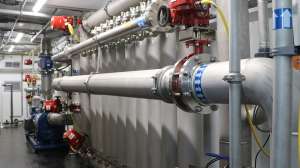
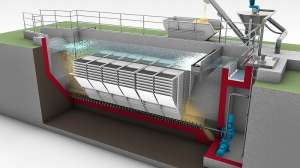
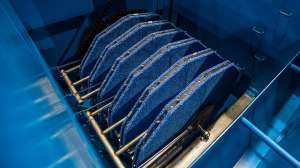
At Dry Creek, the plant’s five effluent channels are treated with a Trojan UV3000 Plus disinfection system. Each channel, with four banks of 120 low-pressure, high-intensity lamps, can treat up to 9 mgd, for a peak disinfection capacity of 45 mgd. The system began operation in May 2009.
“We went through extensive testing to make us absolutely confident using the system before we discharged to the creek,” says O’Brien. The staff opted for a UV system with automated cleaning to minimize routine maintenance.
Running odor-free
The two plants also use biofilters for odor control that are virtually chemical-free. At the newer Pleasant Grove plant, biofilters are used in conjunction with preliminary treatment and solids handling. At Dry Creek, the city’s original treatment plant, the biofilter used with the primary clarifiers replaces a chemical misting system.
“The system at Dry Creek was constantly going down and it took an inordinate amount of time to keep it running,” says O’Brien. “And of course, we were getting odor complaints when it wasn’t running.”
At Dry Creek, the primary clarifiers are covered. Blowers drive odorous air into ducts and route it to the open-bed biofilters. The wood-chip media in each filter holds the microorganisms that oxidize odorous compounds to carbon dioxide, water, biomass and other benign byproducts. Rotational sprinklers maintain the proper moisture content in the media.
O’Brien says the biofilters require minimal monitoring and maintenance. The only major requirement is to replace the media every four to five years. Odor complaints at Dry Creek have dropped from four per month to two per year, and only when the filter is down for maintenance. “This is one of the coolest treatment processes any plant manager could find,” O’Brien says. “It’s a very intuitive and simple process for odor treatment. We couldn’t be more pleased.”
Helping the salmon
While showing care for people, the Dry Creek plant also helps salmon thrive. It’s a matter of running the effluent through four large evaporative coolers (Baltimore Aircoil Company) during spring and fall before discharging to Dry Creek. The water, discharged at 60 to 62 degrees F, is essential to maintaining temperature conditions set by the state Department of Fish and Game.
The coolers are automatically controlled through the plant’s SCADA system and need minimal maintenance. O’Brien says Dry Creek is one of two treatment plants in California with cooler units. “There’s a lot of interest in the health of our creeks and the salmon run, and this is an efficient way for us to contribute,” he says.
There’s also a lot of interest in putting a fats, oils and grease (FOG) receiving station at Dry Creek to generate more digester gas and to tap for on-site power generation. The goal is to implement a FOG program as early as fall 2010.
Whether it’s FOG or something else, the Dry Creek and Pleasant Grove plants are fully on board with initiatives that save energy and protect the environment. Says O’Brien, “We’re staying true to what we’ve been called to do.”