Ten years ago officials with the City of Carmel, Ind., and staff at the wastewater treatment plant decided to change the solids handling system.
At the time, the plant used its anaerobic digester and centri-fuge to produce Class B biosolids. The process was effective, but for final disposition the city was hauling 100 percent of its material 40 miles away for land application.
“Our goal was to produce a product that we wouldn’t have to haul,” says Ed Wolfe, manager of wastewater operations. “We wanted a product with value enough that people would come and get it. We still haul some, but we have broken a barrier.”
Besides wanting to get out of the hauling business, the city knew that regulations for Class B biosolids would only get more stringent: sampling requirements would be expanded, tracking made more detailed, and setbacks for land-application further restricted. All would increase costs and limit application sites.
“With Class B there’s a lot more record keeping unless it’s going to a landfill,” Wolfe says. “We knew we would have to handle the material cradle to grave.” In deciding what direction to take, the city performed a market survey, asking farmers what type of biosolids product would be most useful. Because soils in Indiana typically are not acidic, farmers weren’t interested in a product with a high pH. What they wanted was a nutrient source.
“We looked at different technologies to make a Class A solid,” Wolfe says. Most of the processes assessed required the use of cement kiln dust or quicklime to adjust the pH. The city wasn’t interested in buying, storing and handling more chemicals. Other processes took too much room or didn’t use equipment the city already owned.
And the winner is
After careful consideration, the team chose the BioPasteur process, distributed by Kruger, a subsidiary of Veolia Water Solutions & Technologies. The process, which uses pre-digestion pasteurization, heats the solids to destroy pathogens, meeting the criteria for Class A biosolids.
Influent to the BioPasteur process starts with primary and waste activated sludge combined at a rate of 15,800 tons per day (tpd). The solids stream is thickened to about 3.5 percent solids using a belt filter press and then pumped to a 130,000-gallon mixing tank. The tank completely mixes the contents and provides a two- to three-day buffer for weekends and equipment maintenance. From the tank, solids are pumped to the BioPasteur process.
The BioPasteur system is composed of three 3,300-gallon tanks that operate in sequential batch mode, filling, reacting and drawing down, in that order. Solids are pumped in through the top of each vessel to keep the mixture homogenous.
Once full, the reaction vessel goes into react mode. A paddle mixer comes on and the solids are heated up to 160 degrees F. The chamber is then in lock-down mode for 45 to 60 minutes. Once the time and temperature requirements are met, the temperature is lowered. In winter it drops to 110 degrees F, and in summer to 95 degrees F. The solids are then pumped to the drawdown tank.
Pathogen-free sludge from the drawdown tank is pumped to an anaerobic digester and then to a centrifuge. The end result is 2,300 tpd of biosolids at 22 percent solids. The BioPasteur process was installed in 2005 with an equipment cost of $900,000 and $1.9 million for installation.
It’s automatic
The entire fill, react and draw process takes place without human intervention. Many waste-water treatment processes are automated with programmable logic controllers (PLCs), but the BioPasteur process takes automation to a new level.
“We’ve been taking steps toward a degree of automation,” Wolfe says. “We can repair equipment and fix things. For example, even though the primary clarifier is automatic, if something goes wrong, the operators can fix it.”
That’s not the case with BioPasteur, and Wolfe is all right with that. “It’s fully automated, the pumping and the sampling,” Wolfe explains. “This process has no manual method. It’s PLC-based. All the valves and temperature sensors are controlled by the PLC. There are so many events in each sequence, it’s much more sophisticated.”
When the BioPasteur process was first brought on-line, it ran on only one shift. As the staff’s familiarity and comfort level grew, the hours were extended to all shifts and weekends. “Once we got the bugs worked out, it’s been reliable for several years,” says Wolfe.
“The pasteurization process runs 24/7 for the most part, at a rate of 40 gpm, which translates to 56,000 gpd. If the holding tank starts to get too full, the process rate is increased, and the maximum is 60 gpm. If the tank gets very low, the rate can be slowed or the process suspended. The tanks are well insulated and will maintain temperatures above 160 degrees F for 16 to 24 hours, allowing an easy restart.”
The heat is on
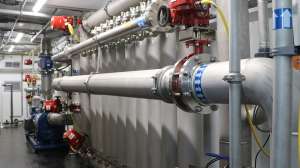
The BioPasteur system is designed to use excess heat. A heat exchanger recovers thermal energy and transfers it from solids to water and back to solids via a tube-in-tube system. The larger, outer tube contains only water as the heat-exchange medium. The smaller, inner tube carries the solids from the first vessel to the reaction vessel.
Water is heated using excess heat from the reaction vessel and is pumped through the outer tube back toward the filling chamber. As the sludge in the inner tube is pumped in the opposite direction, from the filling chamber to the reaction chamber, it is warmed to about 120 degrees F.
In the reaction vessel, a boiler provides the boost to increase the temperature from 120 to 160 degrees F. The boiler is fueled mainly by digester gas but can burn natural gas if needed.
“The system is so efficient,” Wolfe says. “It doesn’t use a lot of biogas. Anaerobic digester gas is running the whole BioPasteur system, but we still have extra gas.” There are plans to install an additional boiler that will burn more of the biogas. There are also plans to install additional biosolids equipment, using even more of the biogas.
The final step
Additional equipment under consideration is a second solar dryer. As it stands, solids treated using the BioPasteur process are run through the centrifuge and are stored in a covered storage area in one of three bays, associated with two different destinations.
“All digested material is dewatered in the centrifuges,” Wolfe says. “About 25 percent of the dewatered material is dried in the solar dryer. The other 75 percent is hauled by us or at our expense to the sod farm. The dried biosolids, for the most part, also goes to the sod farm, but they send trucks to pick it up at our location. A small portion of the dried material, at least so far, is given away to other users that pick it up at our site.”
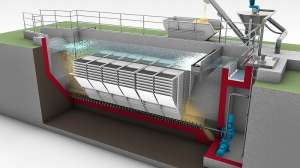
The solar dryer (Parkson Corp.) uses solar power and biogas to dry the biosolids to 75 percent solids. “It looks like a greenhouse,” Wolfe explains. “It’s about 40 by 200 feet. It has fans and vent flaps.”
Like the BioPasteur process, the solar dryer is almost completely automatic. Although in Carmel the material is loaded from the storage area into the dryer using a front-end loader, conveyor belts can be installed for more automatic loading. Once the solar dryer is filled, a robotic mole periodically runs the length of the building, tilling the material.
“The front-end loader just dumps the material,” Wolfe says. “The robot runs maybe three or four hours a day. The way the frequency is determined is proprietary, but it has to do with the temperature and humidity.” Computerized algorithms determine when the flaps open and close.
During June, July and August, the process cycles every three weeks. In colder months, the process slows down. During winter, the solar dryer can literally come to a standstill if the biosolids are frozen, as they were last December. But once warmer temperatures thaw the biosolids, the process gears back up and trucks start removing material from the site.
By adding the BioPasteur process and the solar dryer, the City of Carmel has improved the quality of its biosolids and moved even closer to the goal of leaving the hauling business.