Hardly anyone noticed the Waterville (N.Y.) Wastewater Treatment Plant until head operator Louie Langone started offering free compost.
“I had people say they’d driven past the plant for years and didn’t even know we were here,” says Langone, 55, who pretty much operates the 0.3 million gallon per day extended aeration facility by himself. “But now they come in to pick up compost for their gardens or yards, and they can’t believe how clean and well-kept the place is.”
Langone started composting the plant’s biosolids in 2000, and a brief article in the local newspaper kicked off a wave of interest. More than 200 people pick up compost every year, and when they do, they see a municipal facility where the grounds are tidy, paint is fresh, and everything is in its place.
“I really enjoy mowing the yard and keeping the plant looking nice,” says Langone. “You have to make improvements. I get great support from the village. They encourage and support me, and never question any painting and cleanup.”
The reputation of Langone’s facility has spread beyond local circles. Waterville has garnered numerous awards from New York water and wastewater associations as the best of New York’s 370 plants in its size category. And last year, Waterville earned the EPA Clean Water Act Recognition Award for Operations and Maintenance in the category for small advanced plants.
“It’s one of the nicest plants for its size in the state,” says Brian Romeiser, chief operator of the Manchester-Shortsville treatment plant near Rochester, whose presentation on composting at a professional meeting got Langone interested in the practice. “What you see is what you get with him. His plant is spotless — it’s perfect. He’s received many awards and he deserves them all.”
Pride and passion
Langone’s pride and passion for his operation can be attributed to the fact that this is his life’s work. He has been at the plant since 1983, when the New York Department of Environmental Conservation required the village to staff the facility with a full-time operator. The public works director approached Langone, who was then working for Conrail in the summer and plowing snow for the Town of Marshall in the winter.
“He said, ‘It’s yours if you want it,’” remembers Langone, who has taken classes and worked his way up the operator certification ladder over the years. He mans the plant alone 99 percent of the time, getting assistance from the public works department as needed.
The original plant dates to 1970 and originally consisted of a 60-foot-diameter Walker Process contact stabilization tank followed by polishing lagoons. A major upgrade took place in 1996-97, when Langone worked closely with Mike Harrington of Lamont Engineers, Cobleskill, N.Y., to improve both treatment performance and energy efficiency. “The old process had served us well,” Langone says, “but it was time to replace most of it.”
The renovation project replaced or rebuilt the comminutor, bar screen and grit removal system at the headworks, which receive about 170,000 gpd from Waterville’s gravity-flow sanitary sewer system. The Parshall flume was equipped with an ISCO ultrasonic flow meter. Centrifugal lift pumps were refurbished.
Langone and Harrington supervised installation of Aercor (ITT Water & Wastewater – Sanitaire) full-floor membrane disc diffusers in the aeration sections of the package plant, plus new valves, and the addition of a scum beach and a divider wall to create a selector zone to control filamentous growth. “We’ve had filamentous issues only once since then,” says Langone. “Before that, we had to chlorinate frequently.” The 243,000-gallon, 16-foot side wall tank was completely sand-blasted and repainted.
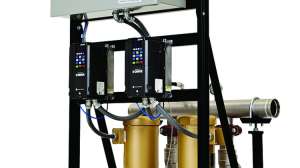
Perhaps anticipating the energy crisis that would come 10 years later, Langone improved the plant’s energy efficiency in several ways. To reduce power consumption, he installed a variable frequency drive (VFD) unit on the blower. He added a dissolved-air monitoring system (ITT Water & Wastewater – Royce Technologies) in the aeration tank so he can select the target dissolved oxygen level and match blower output with influent loading demand.
“Those units, plus our membrane diffusers, probably save us $500 to $600 a month in electricity costs,” reports Langone. The project also incorporated a new motor control center, new wiring to all process units, and a rebuilt emergency power system and automatic transfer switch.
The two 750,000-gallon settling ponds at the west end of the plant, each equipped with floating aerators, now serve as a backup in case of a malfunction in the main plant. Effluent flows to Big Creek, a classified trout stream.
Serendipitous meeting
The Waterville composting operation is the only one in the central New York State Region 6, but it might not have existed at all except for a meeting between Langone and Romeiser a few years ago.
“I went up to a Rural Water Association training session in Rochester and heard Brian’s presentation on his composting operation at Manchester-Shortsville,” recalls Langone. He was interested, and Romeiser suggested he stop in at the Manchester-Shortsville plant for a visit on his way home from the meeting.
“I had my boss with me,” remembers Langone, “so it was good for him to see the operation, as well.” They both were sold: “We said, ‘There’s no reason we can’t do this.’” With Romeiser’s help, the composting process at Waterville took shape and became operational a year later.
A progressive cavity sludge pump transports waste biosolids from the digester to a pole building. A PolyBlend polymer feed system (Siemens Water Technologies) adds polymers to the material which then passes to a belt press (ALRick Press Co. Inc.). Langone mixes cake at about 12 to 14 percent solids with a pre-calculated ratio of woodchips that ranges from 50 to 80percent solids. The village public works department, town highway crews, and the local power utility provide the chips from green waste.
“Once the proper mix is done, the compost mixture needs to be between 38 and 42 percent solids, in order to start the biological process,” explains Langone. The mix is dumped on top of a plastic-covered drainage area, and a perforated 6-inch ABS pipe distributes air evenly throughout the pile. “A typical pile is 10 feet wide, 33 feet long, and 6 feet high,” says Langone.
Additional wood chips placed on top of the pile provide insulation and even heating without blocking the flow of air. The compost stays in this aerated static pile for 21 days; a temperature probe coupled with an air blower monitors and controls pile temperature. “The pile must be at least 55 degrees C for three consecutive days, and over 40 degrees C for 11 days,” says Langone.
Curing is next. Langone breaks up the static pile and moves the material into a nonaerated curing pile where the bacteria continue to stabilize the compost. “Curing takes 30 days — no exceptions,” says Langone. “We break it up every five to seven days to allow oxygen to circulate completely.”
Finally, screens remove and recycle about 75 percent of the wood chips, and enable the material to meet New York state Class 1 compost standards. The finished material is brown, granular, and has a natural earthy smell with very little or no ammonia present. “We then sample and analyze the compost according to our permit,” says Langone, “and it’s ready for use.”
Not going anywhere
In the winter, Langone stores the compost, and makes it available in the spring. He has no trouble getting rid of all the compost he can produce, reserving most of it for village residents. “Once the word got out,” he says, “word-of-mouth took care of the rest. I have people who say they don’t want to tell anybody else in case we run out.
“It’s so much better to manage biosolids this way. We used to spread it on farmland, but that wasn’t really an appealing practice to our neighbors.” Now, the neighbors applaud Waterville’s biosolids beneficial reuse project, especially Brian Sharing, a local gardener. He used the compost on his pumpkin patch and produced a 700-pound winner.
As for the future, Langone has no plans to leave his post at the Waterville Wastewater Treatment Plant. “I receive wonderful support from the village,” he says. “We produce good effluent, we don’t cost too much, and the village and regulators are happy. That’s the bottom line.
“This is a great job, and a great field. I would think young people would do well to go into it.” A day at Langone’s pristine, efficient treatment plant might inspire them to do so.