The Yankee Lake Regional Wastewater Treatment Facility is a state-of-the-art system along the St. Johns River in Sanford, Fla. Natural landscape features allow for wetlands effluent treatment and rapid infiltration basins (RIBs).
From its inception, the plant was designed to provide reclaimed water for external customers, including irrigation for farms and golf courses. Water reclamation helps offset demand on the public water system, which has been stressed by drought conditions in recent years.
The Seminole County Environmental Services Division now manages the property to enable preservation of a nearly pristine wildlife area. This includes a tract of more than 1,000 acres on the northern half of the original site that has been turned over to the Seminole County Natural Lands Trust for hiking and nature trails, now called Black Bear Wilderness Area.
Of the remaining 1,000 acres, all but 40 reserved for the facility itself are being preserved as habitat for the endangered scrub jay, a Florida-only indigenous subspecies now found in very few sand ridge locations.
Natural filters
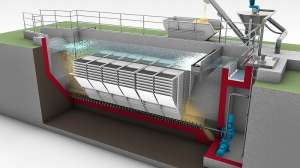
Roughly the southern half of the property immediately around the facility is actively managed by the plant, which went online in late 1996. The site itself includes a 2.5 mgd advanced anoxic wastewater treatment plant. Effluent flows are split between the RIBs and the public-access reclaimed water system.
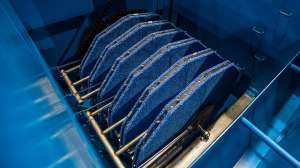
A wet-weather backup system of natural wetlands is used for additional discharge. Deep-bed filters are used upstream of chlorine contact chambers. Effluent is first directed to a storage tank for reclaimed water. Effluent is directed to the RIBs only when there is excess flow.
The RIBs are located on a high, sandy ridge that provides excellent scrub jay habitat. A small population of the birds occupied the area east and north of Yankee Lake when the property was purchased in 1985. This made it an endangered species habitat, requiring Seminole County to create a mitigation plan under Florida Fish & Wildlife Service regulations.
The RIBs were laid out in a circular array, leaving the middle area timbered in scrub oaks. This placement prevents surrounding, aggressive-growing sand pines from choking out these oaks, preferred by the jays for nesting.
Habitat mitigation
The site was under construction from 1988 to 1991. Mitigation and oversight of the RIB site was handled by an outside contractor under Fish & Wildlife guidelines. No new planting was done. Instead, unwanted species were cut down and roller chopped, slashing heavy brush down to ground level without disturbing surface soil.
Part of a total property management strategy, this technique creates fire lines without encouraging weed growth. It also lowers some higher scrub to provide habitat without creating a hazard, and encourages production of acorns, a wildlife food source.
“Our biggest challenge has been managing the property to meet habitat requirements without using fire,” says Ruth Hazard, assistant utilities manager. Controlled burns are sometimes used to manage undergrowth, but a major road and homes to the east prevent burning unless wind and weather conditions are perfect.
To avoid safety issues, says Hazard, “biologists from our engineering firm perform some of this land management on a monthly basis. They go out with machetes to hand-cultivate, remove sand pine seedlings, spray for invasive species, and keep up the management plans.” Plant staff take care of the broad maintenance duties.
Hazard was Seminole County’s wastewater manager when the plant opened, helping plan oversight of plant and property management, the meeting of wetlands criteria, and required wildlife monitoring.
Other species benefit from Yankee Lake’s preservation program. The endangered Florida black bear, threatened sandhill cranes, and gopher tortoises all find refuge there. “Gopher tortoises can’t have their burrows disturbed, so we must move them if necessary,” explains Hazard. “We have a lot of them on the property, so we have to make sure they don’t get in the way of what we need to do.” No specific permits are required for this work, as long as Fish and Wildlife regulations are followed.
Meeting regulations
To determine the original scrub jay management area, Fish & Wildlife biologists performed studies and surveys of nesting family sites, mapping their locations. They determined that a sand ridge area of 222 acres would be suitable for the birds, which don’t like wetlands. Out of that acreage, Seminole hired a timber harvesting company to clear-cut sand pines in 1996 to make room for scrub oaks.
The county is required to do photographic site surveys each year at Yankee Lake that describe changes in vegetation from year to year. Biologists monitor breeding behavior and hatchlings during the March-to-May season. No construction is permitted during that time in or near the management area.
The first such survey was done in 1994, identifying six families. Now there are five families, but this indicates healthy migration of mature offspring into the adjoining nature preserve and wilderness area, as well as to another state preserve on the other side of the Wekiva River.
At summer’s end, a biologist comes to identify individual nestlings with different-colored leg bands as they begin to fledge. Fish & Wildlife biologists use the bands to track the birds’ movements. They also take blood samples to track DNA.
Environmental payoff
No public programs are offered on the site, but Yankee Lake does host some local groups for private activities. The Seminole County Sheriff’s Department has used the facility several times to do search-and-rescue and night-vision training.
“It’s a controlled site where they can stage the training without interfering with a lot of people,” Hazard explains. Her staff has also worked with the county fire department and State Division of Forestry on practicing controlled burns.
Hazard occasionally takes members of the Audubon Society and The Nature Conservancy for weekend birding-spotting field trips. “This has really made a nice working relationship,” she says. “They know we’re out there doing our best to protect the species. This area is now the only place in Seminole county where the scrub jays have existed for 10 to 15 years now.”
She has one piece of advice for other municipalities who may be considering such projects: “Make sure you talk to state permitting people a lot in the very beginning, then keep them informed. We’ve found over the years that it becomes easier to share our ideas about ongoing management if we keep them in the loop.”
Hazard is proud of the environmental program at Yankee Lake. “Though it’s a significant cost to run this program, it’s worthwhile to manage the land,” she believes. “We have to do something to help these species.” Positive public relations are a nice benefit, too — and a regular deposit into the karma bank never hurt anyone.