Sugars, starches and wheat pulp from a breakfast cereal plant relocating to Tremonton City, Utah, would cause the wastewater treatment plant to exceed its discharge permit limits of 25 mg/l BOD and TSS. The added loading was equivalent to 550 new homes.
Public Works director Paul Fulgham and plant superintendent Jon Miller considered rehabilitating an unused 0.5 mgd trickling filter to handle the load. However, Scott Rogers and Brad Rasmussen, engineers at Aqua Engineering Inc. in Bountiful, Utah, suggested a system another local community used to handle additional loadings from a cherry processing plant. That community was using the STM-Aerotor technology from WesTech Engineering Inc.
“We liked what we saw,” says Fulgham. “We could replace the trickling filter and 1 mgd oxidation ditch with the basin for the Aerotor system. Its footprint was much smaller, yet we would have better treatment and increase our capacity from 1.5 to 1.9 mgd. We would use less electricity, because eight 7.5-hp motors would replace the two 50-hp aeration motors on the brush air rollers in the oxidation ditch.”
When the cereal plant started production, influent BOD and TSS shot from 168 and 185 mg/l to 350 mg/l. The new treatment system produced effluent containing less than 6 mg/l BOD before discharge to the Malad River. It also enabled the city to attract more business without expanding the wastewater treatment plant.
Business attraction
The Tremonton Wastewater Treatment Plant serves 1,800 residential and 250 commercial, industrial and institutional accounts that generate 1.2 mgd. Those accounts now include a fast-food meat packaging supplier that relocated to the city in part because of the success of the STM-Aerotor system. The Aerotor installation gave the treatment plant extra capacity, enabling the municipality to reduce the impact fee as an incentive for the company to relocate.
The oxidation ditch removed 1,500 pounds of BOD/TSS per day, but the STM-Aerotor system removes more than 5,600 pounds per day. “Without it, we would have needed another clarifier to handle the solids from the meat packaging supplier,” says Miller. “Instead, we kept the old 45-foot clarifier and converted the newer 55-foot peripheral-feed clarifier to a center feed.”
WesTech designed a clarifier optimization package (COP) for the retrofit that improved the mixed liquor, with higher settled solids in the underflow and lower solids in the effluent. The package included an energy-dissipating inlet, flocculating feed well, effluent weir baffling, efficient scum removal, and customized spiral rake blades.
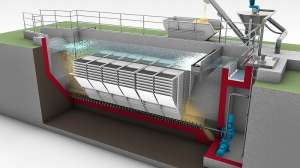
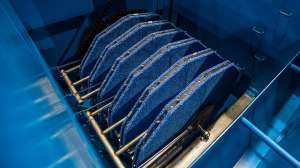
The 44- by 84- by 17-foot-deep concrete basin for the STM-Aerotor system is divided in half lengthwise, and each side operates independently as a separate train. An Aerotor resembles a paddle wheel. Eight mixing paddles reach deep into zones where oxygen is limited.
A continuous series of polypropylene discs attached across the periphery of the wheel provides surface area for fixed-film growth, while optimizing the captured air volume and release depth for efficient aeration.
Based on oxygen demand, coarse-bubble aeration is controlled using a variable-speed drive connected to the rotor. During rotation, additional cascade aeration elevates the dissolved oxygen in the upper layer of the basin. “Slow rotation and increased air release ensures thoroughly mixed liquors,” says Miller.
Better settling
The fixed-film growth, supplying 15 to 25 percent of the total treatment, increases the effective sludge age and improves sludge settling characteristics. The microorganisms react quickly to shock loads or an increased food source to eliminate discharge violations.
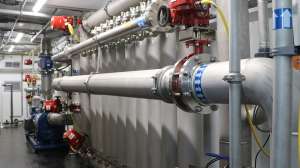
Each side of the basin has four Aerotors. Separate dissolved oxygen meters run the front two and back two units. “The wheels are 16 feet tall and are anchored at the midway point in the basin, so about 14 feet of each wheel is submerged,” says Fulgham. “When the DO is low, the unit speeds up to match the oxygen demand. At full speed, the wheels make just over one rotation every minute.”
Return activated sludge is recirculated to the head of the basin, where it combines with raw influent. Waste activated sludge is diverted to the digester. Effluent is UV-disinfected and discharged to the river.
“The aerators added years to the life of our treatment plant,” says Fulgham. “Without them, we were facing a $2.2 million expansion within five years because we were running out of capacity. Now, looking at normal projected growth, our next major upgrade is around 2020.”