With a mix of old and new technology, the Riverside (Calif.) Regional Water Quality Control Plant is like a green orchestra that plays a symphony of music in the form of water and air quality.
For this publicly owned 40 mgd tertiary treatment/reclamation plant, the main instruments include a combined heat and power (CHP) facility and a new fuel cell plant, both powered largely by digester gas, which is plentiful thanks to a highly successful fats, oils and grease (FOG) program.
As with any symphony, the quality of performance has a lot to do with how the orchestra is conducted. “It’s a lot of balancing,” says Chandra Johannesson, wastewater operations manager. “Ultimately, our efforts must have long-term benefit, not just for our facility, but also the environment and the people we serve. Riverside as a city is very green, and everyone is on board with green technology that gets us where we need to be. It’s all about sustainability.”
Thanks in part to the treatment plant’s efforts, the California Department of Conservation recently designated Riverside as the first Emerald City in California. The status recognizes sustainable green initiatives and the city’s commitment to help the state achieve multiple state environmental priorities.
An early start
The Riverside plant has had its eye on renewable energy for years. In 2000, it started a CHP facility to meet a large share of the electrical load and to provide process heat for three anaerobic digesters. The CHP exhaust heat also powers a chiller to cool the plant’s administration facility.
The CHP facility can produce up to 3 MW with three Caterpillar engine-generator sets, each rated at 1.1 MW. All three operating at full capacity can meet the plant’s entire power demand. However, because air-quality regulations prohibit running all three at once, the plant runs two at near capacity, around the clock, delivering about 2 MW. The third unit serves as a backup.
Two specialists oversee the cogeneration facility, which is tied into the plant’s SCADA system. The strategy is to fuel the units with 95 percent digester gas and never more than 5 percent natural gas. Wastewater operations cogeneration specialist Ted Crehan says the two-man team spends most of its time monitoring engine emissions and working to ensure the proper blend of fuel to the units.
“A lot of systems are designed to run in automatic mode, but we run it manually so we can make adjustments and keep us well in compliance,” Crehan says. “You need a dedicated IT administrator to maintain the SCADA system and a dedicated and knowledgeable instrument technician so that you have all the data you need,” he says.
He says the team also has a good mix of plant operations engineering expertise that has led to smooth CHP system operation for the past nine years.
“We’ve got almost 40,000 hours on the engines and we haven’t had to do a major rebuild yet even though they’re running on biogas,” he says. “They continue to run well, and they’re very forgiving in terms of emissions and being able to fine tune them.”
Fuel cell fills the gap
Most recently, Riverside has set its sights on other ways to capitalize on digester gas and protect the environment. The newest green technology is a 1 MW fuel cell cogeneration system. The fuel cell, which went online in August 2008, is the first unit of its size in California that is designed with the capability to operate on 100 percent biogas.
The idea is to operate the fuel cell at near peak capacity to supply one-third of the plant’s energy needs. The engine-generator sets supply the rest. The combination lets the plant meet its total electric power needs and operate well within air regulations. The plant also taps the fuel cell’s exhaust to heat the digesters through the existing CHP heat loop.
The fuel cell runs on 75 percent digester gas and 25 percent natural gas. The plant contracts with the fuel cell manufacturer, FuelCell Energy Inc., to operate and maintain the unit through 2012. The operators keep a close eye on digester gas production and notify FuelCell Energy to make the adjustments to the fuel mix when necessary. The company does that remotely through the SCADA system.
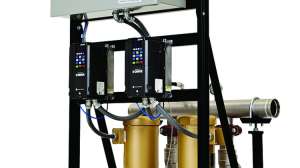
The fuel cell’s fuel pretreatment system has posed some challenges. “If you don’t have a good pretreatment system, your fuel cell isn’t going to last,” says Warren Huang, the plant’s principal engineer.
The fuel cell as a whole requires a watchful eye because it is a new technology. Uptime to date is approximately 80 percent. Early indications also show that the fuel cell is an economical energy source. As of early 2009, it cost 5.8 cents per kWh for biogas power. That compares with 7.0 cents per kWh for natural gas (based on a rate of 84 cents per Btu) and 9.0 cents per kWh for utility power.
The plant staff is still learning about the realities of the fuel cell but welcomes the technology. “We have a fantastic source of power that allows us to operate our facility and keep water quality in check while emitting nothing into the air,” says Johannesson. “It’s a huge benefit. There is a learning curve, but we’re happy with it so far.”
Good as gold
Whether it’s new technology or the tried and true, Riverside decision makers know on-site power generation depends on an ample supply of biogas. That’s why it’s full steam ahead with an aggressive FOG program.
The program began in 2005 with a pilot project that involved construction of a grease receiving station and digester injection system. The plant also contracted with a hauler to collect grease and deliver it to the plant. Originally, the hauler supplied untreated and unheated grease, and 27,000 gpd was loaded directly into one digester.
The pilot showed that FOG is as good as gold. The average increase in gas production from April 2006 to March 2007 was more than 90 percent. The average methane delivered to the engine-generator sets increased 8 percent, and gas heating value increased from 575 Btu to 649 Btu per cubic foot.
As a result, the plant saves $80,000 to $85,000 a month on natural gas. Biosolids production also dropped by 25 percent, saving an additional $48,000 per month. The FOG program also helps reduce discharges of restaurant grease into sewers. In the past, 30 percent of calls to the public works department for sewer overflows were associated with blockages caused by restaurant grease. That figure has dropped to 1 percent.
The Riverside plant now accepts only rendered FOG to avoid potential mechanical problems. Additionally, the plant built two 10,000-gallon heated storage tanks to recirculate the grease and allow for controlled dosing to two digesters. It now receives 35,000 gallons of rendered grease per day. The grease is injected into the two digesters at 180 to 200 gpm around the clock.
Based on the success of the program, the plant has waived its grease tipping fee of 1 cent per gallon. The plant is also studying biogas storage options so it can operate its CHP and fuel cell systems on biogas more consistently. “What we’ve learned from the big-picture point of view is that all of us need to take a closer look at things we consider to be waste,” Johannesson says.
Being neighborly
Johannesson says the treatment plant staff takes pride in protecting the environment. “These are really exciting times, and it really makes you proud to be a part of it,” she says. “It’s really a good-neighbor issue. After all, we don’t want to protect the water without protecting the air. It’s really about having a good balance and being a good environmental steward in every regard.”