It’s all about working together to protect the environment in Sacramento County. The Sacramento Regional Wastewater Treatment Plant (SRWTP) does virtually everything possible to supply the county with renewable energy and help minimize its own carbon footprint.
That’s not to say this pure-oxygen activated sludge treatment plant (165 mgd average, 392 mgd peak) hasn’t been environmentally conscious for decades. Instead, the county and state of California have looked to the plant as an increasingly important partner in the effort to go green.
SRWTP is happy to oblige, says Stan Dean, the former plant manager, recently named manager of the Sacramento Regional County Sanitation District (SRCSD), the plant owner. “We view ourselves as environmental stewards because we’re treating wastewater, and by so doing, protecting the environment,” Dean says. “We ought to take a broader stewardship role whenever we can if it helps the community in the long run.”
SRWTP’s green initiatives include a partnership with the local utility that creates a renewable energy source for area residents. Through the partnership, SRWTP provides methane gas to an independently operated cogeneration plant located on the treatment plant grounds.
The cogeneration plant, in turn, provides the SRWTP with low-cost steam for anaerobic digestion and cooling. The cogeneration effort is combined with a host of other initiatives underway, ranging from a pilot test of adding fats, oils, and grease to the digesters to increase gas production, to a tentative plan to reduce energy consumption with solar aerators in solids storage basins.
Cogeneration evolves
When the treatment plant became operational in 1982, it took advantage of digester gas from the start. The plant used 50 percent of the methane to fire boilers, which produced steam to heat the anaerobic digesters. The steam also powered chillers to meet the operation’s vast environmental cooling requirements. Still, some methane was flared.
As the 1990s approached, the Sacramento Municipal Utilities District (SMUD) looked to alternative sources of energy to meet growing demand for electricity. It needed other energy sources after decommissioning its nuclear plant years earlier.
At the same time, the SWRTP needed a reliable source of backup power for utility power outages. To satisfy both needs, a funding structure, known as the Central Valley Financing Authority, built a cogeneration plant on the existing plant’s grounds.
The cogeneration plant, operated under contract by Carson Energy, is rated to produce up to 106 MW of peak power. On average, it supplies 40 to 45 MW per day. Key components include gas-fired combustion turbines (GE Energy), a heat-recovery steam generator equipped with duct burners (Deltak LLC), and a steam turbine generator (ABB).
Under the SRCSD-SMUD agreement, digester gas is sold to SMUD and piped to the cogeneration plant next door. The power generated at the facility is fed to the SMUD grid. The steam is sold back to the SRCSD and piped to the treatment plant. There, it heats the plant’s eight digesters and powers absorption chillers (Trane Co.)
A win-win arrangement
The SRCSD-SMUD partnership has been a win-win arrangement since the cogeneration plant became operational in 1995. By tapping digester gas, SMUD adds a renewable source to its broad mix as it supplies power to a 900-square-mile service area with a population of 1.4 million. The practice coincides with SMUD’s global reputation for innovative programs and services, especially in renewable energy generation, including wind and solar.
For SRCSD, the cogeneration plant provides financial and environmental benefits. The agency buys steam from SMUD at a much lower cost than the revenue from selling the methane. Since 1995, the arrangement has netted SRCSD approximately $6.6 million. “That’s money we never made before,” says Michael Donahue, SRWTP operations support. “Making money off of gas we used to flare is a really good thing.”
With cogeneration, SWRTP has also greatly reduced flaring of methane. That is critical given stringent state and local emission limits and permitting requirements. The treatment plant produces 1,500 cfm of digester gas, all supplied to the cogeneration plant.
When that plant is offline, gas is routed to holding tanks and the plant’s three boilers from Keeler Boiler Works (now Metso Power). That ensures a sufficient supply of steam to heat the digesters, as well as the plant’s three absorption chillers, at all times. Only a nominal amount of gas is flared when the treatment plant’s gas management system exceeds capacity.
Another major benefit of the cogeneration arrangement is the availability of backup power for SRWTP. In the event of an area-wide power outage, the cogeneration plant is contractually obligated to supply enough power to meet SRWTP’s 10-MW peak load. As such, the facility continues to process wastewater at all times.
“It’s a credit to SMUD that they took advantage of an industrial source of renewable energy here,” says Donahue, who is also part of SRCSD’s Capital Improvements Group. “I personally think the reduction in pollution is the biggest benefit to the cogeneration plant.”
Supplying clean gas
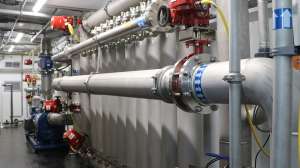
The solids residuals team manages the gas-supply side of the operation. A large part of the job is making sure the digesters operate at peak performance. The team also services other gas management system components, such as gas scrubbers, ground flares, compressors, heat exchangers and storage spheres.
“On and off, there are two to three people devoted to the gas management system,” says John Bailhache, a solids residual team member and plant operator supervisor. Other employees with specific skills, such as electricians and control technicians, work with the system when needed. Operators spend a great deal of time monitoring systems. “We basically do a lot of preventive maintenance to ensure everything is working well,” Bailhache says.
That maintenance ranges from ongoing checks for leaks on virtually every aspect of the system to changing out media in the plant’s nine gas scrubbers (Marcab Co. Inc.). The task of supplying clean gas is the most time-intensive and costly aspect of the system. “With the amount of gas we put through the scrubbers, it takes its toll on them,” Bailhache says.
Each month, team members take a number of scrubbers offline for maintenance and rotate them back online. They change out proprietary scrubber media quarterly.
Bailhache says there are few bumps in normal operations, thanks to the fine-tuning that went into the plant’s highly automated gas management system.
Putting steam to good use
SRWTP’s facilities maintenance team manages the steam processes at the treatment plant. The main focus with cogeneration operation is to ensure the boilers are ready to go and functioning properly whenever the cogeneration plant is offline, whether planned or otherwise. That means at least one operator is dedicated to the boiler room, 24/7. The boilers are warmed up and tested each shift.
“When the cogeneration plant crashes, it crashes hard and usually without warning,” says Tom Chew, senior stationary engineer, who oversees the facilities maintenance team. “We have to maintain that ready-to-go status because we have to come back up. When cogeneration is down, we’ll have two operators on a shift for safety purposes and to have another set of eyes and ears.”
Another carefully controlled operation involves ramping up the 1,500-foot underground steam line between the cogeneration plant and the treatment plant after the cogeneration operation shuts down. In 2008, the volume of steam sent to SRWTP totaled 186,000 MMBtu.
“Although seamless, the biggest challenge is steam line warm-up,” says Chew. “It has to be done slowly and carefully, and we have to make sure all of the condensate is purged out of the lines before we bring it up to full temperature, pressure and flow.”
Aside from planned or unplanned cogeneration shutdowns, the facilities maintenance staff prepares the boilers for inspection and routine maintenance once each year. The process takes two to three days per boiler. Together, boiler room and cogeneration plant personnel perform quarterly mechanical safety inspections of steam traps and condensate drain lines.
In addition to managing the steam side, the facilities maintenance staff oversees the air conditioning systems that provide cooling throughout the vast SRWTP complex.
All green
Since the cogeneration plant operates with relatively few glitches, Chew and Bailhache say it’s well worth the time and effort in holding up the treatment plant’s end of the bargain.
“We were using methane and boilers long before the cogeneration came on board, and why not continue to do so?” says Chew, who has been with the treatment plant for 21 years. “Why not use the byproduct of the treatment plant process for energy savings? It makes a lot of sense.”
As SRCSD implements green initiatives across a wide range of fronts, Dean says the district will continue to look to SRWTP as a prime example of environmental stewardship. “That’s the main message,” he says.