Odors from the open wet well at the Las Vegas Street Wastewater Treatment Plant septage receiving station in Colorado Springs, Colo., were upsetting residents and business owners. Trash in the septage was plugging the impellers of the two old pumps and breaking their components two or three times per month.
“We were holding the pumps together with Band-Aids,” says maintenance supervisor Dan Hammer. “My four mechanics were in the pit a lot and it was a hazardous environment. Besides being a confined-space entry, they had to wear respirators and constantly monitor air quality.”
Replacement parts were difficult to locate and often required custom fabricating in the machine shop. Downtime lasted a few hours to a day, during which the 20 liquid waste haulers were rarely turned away. Lacking storage tanks, the utility’s collection crew occasionally had to lower the level in the wet well with their vacuum trucks, then discharge into a manhole in the treatment plant.
Rather than replace the pumps, Colorado Springs Utilities decided to build a two-level, 500-square-foot receiving station. It uses grinders and automatic, self-cleaning fine screens to protect the pumps, provides a safe work environment, requires only preventive maintenance, and has eliminated all odor complaints.
Only game in town
The Las Vegas Street plant (50 mgd design, 32 to 33 mgd average) is fed by 1,600 miles of sewer mains and 14 pump stations, all servicing 115,000 residential and 6,400 commercial accounts. The utility adds 30 to 35 miles of sewer pipe each year.
The plant also is the only facility in its immediate area that accepts septage. Initially, haulers discharged into the open wet well, filled out their own load tickets, and deposited them in a box. The unattended area operated on the honor system.
The new receiving station, built to process 200,000 gpd of domestic waste and restaurant grease trap waste, now receives only 10,000 gpd. “The designers expected usage to expand, but it hasn’t,” says Hammer. “The economy didn’t go where it was supposed to and only 30 haulers discharge here.” Haulers are charged $92 per 1,000 gallons plus a $50 annual permit fee.
Trucks arriving at the station pull into a circular drive. Electronic gate cards and an electronic billing system record the trucking company, meter the flow, and read the pH level. After swiping the card, drivers connect their hoses to an exterior 2-, 4-, or 6-inch fitting that empties into a sealed PVC-lined 3,000-gallon concrete wet well. Before leaving, haulers can wash their vehicles at a special grating.
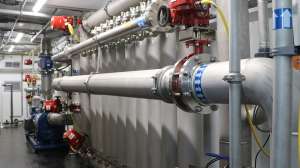
The enclosed receiving building has all electrical equipment on the second floor where digital instrumentation monitors pH, lower explosive limit, and liquid levels. Processing equipment is on the first floor.
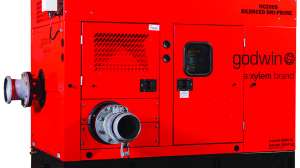
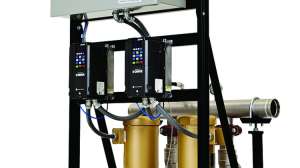
A level meter in the wet well sends septage alternately into two Model 30000 Muffin Monster grinders (JWC Environmental). The dual-shafted grinders, which replaced bar screens with 1/2-inch openings, pulverize rags, clothing, wood, hair, plastic, and small rocks into tiny particles that flow through two alternating 5-hp chopper pumps to the headworks.
“Pretty much anything that goes into the grinders comes out in tiny bits,” says Hammer. “The only items that ever stopped them were a screwdriver and hammer. The machine reversed a couple of times and, when it still couldn’t chew up the obstruction, stopped and sent an alarm. My men removed six bolts on a little cover and pulled out the tools. The units are that simple to operate and maintain.”
Dewatering waste
In the treatment plant, liquid passes through another Muffin Monster unit before entering a wet well with a 5-hp recirculating chopper pump that keeps grit, scum and grease suspended. The liquid is dewatered using washer compactor augers (Vulcan Industries Inc.). As the long auger pushes the slurry through the tube, liquid drains out. The remaining solids are sprayed and washed with water, then squeezed dry and compressed. Material falls out the end of the pipe into a 3-ton dump truck that is emptied every other day at the utility’s disposal facility.
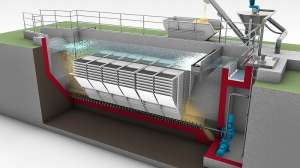
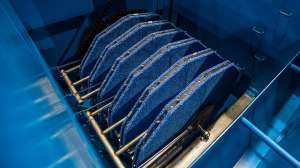
Wastewater is screened and dewatered, too. After reaching the headworks, it flows through Model ESR automatic, self-cleaning stair screens with 6-mm bar spacings (Vulcan Industries Inc.). “We got them last year,” says Hammer. “They installed easily without channel modification, and their maximum setting angle of 57 degrees makes for a compact footprint.”
Residue passing through the stair screens settles out in three 750,000-gallon primary sedimentation tanks. That material is land-injected at about 6 percent solids on property owned by the utility.
The Las Vegas Street plant operation is monitored by several digital instruments that interface with a PLC-based control system (Allen-Bradley) and several Rockwell Soft-ware products, including RSView32 for full SCADA operation. The program monitors levels at the receiving station and the flow meter in the wet well, and controls the pumps.