The City of Lawrence (Kan.) Wastewater
Treatment Plant already had a good rapport with neighbors, especially the farmers who benefit from the plant’s biosolids.
Along with that, employees are conscientious and management is responsible. So it was natural for Jeannette Klamm, utilities program manager for the city, to pursue an official management certification for a smooth-running biosolids operation.
Klamm knew the benefits of having effective management systems would be numerous, and she looked to the National Biosolids Partnership (NBP) and its Environmental Management System (EMS) certification as a place to start.
When the process was complete, a successful third-party audit put the city on the map as the smallest agency in the country to earn the certification. Achieving certification wasn’t so much a goal as just one more step along the way. “In the realm of things,” says Klamm. “It’s just the way we do things.”
In fact, the facility had already earned international certifications for environmental management and occupational health and safety. The biosolids program supplies local farmers with a valuable fertilizer.
Quality marks
The Lawrence treatment plant, about 40 miles southwest of Kansas City, serves a population of about 89,000. It was built in 1956 and has gone through numerous renovations and expansions. The secondary plant uses the activated sludge process and discharges to the Kansas River after its effluent is disinfected with chlorine.
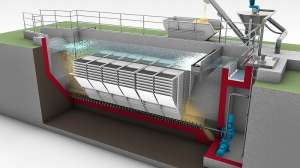
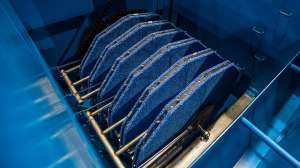
The plant’s design capacity is 12.5 mgd, and it can handle wet-weather peaks of up to 25 mgd. But in a part of the country known for spring downpours, additional treatment capacity is needed. Therefore, the plant uses the ACTIFLO process from Kruger Inc., a Veolia Water Solutions & Technologies company, to handle flows up to 40 mgd.
Awards and certifications for the Lawrence plant do not stop with the EMS. The plant has received three awards from the U.S. EPA. In 2005, the facility received Clean Water Act Recognition Awards for exemplary biosolids management, and operation and maintenance. In 2008, the plant again won the exemplary biosolids management award.
The city is also a member of the EPA’s Performance Track, a program that recognizes environmental excellence and encourages facilities to operate beyond their regulatory or permit requirements.
As part of the drive in the Utilities Program to improve management, the city also received certification under two international management programs: ISO14001 for environmental management, and OHSAS 18001 for occupational health and safety. Combining these with EMS certification is a unique achievement.
“We are the only plant in the country to have all three management systems in place,” says Klamm.
Bounty for farmers
The plant’s anaerobically digested biosolids are provided at no charge to local farmers as fertilizer. The city has been distributing the material since 1956, but the system in place now started in the mid-1970s. From the digester, the sludge contains about 2 percent solids. It is dewatered using two 2-meter belt filter presses (Ashbrook Simon-Hartley) to cake containing 22 percent solids.
“We take it to the farmers using a contractor,” explains Klamm. “EPA regulations require that we hire a contractor to do the loading rate calculations and haul it to the fields. The calculations are based on nitrogen content and the application rate. It’s usually two truckloads per acre, so a farmer with a 20-acre field would get 40 truckloads.”
The plant has a storage capacity for 4,000 cubic yards of biosolids (six months), enough to get through the winter when the land application program is inactive. The material is stored in two above-ground rectangular bays with concrete floors and walls and a single domed roof.
The roof sits squarely on the two outside, longer sides of the storage bays, leaving a gap between the bottom of the roof and the top of the shorter sides of the bins. This allows for ventilation, and avoids the expense of an air exchanger, while protecting the biosolids from wet weather.
The storage bays are loaded from the top via a conveyor belt that runs from the belt filter press up an incline and across a catwalk in between the bays. The end of the conveyor can be swung to fill either of the bays. Large stainless steel gates on a shorter side of each bay allow loader access.
During unloading of the bays, the gates are lifted slightly, allowing access from the bottom. As more biosolids are removed, the gates are opened higher. The gate is large enough that when completely opened, a loader can drive into the storage bay.
Once the material is deposited in the fields, the farmers use manure spreaders to apply it evenly. The city requires them to disk the material into the soil to make the process more aesthetically pleasing and to deliver the maximum benefit of the nitrogen.
The biosolids are in limited supply, and it is up to the city to determine who receives it. The plant is on the east side of the city, and so farmers on that same side of town benefit. “We typically don’t go west because we would have to go through town,” Klamm says. “There is a lot of farm land 15 miles north and east of the plant.”
Beyond that, the city can deny farmers’ requests for application on their property if it could be objectionable. “If there is a development or church right next door, we say no,” Klamm says. “We try to be mindful and not disturb the public. We know it’s not a good idea to deliver loads near pumpkin patches in October or next to a church when there’s a funeral scheduled.”
It was that kind of planning that made the EMS certification a logical step.
Road to EMS
Klamm says there was no single impetus for getting EMS certification through the NBP; there were multiple reasons to take that step. “We’ve always had success with our program and support from the community, including the farmers,” says Klamm. “We just wanted to continue to improve our program.”
Klamm had learned about the program through her involvement with the Water Environment Federation (WEF). She saw the importance of EMS and the benefits it provided in improving the biosolids process and reinforcing public opinion. But when she decided to take the step, the program was still in the early stages of development.
The NBP was looking for participants, and Klamm noticed that small and medium-sized plants were under-represented. Klamm was encouraged that the NBP offered funding for communities working through the certification process.
“Being part of the development process was a good learning experience,” she says Twenty-eight agencies took part in the development process, which included workshops where organizations traded valuable information — not just what worked, but what didn’t. In the end, Klamm believes teamwork was a major benefit for everyone and helped improve the quality of the program.
But it did take time. “It took us five years,” says Klamm. “Now that the program is ironed out, it should take new applicants one-and-a-half to two years.”
Reaping what they sow
The certification brought changes in operations and allowed all the employees to examine different programs at the plant. That kind of detail work can be overwhelming, but the EMS gave it structure. “Anytime you implement a new program, there’s a learning curve,” Klamm says. But Klamm believes the effort is an investment: the EMS program is intended to last a long time.
For Lawrence, health and safety was a critical concern. “Our staff was involved,” says Klamm. “We determined what it is we do, what’s our impact on the environment, and what are our health and safety concerns, all the way from a paper cut to a confined-space hazard.”
Now improvements in health and safety, and other areas, are part of the discussion in regular staff meetings. This helps the plant move from a mindset of corrective action to preventive action. “The employees say the plant is the safest it’s ever been,” says Klamm.
And health and safety correlates to dollars. As safety increases, injuries decrease, along with worker’s compensation claims. There are other ways to measure financial success. In the search for property on which to build a second wastewater treatment plant, the EMS helped smooth out the process.
“We wanted to purchase 530 acres,” says Klamm. “We did a huge outreach to neighbors and explained where the plant would be and the date it would be built, and we had people available to talk to them.”
The result was a seamless real estate transaction which Klamm believes is a direct result of the management program and credibility it conferred. The public support saved the community more than $100,000 that had been budgeted for a community relations campaign.
From the successful pursuit of EMS certification to a community-accepted plant expansion, the City of Lawrence knows the importance of conscientious and considerate operations. It illustrates that investing in management systems, employees and the community pays for itself again and again.