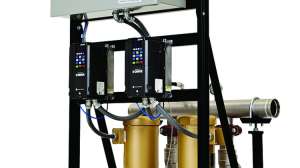
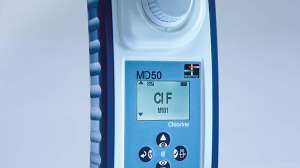
The DFM 5.0 flow meter from Greyline Instruments Inc. is designed to read difficult liquids, such as wastewater, sludge, slurries, abrasives or any liquid with bubbles or suspended solids from outside the pipe. “You don’t have to cut pipe. You don’t have to shut down flow,” says advertising manager Ernest Higginson. The meter’s no-contact design also means no maintenance, no sensor fouling, no obstructions and no drop in pressure.
Another key feature is the meter’s one-size-fits-all sensor. “Any pipe over 1/2 inch can be measured with this meter,” Higginson says. “Unlike other meters that are matched to the bore size of the pipe, with this one, you just tell it that it’s a 6-inch, 12-inch or whatever the pipe diameter is, and it does the calibration.” That also can be a cost-saver compared to meters that increase in price as the pipe gets larger.
“For Greyline, this is a new platform, basically,” says Higginson. “It’s a completely redesigned product in every respect — hardware, software, transducer. The signal processing is probably the most advanced feature, certainly the most advanced in an ultrasonic flow meter that we’ve ever made.” The design goal is for the meter to either read flow accurately, or to read zero if it’s unable to pick up a clear signal.
Data can be output to memory sticks, so there’s no need to take a laptop to the instrument to retrieve files. Options enable control relays to be added by plugging in a circuit board. “The instrument detects that the board has been plugged in and it loads the software for the circuit board and adds that to the menu structure, so it’s self-configuring if you change a component,” he says.
Calibration and startup are completed using a built-in, five-button keypad, once the flow unit and pipe diameter are input. Settings are password protected to prevent tampering.
Upon activation, the sensor continuously transmits an acoustic signal that is reflected back from moving particles or gas bubbles suspended in the fluid. If the fluid is in motion, the echoes return at an altered frequency proportionate to flow velocity. The meter measures the frequency shift to calculate flow. Noise-suppression circuitry filters “dirty” power and electric interference. This is all done with one sensor, Higginson says. “Most manufacturers of Doppler sensor flow meters use two sensors. They separate the transmit and receive function,” he says. This makes for more difficult installation since the sensors have to be mounted in the correct position for optimum signals. “In our case, because it’s all self-contained, the installation is fairly simple.”
Calibration data and totalizer values also are automatically stored during power interruptions. Other standard features include isolated 4-20mA output and two control relays. Options include a built-in data logger and reporting system with USB output and Windows software. For more information: 888/473-9546; www.greyline.com.