The Susquehanna River is the Mississippi of the Northeast.Stretching nearly 450 miles, it’s the region’s longest waterway and among its most significant historically.
Much of the Susquehanna’s recent history is tumultuous. In 1972, the tail end of Hurricane Agnes dumped nearly 2 feet of rainwater on the New York-Pennsylvania border area, swelling the river and its tributaries to flood levels.
More recently, in June 2006, a storm system whipped up by a stalled jet stream flooded the Mid-Atlantic region once again, most destructively in the Susquehanna River basin near Binghamton, N.Y.
Enter Catherine Aingworth, superintendent of the Binghamton-Johnson City Wastewater Treatment Facility in Vestal, N.Y. She led her team in a valiant effort to save the plant — at the time under extensive renovation — from destruction. For that and other exemplary service, she received the 2007 Public Works Leader of the Year Award from the American Public Works Association.
Not-so-warm welcome
Aingworth had signed aboard at Johnson City after more than 17 years of wastewater industry experience in nearby Endicott. She served as assistant superintendent at Binghamton-Johnson City for two years, and was then promoted to the top job.
A week later, she was struggling against flood waters to save not only her plant but a large equipment inventory at risk of being ruined. “The plant was undergoing a refit, and the process left a lot of gear lying around near the riverbank,” she recalls. “I was unaware of a catastrophic flood in the making until I received a warning from the local water department the night before it happened.
“The day of the flood turned out not only rainless but bright and sunny, which seemed at odds with the idea that we might possibly be washed away,” Aingworth says. “The plant employees thought I was nuts when I had them move the exposed equipment out of range of the river, as it hadn’t even crested yet.
“They didn’t know that upriver the stage was set for calamity. The ground was saturated, and all the streams feeding into the Susquehanna were already flooding.”
Treading water
Built before 1960, the Binghamton-Johnson City plant was designed to process an average flow of 26 mgd. It had experienced several major facelifts before the $68 million expansion in summer of 2006. The real estate around the facility was as dense as a shopping center parking lot with propane tanks, cranes, trucks, backhoes and other construction equipment and vehicles.
The lower levels were also full of pricey electrical equipment, such as variable-frequency drives, new pumps, grinders and controls, all of it mortally exposed as water began to lap over the riverbank.
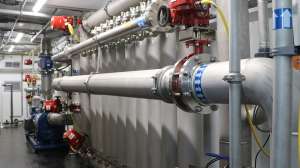
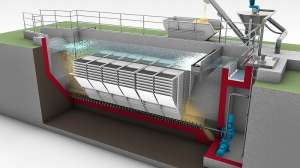
“The aim of the expansion was to convert the plant’s activated sludge treatment process to a technology called biological aerated filtration (BAF),” Aingworth explains. “In the original process, influent passed through tanks containing high concentrations of bacteria and microbes, which chew up solids. High flows neutralize the process because water passes through the system too quickly for it to be effective.
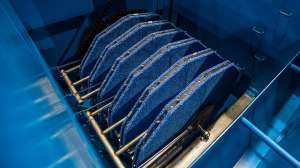
“The solution was BAF, where you have bacteria growing on clay that does not wash out with heavier flow. BAF is SCADA-controlled, so when part of the plant went underwater, the sensors, clay media, wiring and all accessories that accompany it were either submerged, destroyed or both.
Two-year delay
“The expansion was just two days away from going on-line, but the flood prolonged the project by two more years,” Aingworth says. “We finally went on-line in May 2008. This thing really challenged us.”
Aingworth and her crew rescued as much of the smaller material as they could lift, leaving behind the BAF system to the installation contractors. Many of the weightiest items were abandoned, as the logistics involved in their relocation were impossible under the circumstances.
Aingworth personally helped in the removal effort, working with her crew in hip-deep water that kept getting deeper. Work continued until it could advance no further. By noon, the river had claimed almost the entire plant, except the administration area.
“Thankfully, no one was injured,” Aingworth says. “We did, however, put in a great deal of overtime, during which a heck of a lot of doughnuts and pizza were consumed. It took six weeks for the water to subside, and then our work really began.
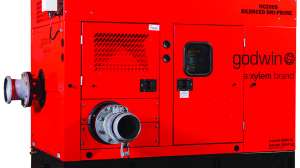
“The flood left an accumulation of mud and silt on everything, and it had to be pumped out along with the water. Motors not rescued had to be refurbished, and there was substantial mud buildup in the acetylene tanks as well.
The disaster has left us still struggling some, but all in all things are under control. Suffice it to say, it’s been quite an ordeal,” she says.
A natural
A native of Cleveland, Ohio, Aingworth has worked in the wastewater business for most of her professional life. Her interest in the field began in 1969, when the northern Ohio branch of the Cuyahoga River literally caught fire. It blazed for only 30 minutes, but the cost of the disaster was extremely heavy.
A child at the time, Aingworth was appalled and became an environmental advocate from that point forward. “I wanted to get into a career field where I could make a difference,” she remembers. “As a kid, I hadn’t yet decided on the job path I would take, but I knew it would be environmentally involved one way or another.
“I was a member of the Cleveland Environmental Club and The Nature Conservatory while still attending community college. I eventually earned a bachelor’s degree from University of Wisconsin in natural science with a focus on bacteriology, a natural segue to the wastewater business.
“My first exposure to the industry was a summer partnership in an Ohio water and wastewater plant,” she says. “My second was with an engineering company that had a wastewater contract operation. I stayed in the business when my husband and I relocated to New York state, and I remain a wastewater industry lifer to this day.”
Change of style
The 2006 Susquehanna flood had an impact on Aingworth’s management style, which in her early career, she says, was mostly oriented top-down.
Today, Aingworth oversees her crew of 38 more collaboratively, thanks in part to positive results earned by that approach at the height of the crisis. “I’ve become a very big advocate of teamwork,” she says.
“During the flood, I worked closely with my management teams to come up with a game plan that identified and prioritized all the steps that had to be taken to save the plant and equipment. Every day, the teams would provide me and one another with progress reports about jobs already accomplished, and recommendations about what should be tackled next.
“This approach fit in very well with my management philosophy. The crisis really tested us, but we dealt with it in a way anyone would have a right to be proud of. Teamwork works.”