In a plant that uses no chemicals, it’s “chemistry” that matters most in award-winning performance. The Kalispell (Mont.) Wastewater Treatment Plant ranks as one of the top 10 biological nutrient removal (BNR) plants in the country and perhaps the world.
Since 1998, an impressive record, including an effluent phosphorus average of 0.12 mg/l, has netted operational honors from the U.S. EPA (2007 Clean Water Act Recognition Award) and the Montana Water Environment Association. Even further, the EPA features Kalispell as an example of exemplary performance in its reference manual on BNR plants (EPA 832-R-08-006, September 2008), leading to inquiries on the BNR operation from utilities around the globe.
And while Kalispell is a chemical-free operation, chemistry of other kinds assures success, according to water resource manager Joni Emrick, and treatment plant manager Curt Konecky. Daily operations meetings with all hands promote excellent staff chemistry. The plant’s laboratory staff is an integral part of the meetings. And management watches plant process chemistry like a hawk.
Ready for upgrade
The Kalispell plant is designed for 3.1 mgd from the city’s 20,000 residents as well as businesses and commercial sites. An expansion, now underway, will boost capacity to 5.4 mgd.
In the headworks building, Vulcan Mensch Crawler bar screens (Vulcan Industries Inc.) and cyclone degritters remove trash and grit, which is deposited in the municipal landfill.
A lift station raises the flow to a pair of rectangular primary clarifiers. An equalization basin takes peak flows and releases volume back into the treatment process after midnight.
At the heart of the treatment plant, Kalispell uses the modified University of Cape-town (South Africa) version of the biological nutrient removal process.
The 11-cell bioreactor provides anoxic, anaerobic and aerobic treatment, operating in series. Coarse bubble aerators supply oxygen to the aerobic basins. The process nitrifies and denitrifies the wastewater while promoting phosphorus removal and reducing BOD and suspended solids.
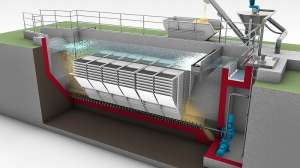
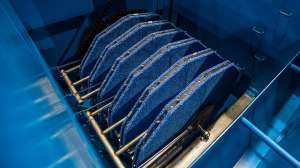
After clarification, the treated water passes through up-flow sand filters for advanced TSS removal. Trojan ultraviolet light units (Trojan Technologies Inc.) disinfect the effluent without chemicals. “We must be one of the earliest plants to employ full-scale UV,” says Emrick. “We’re proud of the fact that we are not adding chemicals to our discharge.”
An aerated effluent channel oxygenates the water before it passes to a creek that feeds Flathead Lake, the largest recreational body of water in Montana. On the solids side of the plant, a two-stage fermenter produces volatile fatty acids from primary sludge, which in turn promote phosphorus uptake in the BNR process.
Primary solids then move on to an anaerobic digester. Once processed, they are blended with raw return activated sludge, thickened, and dewatered to a 16-17 percent solids cake on belt filter presses. Kalispell has received plaudits for its biosolids recycling program.
Using city-owned, tandem-axle 20-yard capacity trucks, plant staff transport the cake to a composting facility operated by Glacier Gold LLC, about 35 miles outside the city. There, the biosolids are blended with wood chips to make Glacier Gold compost, popular with landscapers throughout the Northwest. The material is also used in mining reclamation (see sidebar).
Battle plan
While performance has been spectacular, the plant staff didn’t just hit the “on” button when the BNR process started up in this cold weather city in the early 1990s. “We’ve had to overcome our share of issues,” says Emrick.
Maintenance is the key component in what she calls the battle plan to keep plant performance at the head of the class. A computer-based preventive maintenance program documents maintenance tasks, work orders and replacement parts. But the human element is just as important. “Maintenance is crucial here,” Emrick says. “If you don’t fix it today, you’ll have two things to fix tomorrow.”
An operator is in charge of each section of the plant and has responsibility for all maintenance in that area. “That person operates the equipment, so it makes sense that they have the responsibility for maintaining and fixing it as well,” Konecky says.
The Kalispell staff reviews maintenance needs and operational adjustments regularly at the morning meetings, so everyone knows what is going on all around the system. The treatment team reviews lab reports regularly, too. “We watch the chemistry very closely and are on the lookout for any changes in the bio-cells,” Emrick says. “We want to maximize the biological activity — let the microbes do their thing.”
Depending on the chemistry and biology, plant personnel can determine the number of anaerobic, anoxic and aerobic cells in each of the zones to achieve optimal nutrient removal. Kalispell also monitors and carefully controls all return streams, aiming for smooth, consistent operations.
“You name it, our lab is running samples on it,” says Emrick. “The more eyes and ears we have on the process, the better off we are. BNR processes do best when the flow is consistent.” Over time, this watchful approach has led to a number of key operational changes and process improvements.
For example, in the original design, dissolved oxygen was controlled only in the final aerobic BNR cell. “The trouble was, the whole system would get so low that we couldn’t bring it back by just controlling DO at the end,” explains Konecky. “We moved the control upfront, but that didn’t work either.”
The solution was to position electronic actuators in all the aerobic cells to provide optimal DO control in the BNR system. “We get finer DO control and better phosphorus removal, and we save electricity by eliminating the DO swings,” Konecky says.
In another instance, the bar screen is now controlled by the plant’s programmable logic controller, rather than by level controllers. Corrosion has been eliminated by replacing copper wiring with fiber optics, and the plant staff has made improvements to the sand filtration system.
Keeping up with growth
At 3.1 mgd, the Kalispell wastewater operation strains to keep up with expansion in the Kalispell area, which is growing at about 4 percent per year. The current expansion project, designed by Morrison-Maierle Inc. with the Missoula office of the HDR consulting firm, and due to start up next June, largely mirrors the existing plant. In a way, the $22 million project is a reward to the staff for their hard work in previous years.
New equipment will replace most of the older units, and the capacity of some processes will be enlarged. The lift station will get a new pump, and the headworks will see new bar screens and grit-removal systems. The existing primary clarifiers and equalization tanks will continue to serve, although a new single-stage fermentation system will replace the current two-stage unit.
The plant will add two new bio-cells, both 500,000 gallons in capacity, nearly double the size of the largest of the existing bio-cell basins. The BNR process itself will be converted from the Capetown to a modified Johannesburg design, which incorporates a pre-anoxic zone. The plant will also have a third final clarifier and a larger, modern Trojan UV system. The plant expansion will also incorporate odor control.
Emrick and Konecky are eager to take command of the new systems when they come online next summer, but they know that strong performance will still depend on operators.
“Engineers design the best plant they know how to, and contractors build it as well as they can,” says Emrick. “In the end, though, it’s the operators who make it work.”