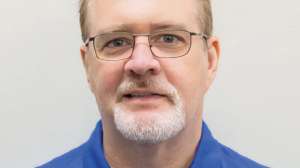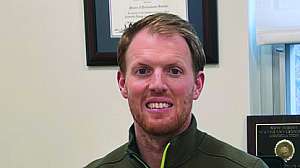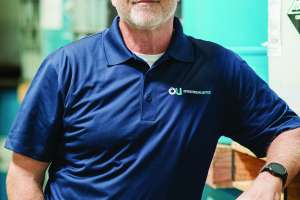
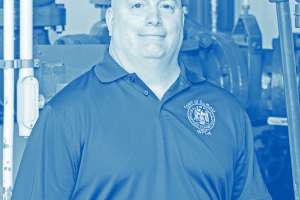
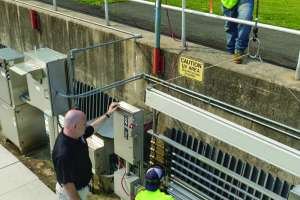
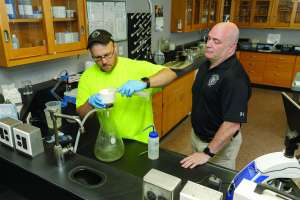
Jamie Kreller is used to overcoming challenges, professional and personal.
As superintendent at the Suffield Water Pollution Control Authority in Connecticut, he has had to address deteriorating infrastructure, use in-house expertise wherever possible to save money and prepare for new contaminants and tightening regulations.
And throughout his career, he has dealt with issues brought on by his lifelong battle with post-traumatic stress disorder. He acknowledges occasional nervousness in public speaking and writing. “I can come across as shy,” he says. “I’m not the greatest at it.”
But he has taken that as a challenge and recently completed the Water Environment Federation’s Water Leadership Institute, an eight-month program designed to educate, train and update water managers and help them build strong, lasting relationships within the clean-water professions.
In a competitive application process, more than 130 professionals applied, and Kreller was one of 54 selected. “It is a great program,” he says. “It was more work than I thought, but I now have more confidence speaking.”
Wastewater treatment was the farthest thing from Kreller’s mind when he started his postsecondary education at State University of New York Cobleskill. Having grown up working on farms, he studied horticulture and conservation and started out in the landscaping business after graduation.
“That wasn’t my thing,” he says now. He moved on to become a dispatcher for the city of Enfield, Connecticut. In 2004, Enfield posted a position in the sewer department, and Kreller thought he’d give it a try. He stayed there until 2013 when he joined the staff at the Suffield authority as an operator at the wastewater treatment facility. Six years later he was named superintendent.
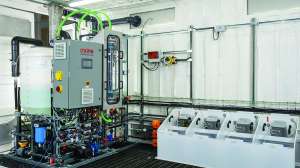
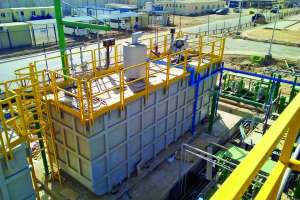
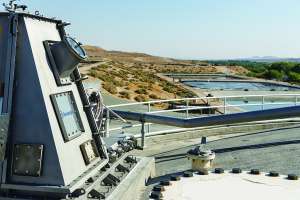
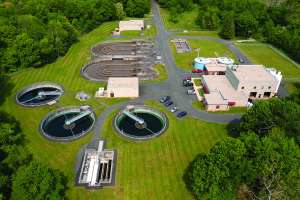
The Suffield facility (2.02 mgd design) processes an average of 1.3 mgd. Influent flows to the plant through 80 miles of sewer lines, 19 pumping stations and three low-pressure sewer systems. The plant handles wastewater from homes and businesses and the MacDougall-Walker Correctional Institution.
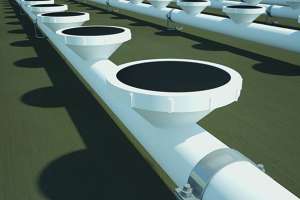
The headworks is equipped with a step screen (HUBER Technology). A Carrousel oxidation ditch (Ovivo) provides secondary treatment, followed by secondary clarification and UV disinfection (Trojan Technologies) before discharge to the Connecticut River.
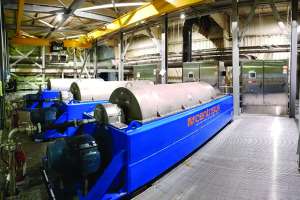
Biosolids are treated with polymer and dewatered on belt-presses (Alfa Laval). Cake is hauled to the Hartford wastewater utility 17 miles away. The plant uses a GE iFix SCADA system.
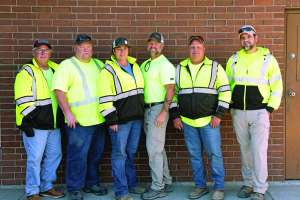
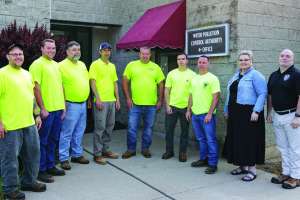
Kreller’s staff eight operators, all of whom hold wastewater operator certification. They include Alex Kaminski, chief operator; operators Mike Koczera, Jim Rusczyk, Jared Murphy, Ed Golec, Tyler Hinckley and Anthony Liquori; and Kevin Bertrand, operator-in-training.
Kreller is proud of the improvements he has overseen and the creative and dedicated work of his staff. They’ve done a lot with the collections system. “It hadn’t been cleaned regularly, and we were really pushing our lines,” Kreller says. “We televise it now, and we have established an annual inspection program. We couldn’t have done it without our operators. The entire system will be cleaned every five years.”
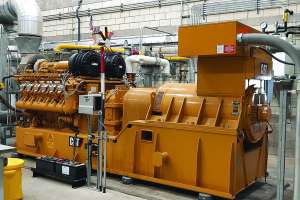
Staff effort is a high point. The Suffield staff has rebuilt several pump station buildings in-house, saving thousands of dollars. That helps, because the utility will need funding to upgrade aging infrastructure including sewer pipes, pump stations and generators. “Most of our equipment and lines are 30 years old or more,” Kreller says.
In addition, it will be costly to meet new regulations, particularly if PFAS have to be reduced or eliminated from the wastewater: “Everything is becoming more and more stringent, but that is why we have our jobs. We’re protecting the health and safety of the people downstream.”
Working with the younger operators is a source of satisfaction for Kreller: “Three of our operators are under age 30. I enjoy helping them, getting them to be the best they can be, so they can have great careers.” He often works with younger operators at home on Saturdays, helping them prepare for and pass their licensing exams.
“We need to think outside the box,” Kreller says. “When you start in this field, people need to help each other out. We need to be open with employees. They want to be part of the decision-making, part of management.”
Becoming a better clean-water professional was the aim of Kreller and others applying for the WEF Water Leadership program in 2021. Classes and group discussions focused on strength-based leadership; leading with emotional intelligence; technology and innovation; managing versus leading; time and conflict management; and public education, advocacy and communication.
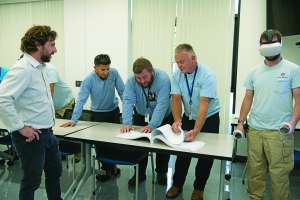
The program included homework, books to read, and a discussion session once a month. Because of the COVID pandemic, most classes and discussions were conducted remotely over a 10-month period. However, at the end of the program, the students were able to gather at the WEFTEC conference in Chicago for face-to-face sessions.
“That was a great experience,” says Kreller. “For our final project, we were given nine topics. We were assigned one and prepared a special ‘TED Talk’ program and a roundtable discussion among our group. Ours was ‘When You Can’t Keep Doing it the Way You’ve Been Doing it,’ reflecting recent changes in the profession, especially those brought on by COVID.
“I focused on the mental health side of the issue. I wanted to focus on the stigma associated with mental health. Not enough people talk about it. There aren’t many people or resources available to help. Having people to help you, to back you up, is important.”
There’s more to Kreller’s desire to improve leadership. Along with Megan Ambrose of the University of Connecticut and Jeff LeMay of the South Windsor wastewater facility, Kreller worked to resurrect an association-level management program.
It was pretty much put on the shelf during the COVID pandemic. “We didn’t want the management program to go by the wayside,” Kreller says. “It was the first activity with the program since 2018.” His participation in the WEF leadership program gave him new ideas for the association-based leadership curriculum.
The program brings outside sources such as state Department of Energy and Environmental Protection staff members to demystify the permitting process. Other experts elaborate on safety and safety manuals. Students shadow superintendents to get a better feel for job requirements. They must complete reading assignments and give presentations, which help them with communication skills: “For many, it’s their first time speaking publicly.”
In the program, 16 students work on skills and knowledge needed to become leaders in the clean-water field. “They have been great,” Kreller says. “Three of them have gone on to top management positions.”
The team of Kreller, Ambrose and LeMay hit it off. “Working with Jamie is fantastic,” says LeMay, who has known Kreller for several years. “He provides insight from all his experiences.”
LeMay observes that Kreller is humble but exhibits leadership in having a clear vision of what he wants to accomplish. At the same time, he is always willing to listen to others: “He can be reluctant at times to toot his own horn, but he has a wealth of knowledge.”
While Kreller will tell you he still has lots to learn, his management style and desire to improve have already paid off. In 2022, the New England office of the U.S. EPA named him an Operator of the Year. The regional awards program recognizes professionals who have provided “invaluable public service managing and operating treatment facilities."