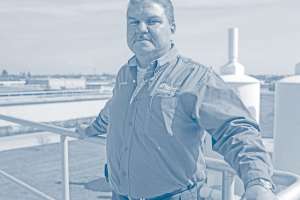
José Moreno has achieved levels of knowledge and licensure that many with advanced degrees would find daunting.
He didn’t have the opportunity to attend college, but that didn’t stop this eager learner from creating a good life and a stellar career, earning the respect of his peers and the community. As North Wastewater Treatment Plant Manager for the McAllen (Texas) Public Utility, he was instrumental in producing Type I reclaimed water for residential use.
Moreno began his wastewater career in 1987, joining the McAllen utility as a Wastewater Class D operator trainee. Taking every opportunity to learn and grow, he quickly worked his way up to a Class B in 1998. His advancement didn’t stop there, as a new requirement enabled him to gain even higher levels of knowledge and technical expertise.
His achievements were recognized in 2020 with the Outstanding Wastewater Operator Award from the Water Environment Association of Texas.
Driving force
In 2000, McAllen had begun generating Type II reclaimed water, for controlled use or areas where human contact is unlikely. The main customers were local energy provider, Calpine Energy, and a community golf course.
Then a local developer, Tres Lagos, asked the utility for Type I reclaimed water to irrigate a new residential development planned for 5,000 homes. The utility board, which had a longtime vision to produce Type I water, decided the time was right and moved to create a private-public partnership.
It was possible to make the needed treatment plant modifications without raising rates for residential customers. The utility raised the necessary $8.3 million through collaboration with Tres Lagos, which had received Tax Increment Reinvest Zone (TIRZ) funding for its development from Hidalgo County.
The McAllen utility also received a low-interest loan from the Texas Water Development Board with a loan forgiveness of $1.25 million, because the funds were to be used for a green project. The utility will also receive $4.5 million from the TIRZ for its investment in infrastructure. Between that and the loan forgiveness, the project is close to 75% funded. As a result, the utility will have two major customers for reclaimed water and an increase in revenue, without placing a financial burden on ratepayers.
Upping the ante
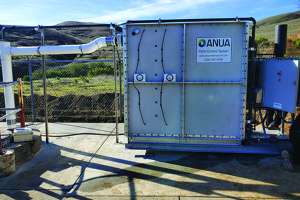
To meet the new demand, treatment plant capacity had to increase from 10 mgd to 15 mgd, and turbidity had to be reduced. To that end, the utility added an AquaDisk cloth media tertiary filter (Aqua-Aerobic Systems); it cut turbidity from an average of 3.0 NTU to 0.03 NTU.
Installing new technology was the easy part; operations required Moreno to up his game and acquire his Wastewater Class A license. “The Texas Commission on Environmental Quality has regulations and rules we have to follow to operate,” says David Garza, director of wastewater systems. “When the decision was made to produce Type I reclaimed water, the jump from 10 mgd to 15 mgd placed required that the North Plant have an operator with a Class A license.”
The step up to Class A meant a substantial commitment of time and energy; Moreno took on the challenge. To begin qualifying coursework he needed six years’ experience; to win the license he needed eight years’ experience and successful completion of 120 hours of core coursework.
“When José says he only has his high school diploma, no, he’s done so much more,” Garza says. “That license process and requirement, when you think about it and compare the hours dedicated, it is like getting a college degree. He has done that, and it isn’t something everyone can do. His passion and drive are to be commended.”
Operating challenges
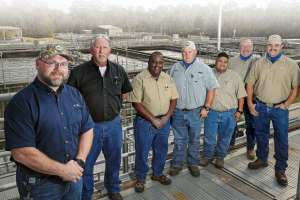
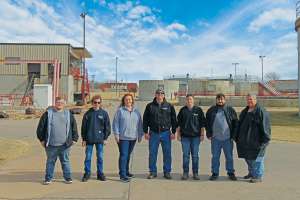
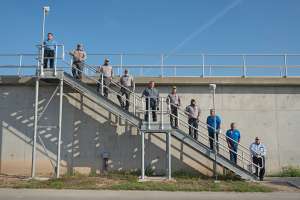
Moreno and a 15-member team keep the North Plant running smoothly. The team includes:
-Operators Emilio Castro, Daniel Lara, Rodrigo Martinez, Roberto Martinez, José Munoz, Gerardo Velasquez, Miguel Ramos, José Saldana Jr., Frank Villa and Oswaldo Oropeza
-Ramon Trevino, working supervisor
-Sergio Salinas and Lupe Montez, journeyman mechanics
-Juan Sanchez and Fernando Valente, lab technicians
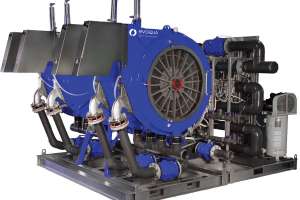
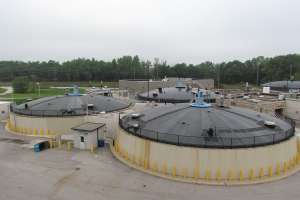
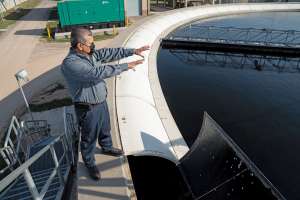
Reclaimed water production averages 8 mgd; the facility serves 146,000 residents. The treatment process consists of headworks with Hydro-Dyne fine screens and a Hydro International grit collector; four Envirodyne aeration basins fed by five APG-Neuros turbo blowers, four Envirodyne clarifiers, the cloth media filters, and an Ozonia UV disinfection system (SUEZ).
Keeping things running during the facility modifications was sometimes challenging. “Stopping incoming flow and powering down during periods of construction affects the treatment process,” Moreno says. “During this, we had to be vigilant, always making sure the water kept up and nothing got upset. Sometimes we were re-routing connections to ensure maintenance of our permit and to maintain delivery of the reclaimed water we committed to.”
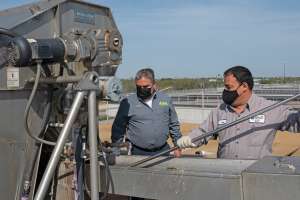
Those experiences confirmed the importance of what Moreno has consistently practiced as a manager: cross-training of teams. Although McAllen has very low staff turnover, Moreno has seen the benefit of training all the operators, regardless of level, how to troubleshoot all plant equipment. As a result, team members are equipped to handle most situations without Moreno’s involvement.
Moreno also holds daily briefings with his team to keep them up on in-plant requirements and what is happening outside of the facility. “Everyone gets a turn,” he says. “Everybody can be learning and aware of where things stand, even when I’m not here, so things keep moving forward as needed.” He is deeply involved with the plant’s lab work in reviewing, analyzing and acting on the results.
It takes a village
While taking a community approach within the plant, Moreno does the same with the utility’s outreach program, a favorite aspect of his position. He derives fulfillment from helping residents understand wastewater treatment and become an integral part of making the wastewater system better.
“The more the community knows about what’s going on in their environment and in their household, the more they can help us,” Moreno says. “Most people don’t think about the impact of what they flush down the drain, but once we educate them, they become partners in keeping the system healthy.”
To make the learning more fun and engaging, Moreno and his team decided to offer something more than static picture displays and balloons and candy for children at the annual McAllen Public Utility Night Out, an open-house event for citizens.
The team built a scale model display of the treatment plant with realistic details, like colored water that changes shades and eventually becomes clear as it goes through the treatment stages. Over the years, the crew has enhanced it with an actual working fine screen and UV light. They incorporated aquarium rock to simulate grit, pumped diffused air into the aeration basins and added extra touches like tractors, model trees and cars.
The display attracts many people each year and is a highlight of visits to the Night Out event. Moreno and his team explain the process with the aid of the model, along with samples of water at process stages from influent to effluent or reclamation. The creation and use of the model has been great for building teamwork and camaraderie.
Credit where due
When told he was to receive the Outstanding Wastewater Operator Award, Moreno thought it was a practical joke: He asked the caller, “Who is this?”
His peers felt that his quiet humility and dedication to his work deserved to be acknowledged. Moreno’s experience illustrates why a degree is not the only option for a having a great job — dedication, attention to detail, a strong work ethic and a positive attitude can take a person far in a wastewater career path.
He encourages young people in his community to give wastewater treatment and operations a serious look. “You learn a lot,” he says. “It’s a long journey, but if you dedicate yourself and stay humble, you’ll succeed. If you love what you do, all the puzzle pieces will fall into place.”