If there isn’t a smiley face on Dennis Wilson’s office door,there should be. Wilson, superintendent of the Oxford (N.C.) Wastewater Treatment Plant, is one of the happiest guys in the water profession.
“I love wastewater,” he says. “I think it’s the most fascinating thing on the planet. I learn something every day I come to work.” Some enthusiasm may stem from the fact that Oxford is his hometown, and he feels he’s giving something back to his community in the form of clean water and a sustainable environment.
Wilson graduated from the local high school in 1986 and went straight to work for Hydro Management, then under private contract to manage the Oxford treatment facility. He started as a laborer, cutting grass and doing the heavy lifting. In his six years with the firm, he advanced to operator grade II, but he found it difficult to move higher because the plant didn’t have an in-house laboratory to give him the required lab experience.
In 1992, he signed on with the wastewater plant in nearby Warrenton, serving as assistant superintendent and then superintendent. Along the way, he achieved his operator grade IV certification.
But his heart remained in Oxford, a picturesque community whose central business district and residential areas are on the National Register of Historic Places. When the municipal utility resumed public operation of the plant in 2001, he applied for and won the superintendent’s position.
“Larry Thomas is the city engineer and public works director, and he and I hit it off real well,” Wilson recalls. “It was like a dream come true.” Thomas agrees it was a good fit. “Dennis is really dedicated to his job,” he says. “He literally lives and breathes it, and he is always giving back to the community.”
Back home again
Today, Wilson looks after a well-run, well-manicured facility that recently underwent a major upgrade and expansion. Average daily flow is about 1.5 mgd from a service area of 4.5 square miles and a population of 9,300. Pretreated industrial flow comes from several companies including Bandag and cosmetic maker Revlon, two of the area’s most important employers.
The administration building is about the only thing left from the original earthen lagoon plant, built in 1970 and added onto in 1989. A $12 million expansion designed by Dewberry Engineering of Raleigh, N.C., and completed in September 2006, incorporated new headworks, as well as secondary and advanced treatment processes. Permitted capacity increased from 2.17 mgd to 3.5 mgd.
The head end of the plant now includes a new influent pump station that houses three 40-hp/4,000-gpm pumps (Fairbanks Morse), an Aqua Guard Bar/Filter Screen and screenings compactor (Parkson), aerated grit removal (WSG & Solutions), and Parshall flume.
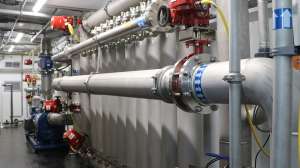
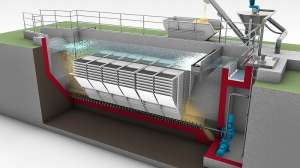
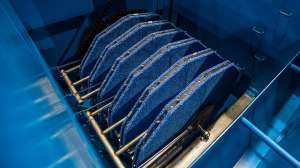
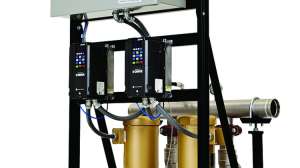
A pair of Carrousel oxidation ditches (Eimco Water Technologies) provide secondary treatment and include aerobic and anoxic zones for biological nutrient removal. Two 200-hp Excell aerators (Eimco Water Technologies) provide the required oxygen. After final clarification, a splitter box directs flow to a pair of 20-inch-bed traveling bridge filters (Parkson) and two UV light disinfection systems (Trojan).
Polished further in a post-aeration channel, the high-quality effluent runs into Fishing Creek and eventually the Tar River, Pamlico Sound and the Atlantic Ocean. The 2006 expansion also added a new return sludge pump, flow monitoring and a new outfall line. The Oxford plant lab is now certified to analyze for total suspended solids, fecal coliform, chlorine, dissolved oxygen, temperature and pH.
Working with the engineer and contractor, Wilson’s team carefully planned the expansion so it could be completed alongside the existing treatment processes without disrupting the operation. “Anytime you’re digging on an old plant site like ours, you need to be careful,” says Wilson. “But things went very smoothly here, and we experienced no problems. It was really seamless.”
At 13 acres, there was plenty of room at the Oxford site for the new construction. Contractors installed new processes right alongside the old systems, and then tied them in when ready with no interruptions in service. Representatives from the manufacturers of the new equipment and processes were scheduled on site to provide hands-on training to the Oxford staff.
Handling biosolids
An earlier expansion in 2001 dealt with biosolids. “We were coping with an undersized 300,000-gallon digester,” explains Wilson. “We added more digester volume, plus a 4-million-gallon holding lagoon.” Synagro, a private biosolids contractor, empties the lagoon twice a year, trucking the liquid to area farms, where it is spread on land.
A new SCADA system allows operators to pull up the plant and its processes on their home computers, monitor operations, and check security. “That’s a big plus,” says Wilson. “We don’t have to come back to the plant to do that.”
Performance has been top shelf, earning Oxford recognition from the North Carolina AWWA-WEA as the best for operation and maintenance in the state’s central section in 2008. “That was very special recognition, coming from our peers,” says Wilson. It also marked a significant achievement by Wilson and his staff, since in former times the plant had recorded several violations and fines. Says Wilson: “It was like going from zero to hero.”
Public works director Thomas says Wilson has made a big difference at Oxford. “Dennis has really turned things around,” he says. “He’s worked very hard to get us where we are today.”
These pleasant outcomes are really a reflection of Wilson’s positive personality. “I mark my time as good days — when everything is smooth sailing — versus bad days,” says Wilson. “We have a lot more good than bad.”
Cohesive team
But even on bad days, his positive attitude helps get things back on track. “I like to fix things,” he says. And he admires his staff of James Wright and Antoine Lewis, operators; Marvin Keeton, pump mechanic; and Cindy Marks, laboratory and pretreatment coordinator. “Our relationship is based on respect,” Wilson says. “I’ve been through it all myself. When folks come to you and you don’t know how it works, they lose respect.”
Marks, who just came onboard a few months ago, really appreciates Wilson’s interaction with his employees. “He’s the best manager I’ve ever worked for,” she says. “He really knows wastewater and shares his knowledge with his staff.”
Wilson also spreads the good word about wastewater with the greater community. Based on the theme of Keeping it Clean Downstream, Oxford’s public education program teaches local citizens and students about how wastewater treatment results in clean beaches, flourishing wildlife, and public health.
“A lot of people just don’t realize they drink the same water over and over again,” Wilson observes. “It’s especially fun to get the young kids in here and show them how our plant operates.”
Wilson’s “dream job” is not without its challenges. North Carolina has a fairly wet climate, and the Oxford system experiences infiltration and inflow problems from time to time. “Nothing we haven’t been able to handle,” he says. “We haven’t gotten blown out yet.”
Still, plans are in place to add an equalization basin in one of the old lagoon locations to guard against overflows. Other improvements include configuring a third oxidation ditch, improving the plant’s security system, and installing a larger UV system. Other than that, Wilson doesn’t anticipate anything earth-shaking. “We try to keep things simple here,” he says.
And he doesn’t plan to go anywhere: “This is a nice city. I love it here. It’s heaven for me.”