Residential and commercial growth has been a constant in Waukesha County, Wis., just west of Milwaukee County. Over the last 50 years, the Sussex Regional Water Pollution Control Facility has kept up admirably through well-designed upgrades and expansions and conscientious operation.
Since 1959, the plant has dramatically increased in physical size, design capacity, and treatment performance. It has gone from a 0.3-mgd primary and trickling filter plant serving the Village of Sussex exclusively to a 5.1-mgd regional activated sludge facility with tertiary treatment, serving Sussex as well as the Village of Lannon, the Town of Lisbon, Lisbon Sanitary District #1, and a portion of the Village of Menomonee Falls.
Because of its small receiving stream (Sussex Creek, a Fox River tributary), the state Department of Natural Resources imposed strict effluent limits in the facility’s NPDES permit. That includes 5 mg/l BOD, 10 mg/l TSS, 7.0 mg/l dissolved oxygen, 400/100 ml fecal coliform, 1.9 mg/l total phosphorus, and 511 mg/l chlorides.
In practice, the plant regularly achieves less than 2 mg/l BOD and less than 1 mg/l TSS. Ammonia is consistently below the detection limits of 0.06 mg/l, while fecal coliform counts run in single digits.
For delivering these results consistently and cost-effectively with a small, dedicated staff, the plant earned a 2008 Operations Award from the Central States Water Environment Association.
Accommodating growth
Sussex and its surroundings, about 25 miles northwest of Milwaukee, have seen considerable growth, including two industrial parks and a number of mom-and-pop businesses, along with heavy residential development. “Despite this growth, we have been able to meet the stringent DNR standards as we continue to upgrade and expand the facility,” says Jim Thalke, wastewater superintendent.
Thalke, who has been at the plant for 28 years, is quick to credit his staff for its performance. Operators are Gerry Spengler, onboard for 23 years; Dennis Wolf, 22 years; and Jon Baumann, one year. “We have a small, but innovative staff that is always trying to make things better,” Thalke observes.
Automation also contributes to the facility’s success. Thalke and staff recently installed a radio-controlled SCADA system (L.W. Allen and Strand Associates) that allows them to monitor plant operations and communicate more effectively when problems arise. Earlier this year, the facility adopted a computerized maintenance management system that also helps manage the laboratory schedule and calculates lab test results from raw data.
Growth drives expansion
At present, the largest employer in Sussex is Quad/Graphics, a U.S. printing company, whose local plant produces 40,000 to 50,000 gpd of wastewater. A major pizza manufacturing facility closed down a few years ago, and a maker of health-food bars plans to take it over in the near future.
The Sussex treatment plant serves a total population of 15,000. Sussex itself, while within an easy commute from Milwaukee, is not a bedroom community but a village with its own clear identity and character. “Fortunately, our engineers had the foresight to upgrade the facility because of the growth we’ve experienced,” Thalke says.
In 1978 the facility was upgraded to a 1.0-mgd activated sludge plant with anthracite tertiary filters. Five years later, a belt press was added to improve dewatering of biosolids. Then in 1994 the plant underwent a $9.8 million expansion to become a full-fledged regional facility.
That upgrade included an oxidation ditch, two aerators, a clarifier, a WEMCO Hydrogritter grit removal system (Weir Power & Industrial), Mahr Bar Screen (Headworks Inc.), a biosolids storage tank, and new tertiary filters Siemens Water Technologies).
“During construction, we wanted to control costs, so we made a decision to renovate some existing equipment and purchase other equipment,” says Thalke. “We wanted to be as cost-effective as possible and still do the job for the people in our area, now and in the future.”
Equipment renovated included a clarifier that was converted into a gravity thickener, a belt press that was converted into a gravity belt thickener, and an old aerobic digester that was converted into a chlorine contact tank for disinfection. In addition, the tertiary filters added in 1978 were removed, and the filter room was converted to house the laboratory, employee locker rooms, superintendent’s office, control room, meeting room and garage.
A major upgrade completed early in 2009 increased pumping capacity, treatment capacity and storage. It added two aerators, a clarifier, and a UV disinfection system (Trojan). In addition, the gravity sludge thickener was replaced with one of the plant’s two 1.5-million-gallon biosolids storage tanks.
Diverse sources
The facility’s collection system includes nine lift stations: three in Sussex, three in the Town of Lisbon, two in the Village of Lannon, and one in the Village of Menomonee Falls. The plant also receives substantial amounts of holding tank waste from homes and businesses that lie beyond the reach of the collection system and are built on soils not suitable for septic systems.
At the plant headworks, a 3/4-inch bar screen removes rags, sticks and other coarse material from the wastewater, which then flows to a wet well where it is pumped up to two grit collectors that centrifugally remove inert solids.
From there, the wastewater travels to the oxidation ditch and is mixed with return activated sludge. Eight computer-controlled disk aerators (Siemens) maintain the desired dissolved oxygen level and keep the mixed liquor in suspension. Ferric chloride is added for phosphorous removal in the last channel of the oxidation ditch, and from there the wastewater flows to the secondary clarifiers.
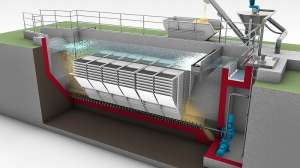
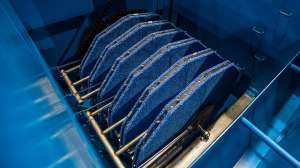
The effluent passes over the weirs of the clarifiers and is pumped to four anthracite media filters for tertiary treatment. It is disinfected by the UV system before discharge. The UV system, which replaced chlorine disinfection, has been highly effective against fecal coliform: Counts typically run in single digits. Thalke notes that the tertiary-treated effluent is so clear and low in TSS that the UV bulbs get only a light coating and require little maintenance beyond a routine, periodic wiping-off.
The facility produces class B biosolids without anaerobic digestion. Waste activated sludge at about 0.5 percent solids is delivered to the gravity thickener, which dewaters it to 2.5 to 3.5 percent solids.
The material is then pumped to the biosolids storage tanks, from which water is decanted to achieve up to 4 percent solids. The finished biosolids are trucked by a private hauler (Super Nova Contractors) to two agricultural sites in the immediate area and to several permitted locations in Washington County, to the north. It is land-applied by injection.
Thalke is proud of the Sussex facility’s record and its ability to serve a growing area with a small staff. “We have built our system wisely with good equipment and good people,” he says. “We should be able to keep up with the region’s growth for the foreseeable future.”