Bob Dodson knows when wastewater treatment energy costs rise, because his phone starts ringing. Plant managers from all over the country call him to ask how his South Durham (N.C.) Water Reclamation Facility produces methane gas from sludge and uses it to provide heat and run blowers, cutting dependence on natural gas and electricity.
“The city started generating methane and using it for fuel at the North Durham treatment works in 1933,” says Dodson, a Penn State University environmental resource management graduate with 25 years of experience as a wastewater professional. “We’ve had the system in place at South Durham since it started up in 1984. We’re old hands at this.”
The facility produces and uses 3 million to 4 million cubic feet of methane per month. The fuel powers the engines that run the aeration system blowers. Then the heat from the engines passes through heat exchangers to provide heat for the plant’s control building and anaerobic digesters, as well as startup heat for the building’s hot water supply. The system saves between $150,000 and $175,000 a year in fuel and power costs.
First-class treatment
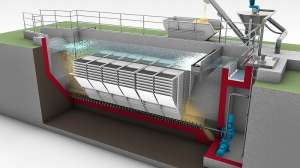
The South Durham plant was built to handle 10 mgd. It was upgraded for phosphorus removal in 1988 and expanded to 20 mgd with full nutrient removal in 1995. Today, about 11 mgd from the city of Durham flows into the system, passing through climber bar screens and a chain-and-flight grit collector system. After primary clarification, the flow moves on to a five-stage Badenpho process (Eimco Water Technologies) for biological treatment, including phosphorus and nitrogen removal.
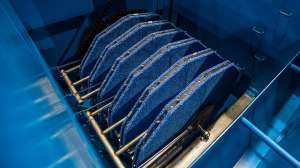
Rubber membrane diffusers (Sanitaire) disperse air into the chambers. Final clarifiers and deep-bed traveling bridge filters remove most of the remaining suspended solids before the effluent is disinfected in a Trojan 3000 ultraviolet light system.
The high-quality effluent flows into New Hope Creek, which feeds Jordan Lake, the drinking water source for the Towns of Cary, Apex and Morrisville and a secondary source for the city of Durham. The plant is also permitted to supply bulk reclaimed water, distributed to commercial entities for irrigation. It also houses a state-certified water and wastewater laboratory and staff from the Industrial Waste Control Section.
Plant performance simply sparkles. “We’ve experienced just one permit violation in the last 13 years,” says Dodson. He attributes such success to the plant staff, which exhibits a true concern for the quality of the local water environment every day. “As with any wastewater operation, it takes a commitment on the part of the operators and supervisors to meet permit requirements consistently,” Dodson adds. “We have an outstanding team who take pride in the appearance, operation and maintenance of the facility.”
In addition to Dodson, that staff includes Charles Cocker, plant supervisor; Reginald Champion, Rodney Collins, George Harris, Peter Saulsbury and William Villanueva, operator III; Robert Battistel, Anthony Jeter and Hugo Martinez, operator II; Adam Turner, operator I; Dean Townsend, equipment operator III; and Jeff Teer, plant maintenance mechanic.
Staff in the laboratory consists of chemists James Blake, Lito Chiu, Sheila Hopkins and Nathanette Mayo; laboratory technicians Bobby Honeycutt, Michael Merritt, Henry Plachcinski and Jackie Carroll-Garcia; and secretary Cathy Byrd. Also housed at the facility are Tyrone Battle, industrial pretreatment coordinator, and Rose Sanchez, industrial pretreatment technician.
Making it useful
Primary and waste activated solids at South Durham are first thickened to about 3 to 8 percent solids in a gravity thickener or a belt thickener (Ashbrook) before being pumped to four floating-cover anaerobic digesters, where the material is stabilized.
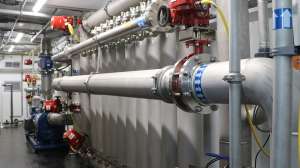
Digester gas flows through a number of condensation traps and a coalescent filter (Dollinger - an SPX Brand) to remove water and fine sediment. Then it is collected and compressed in a Gardner Denver compressor and sent to a pair of 524-hp Caterpillar engines that directly drive the blowers in the aeration system.
Dodson says the performance of the Caterpillar units has been exceptional. “Our original Cat engines were 500 hp and were installed in 1984 and provided more than 20 years of service,” he says. “We finally replaced them in 2005-2006 with the current Model 3512s, which now include catalytic converters to meet emissions standards and more efficient controls and monitoring capabilities.
“Only during equipment downtime do we send any to the waste gas flares,” explains Dodson. A 50,000-cubic-foot tank stores the gas when supply exceeds demand. The gas is an excellent fuel: At 72 to 75 percent methane, it is cleaner than landfill gas.
In addition to heat and hot water for the control building, the recovered heat from the engines’ exhaust maintains mesophilic zone temperatures (98 degrees F) in the digesters. And South Durham’s biosolids provide even more value. Drying beds or belt presses (Ashbrook and Klein) dewater the material to 15 to 18 percent solids. The Class B cake is then stored in a 1.5-acre covered building. Private contractor Synagro Central applies it to area farmland.
Consistency is king
“The key to successful operation of the digestion and gas production system is consistency — consistent flows, temperatures and mixing,” says Dodson. The South Durham operators make every effort to optimize biosolids digestion by supplying as much organic material and primary and secondary sludge to the system as possible. They also collect and process solids quickly to capitalize on maximum volatility. “Maximum gas production means maximum dollars,” Dodson says.
An up-to-date SCADA system also delivers value by reducing electrical usage and cutting staffing needs during off hours. “We’ve employed a SCADA system since the mid-1990s,” says Dodson, “and we’re now modernizing it with a Rockwell [Automation] system with help from our local systems integrator, Lord and Co.”
The SCADA system is a key to South Durham’s ability to save on power and fuel costs. The system alerts operators to the status of peak and off-peak elec-trical rate periods by radio and on the screen of every computer station. The operator can then choose what type of power supply to use with various systems.
For example, during off-peak periods, when electrical costs are lower, it is better to run the aeration system blowers on standard electrical power and store the digester gas. The operator can switch to the gas engines to power the blowers when electrical costs go up during peak times.
Critical maintenance
Dodson explains other benefits of the SCADA system’s peak and off-peak alerts. “If we are conducting tests or other maintenance activities, we will often delay running this additional equipment until off-peak hours,” he says. “The SCADA will also annunciate when we are reaching our peak demand charges and identifies the largest power users. That allows the operator to make decisions on which equipment to run.”
The SCADA system also monitors all processes so that the plant can run with one operator per shift from 4 p.m. to 8 a.m. and on weekends.
Maintenance is critical as well, and South Durham benefits from a centralized maintenance division. The division offers a full shop and staff skilled in electrical, building and grounds, instrumentation, mechanics and engineering. “They’re able to build and repair many of the parts vital to plant operations, without needing to go to outside vendors,” says Dodson. “And when we can’t get a part from the original manufacturer, we can build it ourselves.
“The maintenance division is a great arrangement for us. They under-stand our needs and know what they’re doing.” Like the capacity to produce its own fuel, home-grown maintenance increases the plant’s self-sufficiency and its ability to maintain outstanding and cost-effective wastewater treatment for the residents of Durham.