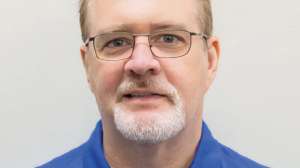
When public radio humorist Garrison Keillor characterizes Minnesotans as “self-effacing,” he could well be describing Dean Nelson.
Nelson, the award-winning superintendent of the Owatonna Wastewater Treatment Plant, shrugs off as “pretty common” the steady performance of his facility. “We’re not much different than anyone else,” he says. “We’re just out there doing our job.”
He’s being modest, of course. His plant has performed exceptionally, year after year, since the late 1980s, when it was modernized to meet current standards and he took over as superintendent. Much of the success has to do with his determined, deliberate management style, dealing with issues one at a time and keeping everything in perspective.
“Dean is a one-step-at-a-time kind of guy,” says consulting engineer Mike Zagar, whose firm, SHE in St. Paul, Minn., designed the 1987 expansion, as well as a current headworks upgrade and the addition of phosphorus removal and belt presses for biosolids dewatering. “I’ve known him for a long time and he always breaks big issues down into simple parts. He believes that if you work out the various pieces of a project, the big picture will be solved in the end.”
Smooth operation
Nelson was born and bred in southern Minnesota and came to Owatonna (population 25,000) out of high school in 1970. Like many others in the wastewater profession, he started working part-time at the treatment plant, was good at it, liked it, and made it his career. Along the way, he has achieved his Class A operator license and 503 biosolids certification. He is married and has two sons and several grandchildren.
His efforts were rewarded in 2008 when he earned the Central States Water Environment Association’s Operator of the Year award. “Dean is one of a long line of outstanding operators in the Central States WEA,” says Eric Lucuyer, plant superintendent in Crystal Lake, Ill., and chair of the operator awards committee. “We honored him for his professional approach to the job and the exemplary performance of his treatment plant year after year.”
Wastewater collection at Owatonna, 45 miles due south of the Twin Cities, dates to the early 1900s. The first treatment plant came on-line in 1940. Expansions followed in 1961 and 1987, when the current extended aeration plant was completed as part of a $17 million capital project. The plant is designed for 5.0 mgd, and flow now averages about 3.5 mgd.
In the headworks, meters monitor the flow, which is screened. A trio of 3,000 gpm Flygt A-C Series pumps and a single 1,200-gpm pump transport it to an aerated grit removal tank. This area of the plant is getting a facelift: “We’re putting in new pumps and a new grit-removal system,” says Nelson.
Suspended solids settle out in two Eimco circular primary clarifiers before the wastewater enters four 180- by 32-foot aeration basins. A Sanitaire system consisting of 5,000 ceramic fine bubble diffusers introduces air to the liquid and provides a gentle mixing action.
The two 85-foot-diameter secondary clarifiers are covered by aluminum geodesic domes to protect against severe winter weather. Six gravity sand filters, with beds 4 feet deep, polish the effluent. Then the flow is chlorinated and dechlorinated with sulfur dioxide before discharge to the Straight River, which empties into Lake Pepin, part of the Mississippi River system.
Biosolids reuse
Diaphragm pumps move primary and secondary biosolids to a pair of anaerobic digesters. The primary solids digester is 60 feet in diameter with a fixed steel cover and two mechanical mixers. The secondary solids digester is also 60 feet in diameter with a floating gas-holding cover that provides storage for methane gas. This methane is col-lected and burned in a Caterpillar engine/generator to generate electricity.
“We can generate about one-third of the electricity we need for the plant operation this way,” says Nelson. The plant also cuts energy costs by recovering heat from the engine jacket water and from plant effluent.
Two on-site biosolids tanks can hold up to 1.7 million gallons. In spring and fall, these biosolids (at about 3 percent solids) are injected into area farmland. The wastewater utility owns and operates two tankers and a TerraGator injection machine (AGCO Corp.).
“This is always a challenge for us because of the weather and road conditions,” says Nelson. “We need a time frame in spring when the fields are dry enough to spread, and in fall after the crops are harvested. We land apply more than 3 million gallons every year.”
The plant upgrade should make biosolids recycling easier. “We are adding belt filter presses and will be able to store cake and land apply the material just once a year,” Nelson says.
A chemical addition system, the third leg of the upgrade, will enable the plant to remove phosphorus to meet a limit of 1.0 mg/l. It’s part of an area-wide effort to limit phosphorus discharges into the Mississippi River system. These efforts should improve the Owatonna plant’s already stellar performance. The plant easily meets or betters its limits of 5 mg/l BOD, 30 mg/l TSS, and 1.5 mg/l ammonia nitrogen.
Team effort
Nelson is quick to credit the staff for these achievements. His team includes lab manager Kevin Lemm, Class 1 lead operators Leon Ellis and Richard Olson, operators Ed Full, Keith Maas and Bruce Frandle, and heavy-equipment operator and collection system head Duane Perkins. “We have a good group here,” Nelson says. “And we’re fortunate to have had very little turnover.”
The staff appreciates the quiet confidence that Nelson has in them and their abilities to do their jobs. Lab manager Lemm, a team member since 1990, says Nelson’s management style enables employees to do their jobs without a lot of micro-managing.
“Dean treats you like an adult and understands that you know what you’re doing,” he says. “He’s very supportive and trusting. Plus, he’s generous with praise and always credits the people around him for the success of the plant. That makes him easy to work for.”
Consultant Zagar observes, “One of Dean’s strengths is his ability to transfer his knowledge to his staff. He helps them find solutions and lets them know that a crisis is not the end of the world. I think in this way he gets the best out of them.”
Jeff Johnson, public works director and city engineer, agrees. “We’re very pleased with Dean’s work as our superintendent,” Johnson says. “He has a lot of experience and a lot of knowledge, and we benefit from that. Our treatment plant and staff do a great job. The facility is clean and well-maintained, and performs exceptionally well. Dean stays educated, keeps informed, and has been honored with numerous awards. He’s an old hand at this.”