The parallel windrows lined up on the property of the St. Peters (Mo.) Wastewater TreatmentPlant reveal a vital step in the biosolids process. The city combines biosolids with yard waste to produce compost as part of the St. Peters Earth Centre organic recycling program.
“The city has been active in organic resource recycling for more than 20 years,” says Bill Malach, director of utilities. “Over that time, the program has evolved and has been refined to meet community needs and create the highly successful recycling operation it is today.”
Malach sees composting as more than a way to handle biosolids. The organic recycling program also supports the community. “Early on, the city viewed biosolids as a valuable organic resource to be recovered and recycled, not as a waste product destined for disposal,” he says.
“In addition to providing a means for handling and processing these waste streams in a cost-effective way,” Malach notes, “the program produces products that are beneficial to citizens, environmentally sound for commercialbusinesses, and an alternative nutrient source for agriculture. The program has provided important environmental and economic benefits to the city and region and will continue to do so in the future.”
Creating a win-win
Biosolids used in the organic recycling program come from the St. Peters treatment plant and from the Metropolitan St. Louis Sewer District (MSD).
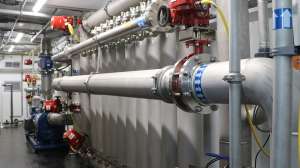
At the St. Peters extended aeration plant, 4.2 dry tons of solids per day are pumped from two clarifiers to two 450,000-gallon aerated holding tanks. After three to four days of aeration, the material, at 1.5 percent solids, is pumped from the holding tanks to the press building, which houses two Ashbrook belt filter presses. The material is pressed to 16 percent solids and discharged from an elevated chute, collecting on a concrete pad.
Biosolids from St. Louis are generated through anaerobic digestion and trucked 10 miles to St. Peters. At 26 percent solids, that material is stockpiled separately, also on a concrete pad.
For tracking and operational purposes, the two biosolids streams are kept separate through the entire composting process. If sampling and analysis of the compost reveals that a parameter is out of compliance, the separate process makes it easier to trace the source. St. Peters is contractually bound to take MSD’s biosolids, but there is flexibility built in.
“We still have an agreement with St. Louis to take 12,000 tons per year, usually one to two loads a day,” says Malach. “But now we’re running low on the carbon source, brush and trees, so we are temporarily diverting their biosolids.”
Even with the temporary diversion, it’s a relationship that works out well for both plants. “It’s a win-win,” says Malach. “They get to save tipping fees at the landfill because we charge less. They’re saving money, and we’re getting reuse material.”
All told, the city produces 1,361 dry tons of biosolids at its own plant and receives 3,120 dry tons of biosolids per year from MSD. The material is mixed with 50,000 cubic yards of yard waste to produce 30,000 cubic yards of compost.
Out with the old
The biosolids-handling system at St. Peters is relatively new. Construc-tion of the press building and the aeration tanks began in November 2007 and the equipment came on-line a year later. Also upgraded were the units used to mix the biosolids with yard waste.
The bucket mixers were replaced with a Roto-Mix feed stock mixer that uses a horizontal mixer with a staggered rotor design. Malach compares using the bucket mixers to stirring two large trash cans: The new equipment is much more effective.
Yard waste is delivered by residents and through city curbside collection. Private haulers and contractors also deliver yard waste, but pay a tipping fee. After the biosolids and yard waste are mixed, the compost is set up in windrows using a front-end loader. Each is labeled with its windrow and batch numbers.
“On average, we have 16 windrows on the ground, either in process or in a post-process stage,” Malach says. “It covers an area of approximately 2 1/2 acres. Each windrow is trapezoidal, 12 feet wide at the base, about 4 feet wide at the top, and 6 1/2 feet tall. The windrows average 250 feet long.”
By composting at the wastewater treatment plant, the city minimized material-handling and hauling costs and the number of permits. The treatment plant and organic recycling operate with one NPDES permit. Stormwater runoff from the composting operation can be easily directed to the treatment plant headworks.
In the windrows
The organic recycling program takes the production of Class A biosolids seriously. To maintain compliance, the staff follows approved Processes to Further Reduce Pathogens (PFRPs). “We use an open windrow process that maintains a minimum temperature of 131 degrees F for at least 15 days,” Malach says. “All temperatures are monitored daily using probes connected to a PDA.”
The staff uses windrow management software to determine when thecriteria have been met. While the compost must be stored a minimum of 15 days, it also must be turned five times. Odor can be an issue. “We’re located in the suburbs, just north of I-70,” says Malach. “North of us it’s all agricultural, but south of I-70 there’s a retail mall and a car dealership. So we have to watch the wind direction.”
The compost isn’t turned when the wind is blowing to the south. That means sometimes it is kept on-site longer than 15 days to complete all five turns. The piles are turned using a SCARAB windrow turner that travels up and down the lanes, mixing and aerating the piles.
Soon, outdoor windrows and odor won’t be issues: The city is bidding out construction of an aerated static pile system. Composting will take place in concrete bunkers equipped with ducts and fans to pull air through biofilters, eliminating odor. Construction is expected to start during the summer of 2009. Based on the preliminary design, there will be six to eight bunkers, each 30 feet wide, 60 feet long, and 9 feet high.
Meeting requirements
After the criteria are met for Class A material, the windrows are broken down to curing piles where the compost continues to dry and age. After curing for six to nine months, the compost is run through a Wildcat trommel designed with a 1/2-inch screen that separates the unders (less than 1/2 inch in diameter) and overs (greater than 1/2 inch).
The unders make up the compost, which is both given away and sold. City residents can receive 2 cubic yards of compost every year. Residents who want more, along with commercial landscapers or other contractors looking for soil amendments and fertilizer, can pay $10 per cubic yard. A discount of 20 percent is available for those who buy more than 500 cubic yards.
Leftovers are hauled to a farm owned by the city. The 200-acre farm is managed by a local farmer, who grows wheat and corn. Compost saves the farmer money on fertilizer.
Overs from the trommel screen go to one of two places. “They either go back to the compost pile as a carbon source, or they’re used for erosion control,” Malach says. Filtrexx socks are filled with larger pieces and can be used on construction sites instead of silt fences. “The benefits of using the compost for erosion control is that it actually filters the water and can reduce the retention area required for a project,” Malach says.
Getting buy-in
Even with the benefits of compost, the organics recycling program has not always been an easy sell. “The city has had to overcome many obstacles over the years, including regulatory staff, farmer, political and public acceptance,” Malach says. “We’ve overcome many concerns through education, pilot projects, and inviting participation in the process. The key to a successful program has been commitment to professional management and dedication to producing a high-quality product.”
St. Peters has published articles in the city newsletter to help educate residents. The city also offers tours for schools and other organizations. Eventually, the city hopes the organics recycling program will be self-sustaining, but current numbers show that only 23 percent of the compost is sold, and 7 percent is given away. The remaining 70 percent goes to city projects or to farmland. But the system is still relatively new.
Ultimately, composting diverts a substantial amount of organic waste from the landfill. Instead, the material improves soil quality, increases crop yield, and makes yards and gardens greener and healthier. Malach and his staff hope it’s just a matter of time before word spreads and compost becomes a popular amendment to more local landscapes.