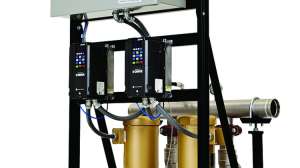
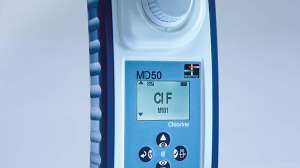
The Greenville (Ala.) Wastewater Treatment Plant has installed online instruments that provide real-time monitoring of its biological nutrient removal (BNR) process, enabling critical immediate adjustments that boost performance and efficiency.
Nutrient levels in effluent are a rising concern as regulatory agencies seek further improvements in effluent quality. As a result, plant managers and operators face more demanding nutrient-removal requirements, especially in areas threatened with eutrophication.
In addition, many managers, anticipating tightening regulations, operate to “goal” levels, removing even nutrients not currently regulated. For plants like Greenville, this means meeting even more stringent standards while maintaining plant efficiency. A critical element to that efficiency is the ability to use new online instrumentation.
Critical adjustments
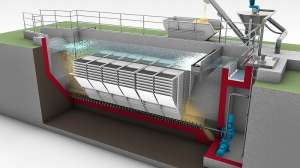
The Greenville plant is a mechanical aeration, activated sludge plant that treats an average of 1.2 mgd and serves 2,800 customers. After primary aeration, the flow is split between two continuously sequencing reactor (CSR) basins.
The plant’s Schreiber CSR system is designed to be a constant-flow, single-basin, complete-mix reactor. Activated sludge is added to basin influent, and a bridge that runs from the middle of the basin to the edge rotates, maintaining a constant mix of solids independent of aeration.
Meanwhile, oxygen levels are manipulated to create oxic, anoxic and anaerobic phases that generate specific bacterial biological reactions aimed at nutrient removal. Besides occupying a small footprint, the automated, energy-efficient CSR system operates by running blowers only intermittently. To optimize the CSR process, the plant has installed online instruments for continuous monitoring of DO, mixed liquor suspended solids (MLSS), and oxidation/reduction potential (ORP).
“Our aeration basins basically operate individually from the other,” says Bruce Branum, plant superintendent. “In each basin we primarily monitor DO. To aid process treatment and energy savings, we also use online ORP measurement. To help us keep a better eye on our bugs (bacteria), we use online sensors to monitor our suspended solids.”
Online MLSS measurement
The accurate measurement of MLSS is critical to the CSR system. “By knowing the mixed liquor concentrations, the volume of the tank and the BOD, we calculate an accurate food-to-mass ratio,” Branum says. “We want to know if there is adequate food coming in for the activated sludge microorganisms in the tank.”
The Greenville plant had long relied on laboratory analysis for MLSS readings. But recently installed online sensors now provide real-time MLSS measurements, significantly reducing reliance on intermittent and time-consuming laboratory analysis.
The plant’s new suspended-solids analyzers (Hach SOLITAX sc) use dual-beam infrared scattered-light photometers and receptors to monitor the mixed liquor. The analyzer provides accurate and continuous measurements completely independent of color. Real-time monitoring of MLSS concentrations in the aeration basins has allowed the Greenville plant to maintain target MLSS levels consistently.
“Before we installed the probes, we had to go out and take samples, measure the mixed liquor of each basin through lengthy laboratory tests, and then make our judgment of whether to waste sludge for further processing,” says Branum. “Now, it’s instantaneous. We can look at a screen and see how many solids we currently have in each basin, 24 hours a day.”
By knowing the MLSS concentration at all times, plant operators can optimize the biomass quantity and quality to meet variations in influent flow and load. The plant has installed a SOLITAX probe in each aeration basin and one at the plant headworks, along with a Hach UVAS sensor.
“The probe at the headworks monitors solids loading of the influent wastewater and lets us know when certain industries are discharging to the plant,” Branum says. “The UVAS probe measures the mixture for toxic shock and tells us if we are receiving an influx of high BOD.”
DO and ORP process monitoring
Two primary process control measurements in the CSR process are oxidation/reduction potential (ORP) and dissolved oxygen (DO). The Greenville plant has ORP and DO probes in each aeration basin and can use either type for blower control. DO control allows for a steady rate of air delivery, while ORP control allows air-delivery rates to be maximized for the BNR process.
“Think of it this way,” explains Branum. “DO tells us how well the bugs are breathing, ORP tells us when they should breathe to maximize nutrient removal.” To meet DO measurement requirements, the plant installed Hach Luminescent DO (LDO) probes in each aeration basin. When DO reaches a certain level, the bacteria have enough air and are satisfied. The blowers can then be cycled on and off to create anoxic and anaerobic environments.
“The great benefit of this process is that it’s power-efficient,” says Branum. “We save power by not having to aerate all day long.” He also finds the LDO probes easy to maintain: “About once a month we clean them off a little bit, and once a year we replace the tips.”
Optimizing CSR system
BNR processes typically require three tanks for nutrient removal. With the Schreiber CSR system at Greenville, one tank serves all three stages. As influent enters the basin, activated sludge provides the necessary bacteria or biomass for the biological reactions that result from manipulation of the oxic, anoxic and anaerobic phases. The changes between phases are automated based on real-time DO and ORP readings.
During the oxic stage, the blowers add sufficient oxygen to the mixture to obtain a DO value of 2.0 ppm. During this time when the DO is high, the ORP increases to a predetermined set point and turns the blowers off. During the oxic stage, nitrification occurs, converting ammonias to nitrates and water.
After the blowers shut off, the process enters the anoxic stage and DO drops to an undetectable amount. During this time, the nitrates reduce to nitrogen gas, producing oxygen, which is used in the respiration of the denitrifying organisms. When there is no more free oxygen, the basin enters the anaerobic stage, and bacteria become stressed and release orthophosphate.
At a low enough ORP level, the system triggers the blowers, and oxygen is reintroduced into the basin. Then the basin is back in the oxic phase, and the stressed bacteria reabsorb the phosphorous, but at two to three times the normal level. The phosphorous is removed when the sludge is wasted.
The Greenville plant discharges an effluent that is well under regulatory standards as established in its NPDES permit. The CSR system provides an efficient and productive BNR process.
About the author
Bob Dabkowski is a wastewater specialist for Hach Co. and a licensed wastewater operator in Colorado. He is the author of several papers, articles and application notes on wastewater treatment and has 10 years of experience at Hach advising on process control and automation solutions. He can be reached at 970/663-1377, ext. 2191, or BDabkows@hach.com.