The ultimate goal of the Saco (Maine) Wastewater Treatment Plant is to be an energy producer rather than an energy consumer. The plant is well on its way with a broad range of initiatives that include wind power, solar collectors, high-efficiency aeration, biosolids reduction, and even geothermal energy from wastewater.
At this 4.2-mgd secondary treatment plant, saving energy and protecting the environment are constants. “If you’re coasting, you’re going downhill,” says John Hart, chief operator at the treatment plant. “We always strive to do better and never sit back, no matter what. Energy efficiency and environmentalism are just excellent goals.”
The plant’s commitment to the environment is also gaining attention. In 2008, it received a certificate of achievement from the Maine Department of Environmental Protection. It also won an operations and excellence award in 2002 from the U.S. EPA.
Progressive approach
The Saco plant’s progressive attitude is part of a citywide effort to save money and help the environment. The treatment plant has taken the lead on a number of fronts. One pioneering effort is a 1.8-kW Skystream (Southwest Windpower) wind turbine that supplements electrical power for the plant’s administration building.
The plant taps about 400 kWh from the turbine, a fraction of the plant’s annual consumption of 600,000 kWh. However, the turbine also satisfies another need: public education. The city wanted to demonstrate the viability of wind technology and needed to find the right spot to capture wind energy. There was no better place than the treatment plant since the property boasts a popular river walk trail. There is no mistaking the 75-foot-tall tower from the trail.
“People started seeing the wind turbine and said, ‘That’s really cool,’” says Howard Carter, deputy director of public works, who serves on the city’s Energy Committee that he helped form. “At that point, we started rounding up public support for it.” The city subsequently installed a larger wind turbine at the city’s train station.
Solar power is also gaining favor among city officials. The treatment plant had Viessmann solar collectors installed on the roof of its grit-handling building in 2006. The system, which feeds two water storage tanks, provides radiant heat that keeps the temperature in the headworks building at 50 degrees F even during the coldest months.
Carter expects a 7- to 10-year payback on the system, which cost about $15,000. The system is virtually maintenance-free – the crew simply checks the glycol fluid every now and then. “We could have accomplished the same thing with electrical heaters, but the cost is minimal and we’re reducing our carbon footprint,” Carter says.
Efficiency in biosolids
Although wind and solar are attractive alternative energy sources, Carter and Hart have never lost sight of lower energy costs through old-fashioned plant efficiency. It’s a main reason the plant has invested more than $30 million in upgrades over 20 years.
One major success is an improved biosolids process. In 2003, the plant replaced a belt press with a Fournier rotary press. It later changed out a gravity belt thickener for an FKC rotary screen thickener. Both take the place of a high-maintenance and cumbersome wet process involving a water pump system. The new process saves $10,000 per year in energy and has cut biosolids tonnage in half, reducing disposal costs by $50,000 a year.
Compared to the old belt systems, Hart says maintenance is as different as night and day. “The new system takes some operator expertise, but for the most part, there’s no mess once it’s running,” Hart says. “We can just set it and forget it.”
Saco also targeted other obvious areas for energy savings including the aeration system and virtually all motors and pumps. In the past, the plant relied on mechanical aeration and ceramic diffusers for its aeration basins. The diffusers would clog with sludge, and the tanks then had to be emptied once per year for cleaning. Clogged diffusers also meant the aeration system was less than efficient.
To address the issue, Saco replaced the ceramic diffusers with Sanitaire fine-bubble diffusers and installed more efficient centrifugal Spencer blowers. The membrane diffusers eliminate clogging.
“We achieved energy savings right off the bat because we had a lot more efficient transfer of air,” Carter says. “When you’re running 75-hp blowers 24 hours a day, it all adds up.”
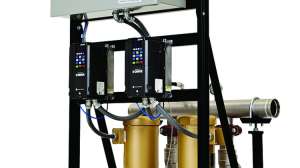
Toshiba variable-frequency drives (VFDs) are used on the aeration system and on most of the facility’s pumps and blowers. The plant began to transition to VFDs in the mid-1980s. It also committed to installing energy-efficient devices in all replacements. The result is a drop in electricity use of about 15 percent.
“Looking back, it’s a no-brainer to use VFDs and things like high-efficiency motors,” Hart says. “Yet we’ve also done things that are considered experimental, even today. When you take the lead, you may experience some failures here and there. Fortunately, we haven’t had any of that, but that’s always a risk you take.”
Exciting times
In the immediate and more distant future, the Saco plant will continue exploring innovative ways to save energy and reduce its carbon footprint. A prime example is a recent decision to use an effluent thermal heat pump to heat and cool a new $4.3 million process building and garage, scheduled for construction this summer. The engineering firm, Woodard & Curran Inc., is designing the effluent heat pump system.
The state-of-the-art system will use the plant’s treated effluent, typically in the range of 50 degrees F, as the heat sink/source. Although the effluent’s temperatures and flows vary slightly, it is useable for a heat pump system. A refrigeration cycle within the heat pump system transfers energy from the effluent to the building during the heating season, and conversely, from the building to the effluent during the cooling season.
Depending on the season, hot or cold water is circulated from the heat pump to terminals that contain heating and/or cooling coils. A fan in each terminal unit draws air across the coils and distributes the conditioned air throughout a given space to satisfy the space setpoint as defined by the automated temperature control system. The heat pump will be located in the process building and will route hot/cold water to the garage via insulated piping.
The new building will also optimize energy wherever possible. A backup generator will be its only fossil-fuel-driven equipment. “Our goal is to be energy producers rather than energy consumers within 20 years,” Hart says. “We’re going to see a lot of technologies involved in that here at the plant and throughout the city. It’s an exciting time to be in the field.”